Pafos Live 25 July

The presence and action of the Police last night was intense, throughout Cyprus, with organized patrols in key points of urban areas, with the aim of preventing serious criminal acts, ensuring public order and increasing the sense of security of the public.
As a result of the preventive police operations, thirteen persons were arrested for various offenses, such as illegal possession of drugs, illegal employment, driving under the influence of alcohol, etc.
As part of these operations, during the night, 600 vehicles were stopped for inspection and 973 persons on board were checked. At the same time, 59 inspections were carried out in premises with the aim of dealing with phenomena of delinquency, during which 15 complaints emerged.
During traffic checks carried out, 317 complaints were made, concerning various traffic violations, while 11 investigated cases of traffic violations also emerged.
Of the complaints made, 103 concerned exceeding the speed limit, while as part of the police examinations, 10 vehicles were detained. 304 alcohol tests were carried out, from which 21 complaints emerged, as well as 2 preliminary drug tests with 2 positive results.
Policing operations, for the prevention and suppression of crime, continue daily, with an increased/enhanced police presence, targeted controls and immediate operational action, with the aim of increasing the sense of security of citizens/protecting citizens and ensuring public order.
* * * * * * *
PAPHOS: Court of Appeal annuls first-instance conviction in theft case
The Cyprus Court of Appeal recently annulled a conviction in a theft case in the case of M.A. (appellant) against the Police (respondent).
As stated in the decision dated 16 July, the appellant is challenging his conviction, following a hearing, by the Paphos District Court for the offence of theft following a previous conviction in breach of Articles 255 and 272 (1) of the Criminal Code, Cap. 154, as amended (1st charge) as well as the charge of entering another person’s property with the intention of committing a criminal offence in breach of Article 280 of the Criminal Code, Cap. 154, as amended (2nd charge).
It notes that according to the details of the 2nd category offence, the appellant was accused of having illegally entered a fenced plot of land with the intention of committing theft and having stolen from it, 800 iron rails 160 cm long and 60 boards, all with a total value of €5,200, property of the complainant. Before committing the above theft, he had been convicted of theft by the Paphos District Court in two cases.
The sole witness of the Prosecution was a police officer from the Paphos Police Station, who was the investigator of the case.
The decision states that “the presence of the appellant in the place where the theft took place, which was recorded on camera footage, with a total duration of no more than two minutes, cannot have as a natural consequence that he himself committed the crime of theft, thus concluding that both the actus reus and the mens rea of the crime were proven. This is because the proof of the actus reus of the theft of the specific disputed objects has a certain peculiarity, which was highlighted by the Defense”.
It adds that this results in “an incorrect application of legal principles in relation to the positions of the Defense on the part of the Court of First Instance, which, consequently, led it to an incorrect view of the circumstantial evidence before him”.
In other words, it states, “the Court must conclude that the testimony of the Prosecution has withstood the test of logic, and of course, if this is the case, then in the absence of documentation of hypothetical positions of the Defense, it may convict.”
In the present case, it is noted, the Court of First Instance on the one hand did not decide whether it was possible during the period for which the appellant was recorded in the premises to steal the disputed objects and wrongly considered that there was testimony that no one else went to the premises.
“We consider that even if the conclusion of the Court of First Instance is correct that according to the above circumstantial evidence, since the vehicle in the possession of the appellant (in the absence of any other explanation) was found in the disputed area, the only conclusion was that he himself was found there, it does not mean that its conclusion regarding his guilt is equally correct. As we explained above, the circumstantial evidence that existed did not lead to the sole conclusion that the appellant committed the offenses”.
With regard to the second and third grounds of appeal that the Court of First Instance incorrectly evaluated the circumstantial evidence in order to conclude that he was guilty, it states that “in view of our above analysis, these two grounds of appeal succeed and the first-instance decision is annulled without the need to refer to other grounds of appeal”.
"In view of all the above, the appeal succeeds and the conviction is annulled. The appellant is acquitted and discharged," the Court of Appeal concludes.
* * * * * *
Filenews
The Police arrested two persons, aged 30 and 37, last night.
The two arrested allegedly stole an EAC transformer from the area of the Moni and caused damage of about €9,000
Examinations revealed testimony against the two persons, who were arrested on court warrants and taken into custody.
* * * * * *
A quantity of cocaine, with a total gross weight of two kilograms and 80 grams, was seized last night by the Police, in two different cases in Larnaca and Limassol.
Regarding the first case, around 11 last night, while a female police officer was on patrol in the area of Larnaca, she spotted a vehicle that was moving suspiciously. She signalled the driver to stop for a check, but he failed to do so by speeding. The police officer followed him, while calling for reinforcements.
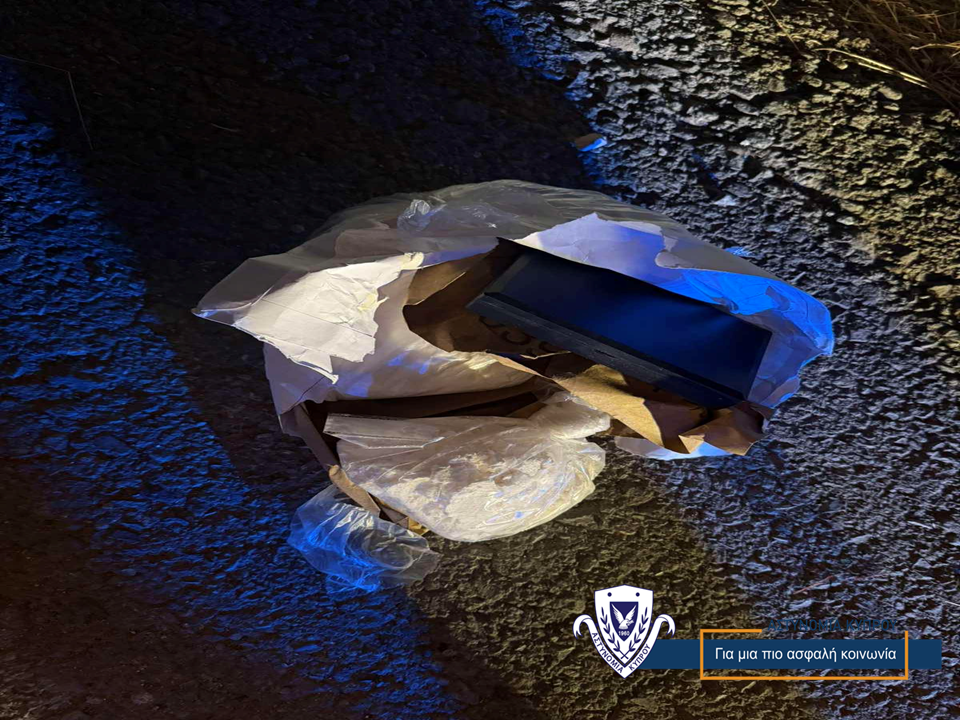
Members of the MMAD immediately arrived at the scene, while the driver, who continued to drive carelessly and dangerously, at some point lost control of his vehicle, as a result of which it went off the road and stopped in a ditch.
As it was established by the examinations that followed, two 34-year-old men were in the vehicle, while a subsequent search of the vehicle found a nylon package with white solid powder, which was found to be cocaine, with a gross weight of approximately 1570 grams.
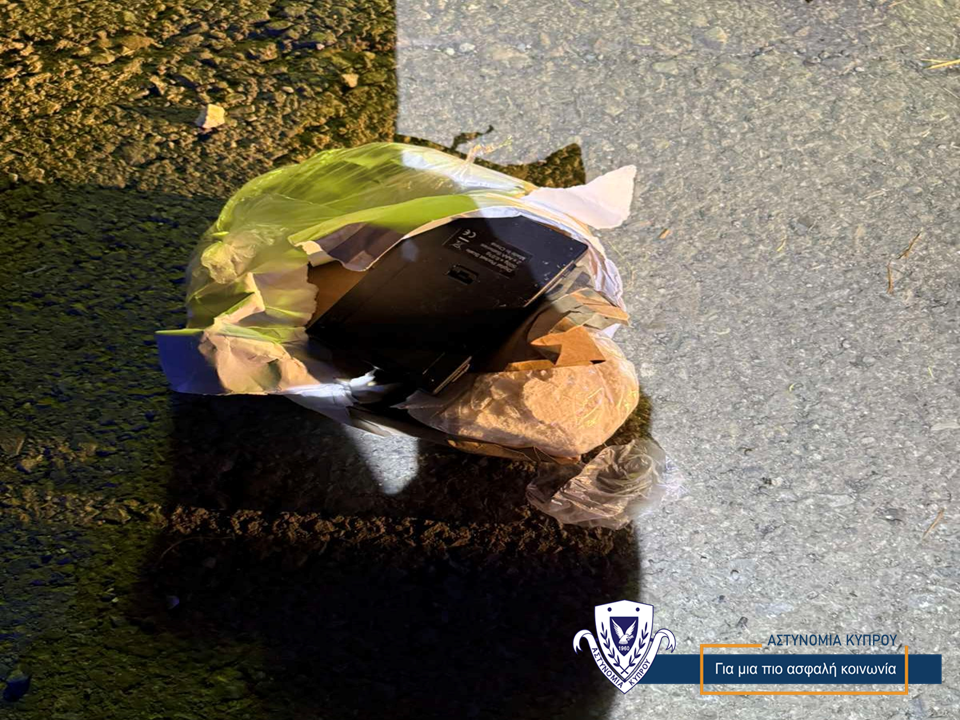
The two 34-year-olds were arrested and brought before the Larnaca District Court today, which issued a detention order for them for eight days.
Regarding the second case in the context of investigating information about drug trafficking and trafficking, around 10 last night, members of YKAN Limassol stopped a vehicle in which two 30-year-olds were riding. From a subsequent check, a nylon package containing cocaine with a gross weight of approximately 510 grams was found in the vehicle.
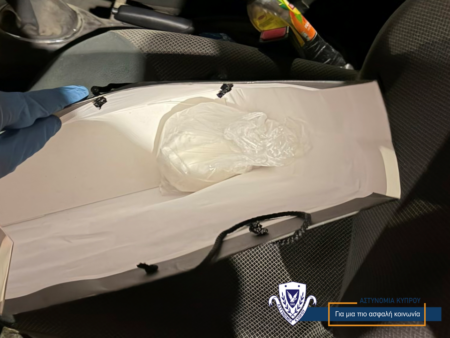
The two 30-year-olds were arrested and this morning they appeared before the Limassol District Court, which issued a detention order for them for six days.
The District Units of YKAN in Limassol and Larnaca continue the examinations.
* * * * * *
A 24-year-old young man from Israel appeared before the Larnaca District Court yesterday in connection with the minor incidents that took place yesterday at the AEK ARENA stadium in Larnaca between fans before the start of the match AEK Larnaca - Beitar Jerusalem for the second qualifying round of the UEFA Conference League.
The Court imposed a fine of €1,200, which he paid.
It is recalled that according to the Police, two groups of fans were involved in clashes before the kick-off, with the security forces intervening immediately to prevent further incidents. To restore order, the special water launch vehicle "Ajax" was also mobilized, while security measures were strengthened along the entire perimeter of the stadium.
It is reported that the tension seems to have been caused when there was a problem at the entrance gates of AEK Arena. Beitar Jerusalem fans moved towards the parking lot in search of shade, which caused a disturbance and led to the clashes. The situation was quickly brought under control, with no serious injuries reported, allowing the match to run smoothly.
At the same time, investigators continue their investigations, using closed surveillance circuits and testimonies, in order to identify and locate all those who participated in the incidents.
It is recalled that Israeli media reported that there were incidents outside the stadium before the start of the match in the Arena, hosting testimonies from Beitar fans about what preceded it. According to them, a group of fans allegedly attacked Israeli fans, using stones, resulting – as they claim – injuring two people.
It is recalled that tension was also noted on Wednesday night at the roundabout of the port of Larnaca, where Beitar Jerusalem fans had gathered. And then the Police had intervened, making limited use of chemicals to restore order.
* * * * * *
The Police arrested three persons, aged 50, 42 and 29, after an operation carried out by members of the Anti-Drug Service, in the provinces of Larnaca, Limassol and Paphos, during which a quantity of methamphetamine, with a gross weight of 150 grams, was located and confiscated, along with other evidence.
Specifically, in the context of investigating information about methamphetamine trafficking and trafficking, members of YKAN on 21/07/2026 located a 50-year-old and a 42-year-old woman trafficking by car on the highway to Paphos and parked in an area of a village in Paphos, where a 29-year-old man then arrived in another car. The 50-year-old approached the 29-year-old driver and handed him an object, which he took out of his pocket where he was earlier seen by the Police placing money, while subsequently, the 50-year-old received another object from the 29-year-old's vehicle.
After the three suspects left the scene in their vehicles, the members of YKAN stopped the 50-year-old and a 42-year-old woman in an area in the province of Limassol, where they subjected them to a check, during which they found in the vehicle, four nylon bags containing quantities of crystal methamphetamine - crystalmeth, with a gross weight of 145 grams in total, as well as a smoking pipe, with traces of burnt crystalmeth.
The 50-year-old and the 42-year-old were arrested for the self-inflicted offenses and then court arrest warrants were issued for the two suspects, under which they were re-arrested. The 29-year-old was wanted by the Police, however, he was not located and a court warrant was issued against him. On 22/07/2026, the 50-year-old and the 42-year-old were brought before the Limassol District Court, which issued a seven-day detention order.
Yesterday, members of YKAN, YDAP and OPE Paphos, after information, stopped a car driven by the 29-year-old wanted man on a road in the Paphos district, whom they arrested on the basis of a court warrant. In a check carried out by the members of the Police, a quantity of crystal meth was found with a total gross weight of approximately 5 grams. The 29-year-old appeared today before the Limassol District Court, which issued a five-day detention order.
The Police are investigating a case of conspiracy to commit a felony, illegal possession of drugs, possession of drugs for the purpose of supplying another person, supply of drugs, illegal use of drugs, and money laundering.
YKAN Limassol and Paphos continue the examinations.
* * * * * *
The conviction of a man, who was found guilty of breaking into a property owned by him and stealing equipment belonging to his tenant, was upheld by the Court of Appeal, rejecting his claim that he was acting in the context of a "sincere claim of rights", due to a financial dispute he had with the tenant.
By decision dated July 16, 2026, the Court of Appeal rejected all the grounds of appeal raised by the appellant and upheld his first-instance conviction for burglary and theft of property, the value of which was limited by the Larnaca District Court to €2,850, an amount for which he was ultimately found guilty, instead of the amount of €132,700 originally mentioned in the indictment.
The case concerned the owner of a property, which had been rented to another person and allegedly operated as a nightclub. The man was accused of entering the premises without the tenant's consent, removing equipment that was in it and then selling it.
The appellant also faced charges of extorting money from two persons, to whom he sold items that he knew were stolen, posing as his own. For the specific charges, however, the Court of First Instance acquitted him and acquitted him.
According to the facts recorded in the decision, the appellant admitted that he changed the locks of the premises he owned and that he sold items that were not his property. He claimed that the tenant owed him rent, that he had informed that the relationship between them would end and that he would proceed with the sale of objects as a way to deal with the debt.
He claimed that he was acting because he believed that he was exercising a legal right to the property located in his premises and that he had no intention of defrauding the tenant. He also claimed that he was in a "state of emergency".
The Court of Appeal rejected these claims, holding that it could not be accepted that the appellant sincerely believed that he had a right to remove and sell items belonging to another person.
Adopting the judgment of the Court of First Instance, the Court of Appeal pointed out that "it is inconceivable that it considered that the theft and sale of objects without the consent of the owner could secure him any legal right".
The Court of Appeal also noted that the appellant was aware that there were legal procedures to recover possession of the premises and claim the rents due. "It is obvious that the appellant, while he was aware of procedures that he could have taken to restore his rights, chose to act in the way he acted," the decision states.
* * * * * *
The Supreme Court granted permission to a driver to proceed with an application for the issuance of a privileged Certiorari warrant, with the aim of cancelling an arrest warrant issued against him by the Larnaca District Court, in the context of an investigation into a fatal road collision that occurred on May 22, 2026 on the Meneou - Pervolia road.
The arrest warrant was issued on May 23, 2026, at the request of the Police, on the basis of a reasonable suspicion that the driver is connected to the offenses of causing death by negligence and driving without due care and care.
According to the information included in the affidavit of the Police, the driver allegedly tried to overtake other vehicles, entered the opposite direction of traffic and collided head-on with a vehicle moving from Pervolia to Meneou. The driver of the second vehicle was seriously injured in the collision, who succumbed to her injuries a few hours later, while the passenger was also injured. The suspect had been tested for alcohol and drugs, with negative results.
The applicant argued before the Supreme Court that the warrant was illegal, citing on the one hand the concealment of essential information from the Police and on the other hand the lack of documentation of the necessity of issuing it. In particular, he claimed that he had notified the authorities himself through the emergency number 112, remained at the scene until the completion of the examinations and left only after being informed by the Police that his presence was no longer necessary and that he would later be called to testify.
Judge L. Dimitriadou-Andreou rejected, at this stage, the allegation of concealment of essential information, considering that what the applicant put forward was his own version of the facts and it did not appear that it was proven evidence that the Police should have disclosed during its application for the issuance of the warrant.
However, the Supreme Court considered that a prima facie debatable issue emerged as to the second condition required for the issuance of an arrest warrant, namely its necessity. The decision points out that, in addition to the existence of a reasonable suspicion of committing an offence, the court examining a request for a warrant must be convinced, on the basis of specific primary facts, that the arrest is reasonably necessary, such as to prevent influencing witnesses or destroying evidence.
The Supreme Court noted that general references in the affidavit to the possible influence of witnesses or testimony are not sufficient on their own, without specifying the facts to allow the court to form an independent judgment on the necessity of the arrest.
Considering that the material placed before the District Court may not sufficiently substantiate the necessity of issuing the warrant, the Supreme Court decided that the applicant had prima facie demonstrated a debatable case and granted him permission to register an application for the issuance of a privileged Certiorari warrant for the purpose of canceling the arrest warrant.
The Court stipulated that the application should be registered within four days, and instructed to set the case on 27 July 2026 and serve it on the Attorney General. The costs of this procedure will follow the outcome of the main application.
* * * * * *
A lack of DNA evidence or visible injuries does not automatically mean that a rape did not happen, Cyprus’ Court of Appeal has ruled.
In a decision that highlights how sexual assault cases are assessed in Cyprus courts, the Court of Appeal rejected a man’s attempt to overturn his conviction, saying that the absence of genetic material or physical injuries alone cannot disprove an allegation of rape.
The decision reinforces a point often raised in sexual assault cases: not every incident leaves behind obvious physical evidence.
The court upheld his conviction for rape, deprivation of liberty with the intention of sexual abuse, common assault, and threats of violence.
The case involved incidents that took place in April 2020, with the Criminal Court previously finding that the charges had been proven beyond reasonable doubt.
The man had been sentenced to:10 years in prison for rape
3 years for deprivation of liberty with the purpose of sexual abuse
4 months for common assault
One year for each charge of threatening violence
The sentences were to run concurrently.
The appeal argument
During his appeal, the convicted man argued that the original decision should be overturned because forensic examinations did not find genetic material and the victim did not have physical injuries.
The Court of Appeal rejected that argument.
The judges explained that DNA findings are only one part of the evidence and that the absence of genetic material does not prove that sexual contact did not occur.
They noted that physical contact does not always leave behind detectable genetic traces, meaning that a lack of DNA cannot by itself rule out an offense.
The court also addressed the issue of injuries, saying that the absence of bruises or other physical signs does not automatically mean that rape or abuse did not take place.
Witness evidence remains important
The Court of Appeal also stressed that trial courts play a key role in assessing the credibility of witnesses because judges who hear a case firsthand are able to observe the behaviour and reactions of those giving evidence.
It said appeal courts only intervene when a lower court’s findings are clearly unsupported by evidence or go against common sense.
In this case, the judges found no reason to overturn the original ruling and dismissed the appeal.
Why the ruling matters
The decision reinforces a point often raised in sexual assault cases: not every incident leaves behind obvious physical evidence.
The court’s ruling makes clear that Cyprus courts must consider the full picture, including witness testimony and all available evidence, rather than relying only on DNA results or visible injuries.
The original conviction and prison sentence therefore remain in place.
