Filenews 5 December 2025

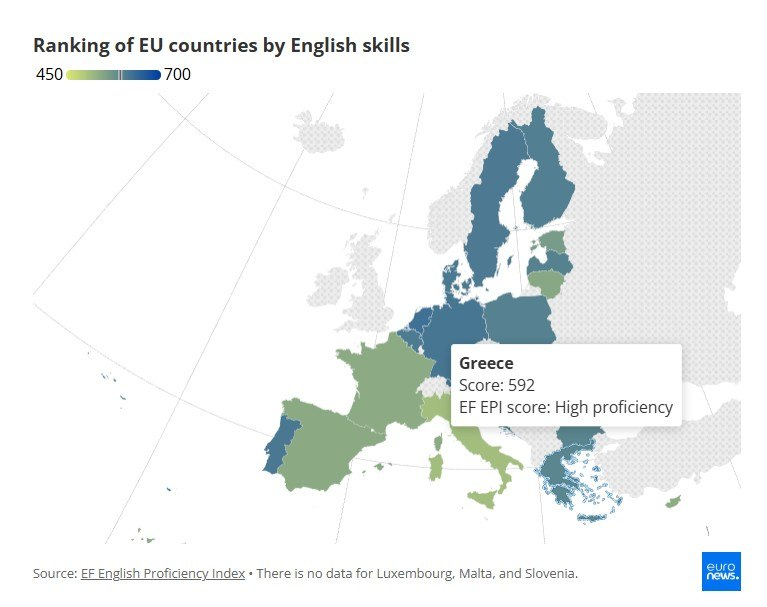
A new survey conducted in the European Union has highlighted the countries where its citizens speak English better or worse. Cyprus, along with Italy and France, rank in the last places, falling into the category of moderate adequacy. The title of the world's best in English as a foreign language has been won by the Dutch for the seventh year in a row, although their skills have generally deteriorated since 2024.
As can be seen from the EF English Proficiency Index report, the Netherlands' overall score has decreased by 12 points compared to last year, but remains in first place.
EF English Proficiency Index - https://en.wikipedia.org/wiki/EF_English_Proficiency_Index#Report
Croatia and Austria round out the top three, with their scores increasing by 10 and 16 points respectively from 2024.
There are 12 EU countries in the very high proficiency category, including Greece (592 EF EPI Score: High Proficiency), which includes the use of subtle and appropriate expressions in social situations, easy reading of advanced texts and negotiating contracts with native English speakers.
In contrast, Italy, Cyprus and France rank last among EU countries, falling into the category of moderate adequacy.
There are five EU countries in this category (Lithuania, Spain, France, Cyprus and Italy), which describes speakers as being able to participate in meetings in their field of expertise, understand song lyrics and write professional emails on topics they are familiar with.
The EF 2025 English Language Proficiency Index is based on the test results of 2.2 million adults in 123 countries and regions.
English was the most studied foreign language in general and vocational education at upper secondary level in the EU in 2023, with 96.0% and 80.1% of pupils at the respective levels attending classes in it, according to the latest Eurostat data.
Despite their prevalence in classrooms across the continent, there are still gaps in skills and even demographics.
Reading and listening are the strongest language skills in all EU countries, compared to speaking and writing.
EF also recorded a gender gap: between 2014 and 2025, English language proficiency in Europe increased by 40 points for men and by 20 points for women.
Younger adult proficiency remains lower than before the COVID-19 pandemic. However, in 2025, more countries saw a further decrease in this group than those that did improve.
In the last decade, only Europeans aged 18 to 20 have recorded a decline in the level of English language proficiency.
How does AI affect English language learning?
There are about 2 billion people who speak English and have studied it at different times of their lives and with different learning techniques, from traditional teachers in schools to video calls with teachers and vocabulary apps with game elements.
In addition to the rise of machine translation, studies show that the use of AI in education is steadily increasing and will continue to expand.
"The consumer English learning market is experiencing an unprecedented transformation as AI powers increasingly sophisticated mobile applications and online platforms," Christopher McCormick, head of evaluation at EF, told Euronews.
According to EF, AI can change English exams by automatically and accurately grading written and spoken assignments, as well as helping to gather ideas, plan lessons, and update materials.
However, experts warn that responsible use, clear instructions, and awareness of potential drawbacks must be part of this progress.
