
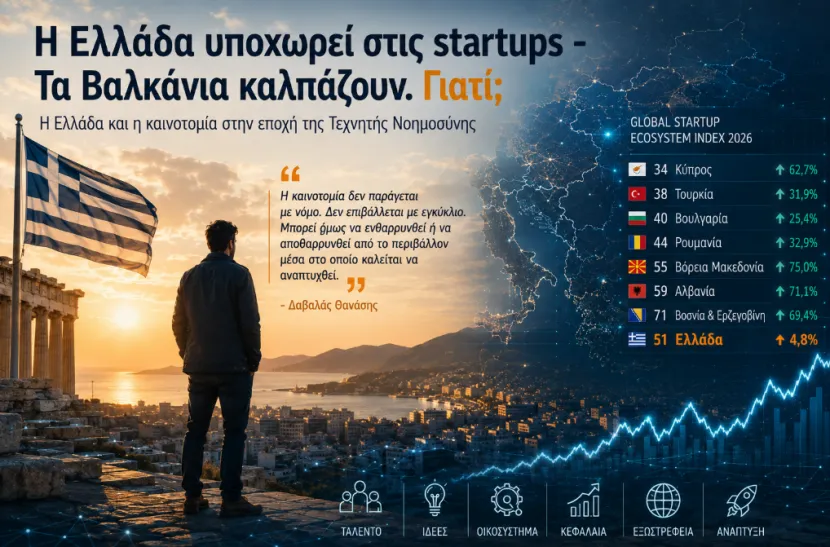
The Global Startup Ecosystem Index 2026 reflects a broader shift in the balances in Southeastern Europe, with Cyprus and other regional ecosystems strengthening their position, while Greece is retreating.
Cyprus records a growth of 62.7% and rises to 34th place in the world ranking. In contrast, Greece falls to 51st place, losing four places in a year, as its annual growth rate is limited to 4.8%.
Turkey is also moving upwards, occupying 38th place, while Istanbul returns to the top 50 startup cities worldwide. Romania, Bulgaria and several ecosystems of the Western Balkans are also on the rise, in some cases at particularly high rates.
In the world of startups, a country's position is not only determined by whether it grows. After all, an already developed ecosystem is logical, to a certain extent, to develop at a slower pace than a system that emerges in a certain period of time. But it is definitely determined by how fast it grows relative to others. When neighbouring economies accelerate, limited progress ceases to be neutral. It turns into a retreat.
The costs are becoming even greater now that Artificial Intelligence reduces the cost of developing new products, allows small teams to move faster and gives smaller states the opportunity to claim a role that until recently seemed disproportionate to their size.
This feature, however, is not automatically enabled.
An ecosystem is needed. It takes speed. Above all, however, we need the ability to turn knowledge into application, application into business and business into an international presence.
What the ranking really tells us
The Global Startup Ecosystem Index doesn't just measure how many startups there are in a country; It examines whether the ecosystem can create them, finance them, and ultimately lead them to real growth.
New businesses do not operate in a vacuum like anything else. They need human resources, capital, their first real customers and access to international markets.
No international ranking can capture the whole reality. It does, however, offer a useful point of comparison. It shows which ecosystems are gaining momentum and which are struggling to follow.
The numbers, of course, do not decide on their own what needs to be done. They need interpretation.
The ancient Athenians were not saved simply because they heard the oracle about the "wooden walls". They were saved because Themistocles saw behind the words a strategic choice and insisted on strengthening the fleet. The information gained value when it was transformed into a political decision and a specific action plan.
This is how Greece's 51st place should be read. Not as a verdict but as a warning.
Greece out of the top 50
The country still has remarkable startups, experienced engineers, research teams and an investment environment that is clearly more mature than that of the previous decade.
The problem lies elsewhere.
Greece is growing, but not fast enough. At a time when Cyprus is moving with 62.7%, Turkey with 31.9%, Romania with 32.9% and Bulgaria with 25.4%, the Greek 4.8% looks more like an inability to monitor developments than substantial progress.
Greece has been for many years the natural reference point of Southeastern Europe in innovation. This year's picture shows that this can no longer be taken for granted.
You see, the avant-garde is not inherited. But it is constantly confirmed.
This is where the real concern lies. Not in the position itself, but in the speed. The country produces talent and ideas. However, it has not yet managed to consistently turn them into companies that grow internationally, remain in Greece and strengthen the very ecosystem that created them.
Cyprus is not just following; accelerates
Cyprus is perhaps the most impressive example of this year's ranking. It climbs six places to 34th in the world, with an annual growth of 62.7%. For the third year in a row, it records the highest growth rate among the European Union's startup ecosystems.
This dynamic is not limited to one city. Limassol enters the top 200 startup cities in the world for the first time, Nicosia climbs 71 places and Paphos also strengthens its position. Four Cypriot cities are now in the top 1,000.
But the numbers tell us more than just a good year.
Cyprus seems to be utilizing and turning its small size into an advantage. It's moving faster, projecting itself more clearly to the outside world, and seems to offer a more predictable and secure environment for companies, investors, and professionals considering where to settle and where to grow.
It does not have a larger market than Greece. It does not have more human resources. But it has something that in startup ecosystems often counts more than size: a shorter distance between the decision and its implementation.
In innovation, you see, small size is not always a disadvantage. It can become a force when accompanied by flexibility, consistency and clear direction.
Istanbul is back in the spotlight
Turkey rises to 38th place in the world, with a growth of 31.9%. Istanbul gains five places, returns to the global Top 50 and records an annual increase of 28.2%. Even more impressive is the case of Ankara, which shows growth of 69.8%.
Turkey is not moving in an ideal environment. It faces severe economic pressures, monetary instability, and a complex political context. Nevertheless, its startup ecosystem maintains momentum.
Part of the explanation lies in some clear advantages. It has a large internal market, a strong pool of technical human resources and enterprises that have learned to think internationally from an early age. Istanbul adds another advantage: its geographical location between Europe, Asia and the Middle East.
The city has steadily strengthened its presence in software, fintech, digital games, and Artificial Intelligence applications. It shows that a startup ecosystem can accelerate even when the broader environment remains challenging.
This is perhaps the most uncomfortable lesson for Greece. The difficulties explain a lot. They don't explain everything.
The Balkans are changing gears
The rise is not limited to Cyprus and Turkey. Bulgaria is in 40th place with a growth of 25.4%, while Romania climbs four places, to 44th, with 32.9%. These are ecosystems that have already gained greater depth and are now moving clearly faster than the Greek one.
In the Western Balkans, the changes are even more pronounced. North Macedonia gains eight places and records a growth of 75%. Albania also climbs eight places, with 71.1%, while Bosnia and Herzegovina grows by 69.4%.
Caution is needed when reading these percentages. Smaller countries start from a lower base. A strong year can dramatically change their position, but this does not mean that they already have mature ecosystems similar to those of Northern or Western Europe.
The direction, however, is clear.
These countries are gradually ceasing to function only as pools of technical personnel for foreign companies. They are setting up their own hubs, local support networks and new businesses with greater international ambition.
The Balkans are no longer just the periphery of European innovation. They are starting to claim a role and some countries are already claiming it.
Artificial Intelligence as a Lever
Archimedes is credited with the famous idea that, if he is given a fixed point and a large enough lever, he can even move the Earth.
For today's startups, Artificial Intelligence acts just as such a lever.
A small team can now develop prototypes faster, automate much of the programming, organize market research, and target international customers at significantly lower upfront costs. Capabilities that once required large teams and significant funds are now accessible to many more.
The lever, however, is not enough. It also needs a stable support point.
In the world of startups, that point is the ecosystem.
It is not enough to have access to the same tools. This is now becoming wider and gradually ceases to be a competitive advantage in itself. The real difference lies in the speed at which an ecosystem allows ideas to be tried, failed, fixed, and reach the market.
They need data, computing power, technical talent, and funding. Institutional flexibility is also needed.
AI does not eliminate the weaknesses of an ecosystem. It often makes them more prominent. It speeds up those who are organized and increases the distance from those who are still debating what needs to be done.
Greece is not devoid of ideas. It lacks exploitation routes
Greek tradition remembers Daedalus as a symbol of intelligence and invention. The interest, however, does not lie only in the conception of the concept of flight. It is found in the construction of the wings. The ability to transform knowledge into something that works.
In the innovation economy, this is precisely the crucial transition. From concept to application.
Greece produces innovation. This is not a wish or a slogan. It is an indisputable reality.
In universities, research laboratories and small groups, applications with real technological value are developed. Some concern health, others education, others public administration or entrepreneurship. The problem begins when these ideas are called upon to pass from the laboratory to the real economy.
There the route often becomes unclear.
This is exactly the need that we at the University of the Aegean tried to approach, developing the Evaluator.Gr. It is a research platform that leverages Artificial Intelligence to evaluate and substantially assist startups.
Not just another chatbot. Not a mechanism that produces a grade and leaves the founder alone to interpret the result.
Its philosophy is based on predefined criteria, multiple evaluation procedures, a confidence index and documented suggestions for improvement. The goal was to function as a tool for thinking and making decisions, not as an opaque "black box".
Behind the technology was a broader goal: to make access to expert guidance and, through it, business opportunities more democratic.
For a new team, even without a dating network, significant funds or access to expensive consultants, to be able to receive a first, structured and documented guidance. To see its gaps more clearly. To improve its proposal. To claim the next opportunity on better terms.
The Evaluator.Gr was developed without government funding, through academic work, personal time and the belief that a useful idea should not wait for the ideal conditions to be tested.
This application is not mentioned because it is the only Greek innovation. On the contrary. It is mentioned because it expresses a much broader phenomenon.
Valuable solutions are being developed in the country that could be evaluated in real terms, used as a pilot, improved and, if proven effective, gain a commercial or international perspective.
But how many really go that far?
How many are tested on real problems?
How many are converted from a research result into an export-oriented product?
The value of an innovation is not demonstrated when it is presented at a conference or when a research project is completed. It is proven when it is given the opportunity to be tested in practice.
Greece continues to draw wings as it did back then with Daedalus. The problem is that more and more often he sees others taking off first.
What do those who go up do differently?
There is an easy way to read the ranking: focus solely on the positions. But there is also a more useful one. To look for what countries that are steadily improving their presence have in common.
Despite their differences, Cyprus, Turkey, Romania and several other economies in the region seem to follow common sense. They seek greater international extroversion, invest in the creation of recognisable innovation hubs and try to attract people, businesses and capital, rather than being limited to their internal market.
None of these countries started with ideal conditions. Others have a small population. Others face economic or geopolitical difficulties. Nevertheless, they are more consistent in the direction in which they want to move.
Greece does not seem to be lagging behind in people or ideas. It loses ground in the ability to connect all available forces into a cohesive ecosystem. Universities, research centres, businesses, investors and public bodies often operate efficiently, but not always in a coordinated manner.
Perhaps this is the defining difference.
Countries that are rising are not just showing more innovation. They show that they have decided in which direction they want to move. Then they move consistently towards it.
The real bet
The Greek ecosystem does not seem to need just another program with a start and end date.
It needs stable structures, continuity and evaluation based on the companies that survived, acquired customers and grew internationally.
The State can act as the first user and introducer of Greek technologies, through controlled pilot applications. Universities need substantial technology transfer mechanisms that link research to funding, businesses and real users.
We rigorously evaluate founders. Why not the mechanisms designed to support them?
Incubators, accelerators and public innovation actions should not be judged solely on the basis of how many applications they received or how many events they held. They must be judged based on what happened to the businesses they supported.
Innovation is not produced by law. It is not imposed by circular. But it can be encouraged or discouraged by the environment in which it is called to develop.
So perhaps the biggest challenge is not to produce more ideas. It is to stop letting the best of them run out on the way to implementation.
Because startup ecosystems are not judged by their promises. They are judged by the opportunities that open up.
alfavita.gr
