
HUMAN TRAFFICKING RINGS IN THE HOSPITALITY SECTOR - REVELATIONS ABOUT SEXUAL EXPLOITATION OF WORKERS - TERRIFYING EVIDENCE - Filenews 16/8 by Marios Demetriou
References to the miserable living conditions and labour exploitation of foreign workers in the hospitality sector in Cyprus, as well as specific suggestions for finding solutions to the chronic problems, were made at the multi-thematic conference organized by the non-governmental organization Step Up Stop Slavery in Nicosia (Journalists' Center) with the support of the Ministry of Justice as the National Coordinator for the Fight against Trafficking in Human Beings. The representative of SEK characteristically said that "the hospitality sector worldwide, but also in Cyprus, is often a 'showcase' or field of action for human trafficking rings, both for labour and sexual exploitation".
As the founder and CEO of Step Up Stop Slavery Katerina Stefanou pointed out at the conference entitled "Promoting fair employment for the migrant workforce in Cyprus", "it is essential to recognize that safe migration policies, ethical and responsible practices of hiring and employing workers, are among the most effective tools for the prevention of labour exploitation and trafficking in human beings". The conference took place on 30 July 2026 on the day of the International Day Against Trafficking in Human Beings, in the framework of the European project HOST ('Tackling Human Trafficking in the Hospitality Sector') involving organisations, public authorities, NGOs and experts from Greece, Cyprus, Spain, the Netherlands and Italy, with the aim of strengthening prevention efforts in the tourism and hospitality industry. The conference in Nicosia brought together representatives of the Ministries of Labour and Justice, the Deputy Ministry of Immigration, the trade unions SEK and PEO, the Anti-Trafficking Office of the Police (GEP), non-governmental and migrant organizations. The head of the office of the International Organization for Migration in Cyprus, Natasa Xenophontos Koudouna, also spoke at the conference, while the keynote speech was made online by Susan Kerr, head of the Human Rights Department of the Organization for Security and Co-operation in Europe (OSCE).
The representatives of PEO and SEK spoke, among other things, about the "hiring of workers" (labour subletting) in the tourism and construction sector, an illegal practice of some employers, which is prohibited under the relevant law. Panagiotis Ioannidis of SEK complained that "the 'rented' asylum seekers do the heaviest work under miserable working conditions" and added that "the deregulation of work, the non-implementation of collective agreements, unpaid overtime and the targeted exploitation of community, students and workers from third countries, is a daily occurrence".
References to the miserable living conditions and labour exploitation of foreign workers in the hospitality sector in Cyprus, as well as specific suggestions for finding solutions to the chronic problems, were made at the multi-thematic conference organized by the non-governmental organization Step Up Stop Slavery in Nicosia (Journalists' Center) with the support of the Ministry of Justice as the National Coordinator for the Fight against Trafficking in Human Beings. The representative of SEK characteristically said that "the hospitality sector worldwide, but also in Cyprus, is often a 'showcase' or field of action for human trafficking rings, both for labour and sexual exploitation".
As the founder and CEO of Step Up Stop Slavery Katerina Stefanou pointed out at the conference entitled "Promoting fair employment for the migrant workforce in Cyprus", "it is essential to recognize that safe migration policies, ethical and responsible practices of hiring and employing workers, are among the most effective tools for the prevention of labour exploitation and trafficking in human beings". The conference took place on 30 July 2026 on the day of the International Day Against Trafficking in Human Beings, in the framework of the European project HOST ('Tackling Human Trafficking in the Hospitality Sector') involving organisations, public authorities, NGOs and experts from Greece, Cyprus, Spain, the Netherlands and Italy, with the aim of strengthening prevention efforts in the tourism and hospitality industry. The conference in Nicosia brought together representatives of the Ministries of Labour and Justice, the Deputy Ministry of Immigration, the trade unions SEK and PEO, the Anti-Trafficking Office of the Police (GEP), non-governmental and migrant organizations. The head of the office of the International Organization for Migration in Cyprus, Natasa Xenophontos Koudouna, also spoke at the conference, while the keynote speech was made online by Susan Kerr, head of the Human Rights Department of the Organization for Security and Co-operation in Europe (OSCE).
The representatives of PEO and SEK spoke, among other things, about the "hiring of workers" (labour subletting) in the tourism and construction sector, an illegal practice of some employers, which is prohibited under the relevant law. Panagiotis Ioannidis of SEK complained that "the 'rented' asylum seekers do the heaviest work under miserable working conditions" and added that "the deregulation of work, the non-implementation of collective agreements, unpaid overtime and the targeted exploitation of community, students and workers from third countries, is a daily occurrence".
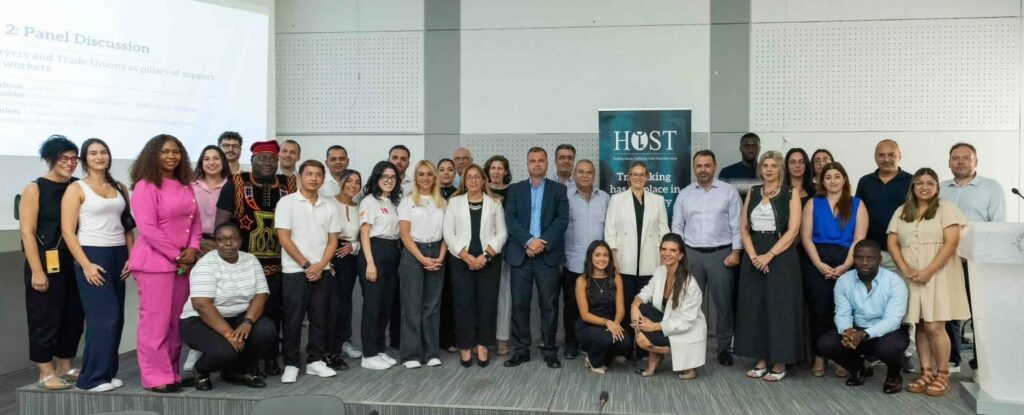 All participants in the multi-faceted conference
"Cheap labour power and expendable hands"
As the general secretary of the Trade Union of Hotel Employees of PEO , Neophytos Ttiminis, pointed out in his statement, "a large portion of employers, unfortunately, find loopholes through the weaknesses that exist in the Employment Strategy to violate the sectoral collective agreements and not even implement the agreements that the employers' associations themselves sign. And as a result, they use immigrants as cheap labour, mainly in kitchen, cleaning, service posts, with the aim of maximizing profits, of course." He added that "as far as living conditions are concerned, while the cut-off rate of the employee's salary for his accommodation and food has reached 40%, there are no effective controls on this issue, as a result of which there is a bundling of these people. In recent years, there has been an increase in the phenomenon of rented workers, both in the tourism and construction industries. We therefore demand the intensification of inspections and the crackdown on undeclared work."
Even more caustic in his own intervention was the deputy general secretary of the Federation of Hotel, Food and Recreation Center Employees of SEK, Panagiotis Ioannidis. "Today," he said, "Cypriot tourism literally rests on the backs of EU and third-country workers, asylum seekers and students. Without them, our hotels and restaurants would close in a day. And yet the state and a portion of employers often treat them as "expendable hands". He said that "it is difficult to protect them, because the walls we find in front of us are high: such as the regime of the reserved work permit, which is the biggest thorn." He explained that "the work permit of workers from third countries is linked to a specific employer and if the employee reports exploitation, he risks losing his residence permit and being deported. This creates a terrible fear mechanism that keeps them mute." He added that "as we have seen recently and with the serious incidents in Xylofagou, the system of intermediaries and employment agencies has gotten out of hand. Contractors "rent" immigrants to hotels on degrading terms, without implementing the collective agreement, keeping the lion's share of their salary." Mr. Ioannidis proposed "disconnection of the work permit from the employer, universal legislative implementation of the Collective Agreement, strict control and penalties for intermediaries and strengthening of the National Integration Strategy 2026-2029".
"Aiming to strike at illegal work"
From the Ministry of Labour and Social Insurance, the head of the Inspection Service and director of the Department of Labour Relations, Andy Apostolou, stated, among other things, that about 8,000 inspections are carried out per year and that the ministry operates a line for anonymous complaints about labour exploitation or violation of employment conditions or about undeclared and illegal work. He said that after measures taken, "illegal employment today in Cyprus, which concerns both foreigners and Cypriots, is estimated at around 20%, while undeclared work has decreased from 15% a few years ago, close to 5% today. Our goal in the coming years, in cooperation with other public services, is to crack down on illegal work." In relation to the terms of employment, he said that "since 1992, the employer has been obliged to offer accommodation to employees from third countries and there was a 10% cut in their salary. After we ascertained through inspections, the inhumane living conditions of some foreign workers, it was decided in 2024 to give the employer the incentive to deduct 25% instead of 10% from the employee's salary, if he offers decent accommodation, based on the criteria set by the Ministry of Labour."
From the Deputy Ministry of Migration and International Protection, Konstantinos Kounnis and Fotini Christou presented the first National Migrant Integration Strategy of the Republic of Cyprus for the period 2026-2029, which was approved by the Council of Ministers in February 2026. They said that "the Strategy marks the transition from fragmented actions to a coordinated and measurable approach with four key strategic objectives. These concern the promotion of socio-economic inclusion, the fight against stereotypes, the improvement of access to health services, as well as the legislative and political alignment needed for the effective implementation of integration actions." In her own intervention, the lawyer and legal advisor Eleni Charalambous proposed the establishment of a more effective and accessible monitoring system in all competent services, the conduct of more extensive and preventive controls by the Department of Labour, the establishment of a standardized employment contract for asylum seekers, approved by the Department of Labour, the imposition of stricter sanctions on employers who violate the law, creating effective procedures for issuing residence permits to victims of trafficking in human beings and establishing clear procedures for granting residence permits to irregular migrants whose deportation is not possible."
False advertisements and practices of employment agencies
Citing the most recent International Report of the United Nations Office on Drugs and Crime (UNODC) on Trafficking in Human Beings and conducted in 2024, Katerina Stefanou said that "the number of victims of trafficking for the purpose of forced labour increased by about 47% between 2019 and 2022, making labour exploitation the most frequently detected form of human trafficking worldwide. Criminal networks, he added, are increasingly using digital technologies, fake ads and employment agency practices to target migrants seeking employment abroad, particularly in sectors facing labour shortages. Ms. Stefanou stressed that "the protection of migrant workers, the promotion of ethical recruitment and the strengthening of cooperation between institutions, employers, workers' organizations and civil society are essential to build fair labour markets and prevent exploitation. Through coordinated action across Europe, we can ensure that migration remains an opportunity for decent work and social inclusion and not a pathway to abuse."
In the same spirit was the appointment of Andreas Hatzigeorgiou on behalf of the Ministry of Justice and Public Order as National Coordinator for the Fight against Trafficking in Human Beings. He referred to the European project HOST and said that "we are committed to building on the findings and recommendations of the project to further strengthen our national policies, inter-agency cooperation and mechanisms to prevent, protect and effectively tackle labour exploitation and trafficking in human beings".
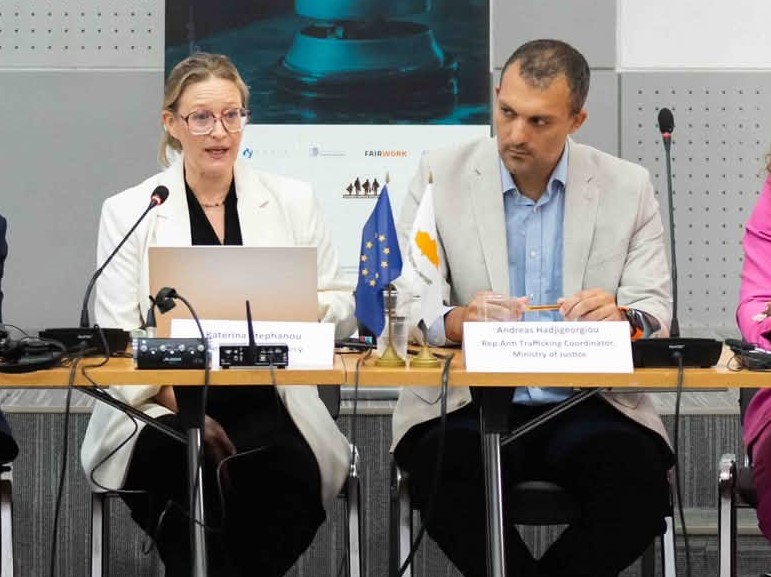 Katerina Stefanou and Andreas Hatzigeorgiou at the conference
Conditions conducive to trafficking in human beings
In his own intervention, the Head of Information and Communication of the Representation of the European Commission in Cyprus, Alexis Pantelides, stated that "in Cyprus, foreign nationals make up almost 40% of the workforce in the hospitality sector, where conditions prevail that favour human trafficking. These concern complex operating models and often limited accountability on workers' well-being, unfair employment practices, as well as the high proportion of 'low-skilled' jobs that attract more vulnerable workers, including many third-country nationals. This implies increased chances of labour exploitation, as well as employment of illegally staying third-country nationals who are more exposed to exploitative conditions, including particularly abusive working conditions." Mr. Pantelides noted that "the majority of registered victims of trafficking in Cyprus are nationals of countries outside the European Union. Although sexual exploitation remains the main form of trafficking, labour exploitation is on the rise, now accounting for 36% of detected cases in the European Union."
The first police investigation into the delivery
The head of the GEP, Senior Lieutenant Eleni Michael, referred to the operation and responsibilities of the Office for Combating Human Trafficking of the Police (GEP) in her own statement. "As an Office," he said, "we are concerned with labour exploitation, sexual exploitation and coercion to commit criminal offenses. Recently, a serious form of labour exploitation involving the delivery sector was investigated for the first time. As far as the fight against labour exploitation is concerned, joint operations are carried out in cooperation with the inspectors of the Labour Office. In this context, a Memorandum of Cooperation has been signed with the Labour Office, which covers education, business, information exchange and information campaigns." Lieutenant Michael observed that "some information transmitted to us and related to work falls more into matters of violation of working conditions and not labour exploitation."
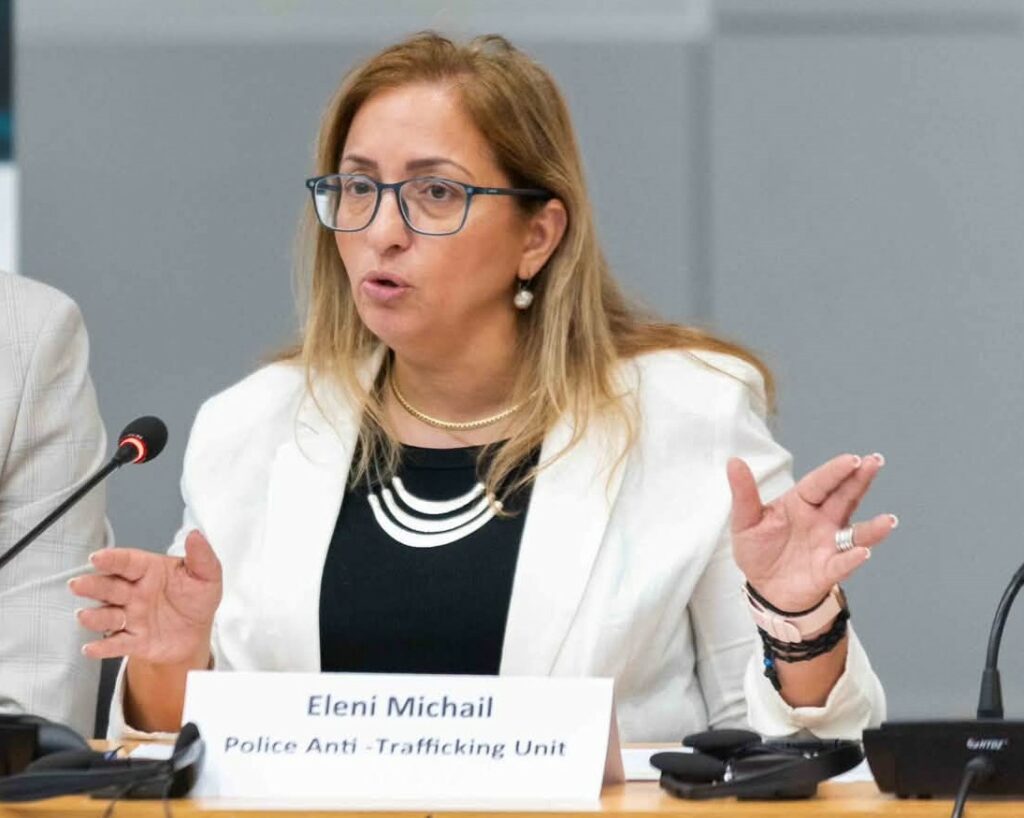 The head of the GEP, Lieutenant Eleni Michael
He added that "the most important challenges we face concern the long time of adjudication of cases and the inability to communicate directly with the victims due to language difficulties. He also said that the GEP cooperates within Cyprus with the Social Welfare and Mental Health Services and with non-governmental organizations that support the victims and outside Cyprus with international and European organizations such as Europol, Interpol and the International Organization for Migration. He also stated that "for the purpose of transmitting information to the GEP, the 4-digit telephone line 1497 has been set up where anyone can anonymously transmit information related to human trafficking. Also in Digipol on the Police website there is a special field for anonymous information related to trafficking." He concluded by saying that "due to the continuous actions by all stakeholders, from 2022 to 2025 Cyprus is in category 1 in the US State Department's assessment. This shows the consistency and progress achieved every year, the improvement of procedures to make them more functional and always focusing on the victim-centred and multi-thematic approach. Indicatively, it is mentioned that in the last 5 years we have convictions in more than 24 cases and more than 40 perpetrators were convicted. Among the cases there are convictions that for the first time occurred in Cyprus, such as the conviction of a customer who received services of a sexual nature from a victim of human trafficking and convictions in two cases of begging."
We note that Nelson Neocleous, a member of the board of directors of the non-governmental organization Cyprus STOP Trafficking, was also present at the conference, who told us that "the Employment Strategy and the Migrant Integration Strategy should be studied more by the non-governmental organizations and the competent state services should be asked to amend them where necessary. In this regard, national action plans should be monitored, evaluated and adapted.'
"They told me they don't hire blacks"
In the first panel of the discussion on the realities of work in Cyprus, primary testimonies from leaders of migrant communities were presented. In this context, Soren Lurabni, an official of the organization Generation for Change CY, presented findings of the research project entitled "FAIR" with the participation of asylum seekers or refugees (over 18 years old) who arrived in Cyprus after 2022. He said that "on the issue of discrimination in job search and employment, skin colour often overshadowed the legal status." The statement of a woman from Cameroon is indicative: "They told me categorically that they don't hire black people. They had posted an ad, but they didn't mention anything about specific accusations." The speaker commented that "there is systematic mistreatment of employees on the basis of racial discrimination.
In the field of employment, 59.7% of respondents were counted who were treated differently from their colleagues on the basis of their colour, 69.7% were not sufficiently paid to meet basic needs, while racial discrimination was also observed in work environments where toilets and rest areas are separated." By Stephan Noel Tchounanteu, director of the refugee-run organization TapSeu Pouh in Cyprus, several points of discussion were raised.
She spoke "about the vulnerability of many migrant workers due to uncertain legal status, discrimination at all stages of employment, exploitative employment practices, gaps in public support services and administrative barriers to integration into the labour market". Mr. Tchounanteu proposed, among other things, "the strengthening of labour inspectorates and enforcement measures, the improvement of the services provided by the Labour Office, the acceleration of the recognition of qualifications, the strengthening of coordination between public bodies, the provision of continuous training to public officials, the improvement of the connectivity of public transport with industrial and commercial areas, the enlargement of the access to specialised employment opportunities for third-country nationals, exploring pathways to work permit for asylum seekers and other groups of migrants, strengthening labour exploitation reporting mechanisms, and promoting closer cooperation between migrant communities, employers, trade unions and other actors".
 Irene Che and Stephan Tchounanteu
Violence against women and unequal treatment
Lama Swas, executive director of the organization "Hold My Hand CY", which is run by refugee women, referred to "incidents of violence and abuse against women migrants and refugees". She said that these incidents "are not reported due to the fear of revealing their identity or losing their job, residence or the outcome of a legal case" and suggested "displaying options for anonymous reporting on official websites, with a clear indication that the identity of the person will not be disclosed".
She also proposed "the obligation of employers, through trade unions, to inform staff of their rights and to post this information in the workplace, especially in high-risk sectors. Given that many women still do not make a complaint, this measure shifts the responsibility to employers and adds a layer of protection." In her own statement, Irene Che, president of the Survivors' Advisory Council of Step Up Stop Slavery, referred, among other things, to issues of "vulnerability and dependence of workers on employers, exploitative working conditions, unequal treatment between migrants and local workers despite performing the same duties". He added that "while these challenges are real, it is equally important to recognize the progress that is being made."
