
CARE IN CYPRUS IS A WOMAN'S AFFAIR -IMPORTANT FINDINGS OF A SURVEY - 52.8% OF WOMEN, COMPARED TO 33.5% OF MEN, ANSWERED THAT PROFESSIONAL DEVELOPMENT WAS 'SIGNIFICANTLY' AFFECTED - Filenews by Marios Demetriou
Care in Cyprus today remains mainly a "women's affair", as found in a survey by the Mediterranean Institute of Social Gender Studies (MIGS) in the framework of the European project CAREdiZO, which records an unequal distribution of home care and costs in women's professional careers. At the same time, as MIGS senior researcher Maria Angeli told "F", "small businesses and organizations are looking for flexibility to support their employees, but stumble upon limited resources and entrenched stereotypes." As part of the report on this issue, we met and spoke with the couple Andreas Mousikos and Evangelia Pavlou, parents of a 5-year-old child who are both employees and are included in the minority of cases where care is a matter of... of both! We also secured the testimony of a 42-year-old employer who runs a small business with a small team of employees, as well as the testimony of a 51-year-old man who is employed by another small business.
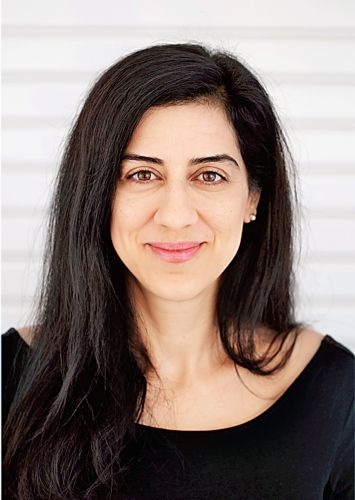
MIGS Senior Researcher Maria Angeli
The conflict between work and care
"In Cyprus, the care of children, the elderly and relatives with disabilities or illnesses, continues to have a strongly female face," Maria Angeli told us and added: "Data from the European Institute for Gender Equality (EIGE) indicate that 70% of women cook daily compared to 33% of men. 41% of women report daily care or education for children, grandchildren, the elderly or people with disabilities, compared to 28% of men. The same pattern – she added – is at the heart of CAREdiZO, a European project that examines how care at home is shared and how small businesses and small civil society organisations can support their workers. The Cypriot survey of the project was based on responses from women and men and focused on people who work, especially micro-enterprises and small organizations. The sample was collected through online, voluntary participation and offers a concrete insight into how the conflict between work and care is experienced."
Inequality and professional costs
"The data are clear," the MIGS researcher pointed out and added: "In the responses for Cyprus, almost half of women with care responsibilities (48.1%) stated that they "mostly" undertake the care themselves, compared to 4.7% of men. In contrast, 71.4% of men said that they share care equally with their partner, a percentage that among women was 40.7%. The difference is also seen in daily tasks. Women made up 86.3% of those who reported arranging appointments, 83.7% of those who clean or do laundry, and 79.6% of those who cook or take care of personal care. Even in medical support and emotional care, most of the responses came from women. Inequality is not only reflected in the type of work, but also in time.
The conflict between work and care
"In Cyprus, the care of children, the elderly and relatives with disabilities or illnesses, continues to have a strongly female face," Maria Angeli told us and added: "Data from the European Institute for Gender Equality (EIGE) indicate that 70% of women cook daily compared to 33% of men. 41% of women report daily care or education for children, grandchildren, the elderly or people with disabilities, compared to 28% of men. The same pattern – she added – is at the heart of CAREdiZO, a European project that examines how care at home is shared and how small businesses and small civil society organisations can support their workers. The Cypriot survey of the project was based on responses from women and men and focused on people who work, especially micro-enterprises and small organizations. The sample was collected through online, voluntary participation and offers a concrete insight into how the conflict between work and care is experienced."
Inequality and professional costs
"The data are clear," the MIGS researcher pointed out and added: "In the responses for Cyprus, almost half of women with care responsibilities (48.1%) stated that they "mostly" undertake the care themselves, compared to 4.7% of men. In contrast, 71.4% of men said that they share care equally with their partner, a percentage that among women was 40.7%. The difference is also seen in daily tasks. Women made up 86.3% of those who reported arranging appointments, 83.7% of those who clean or do laundry, and 79.6% of those who cook or take care of personal care. Even in medical support and emotional care, most of the responses came from women. Inequality is not only reflected in the type of work, but also in time.
Men most often reported 10-20 hours of care per week, while women more often reported more than 40 hours. Only women reported the 31-40 hour range." In relation to professional costs, Maria Angeli said that "for many women, care turns into a career obstacle" and continued: "52.8% of women, compared to 33.5% of men, answered that his/her professional development was "significantly" affected due to caring responsibilities.
The survey also records that women more often reported changing or leaving work to manage caring responsibilities, while men more often reported reduced hours or no effect. Pressure has both a psychological and organizational imprint. In the responses about guilt, anxiety or burnout, 78.5% came from women. The same was true for the hidden hostility of employers towards people with care obligations (83.4%), the lack of available care services (86.3%) and the lack of flexible working hours (76%). These numbers do not measure the total population, but they do reflect the pattern described by this sample: care is disproportionately linked to women's professional precariousness."
Regarding the care of young children and the elderly or sick, the survey showed that "the family fills the service gap", as Mrs. Angeli told us and added: "The care of young children is largely based on nurseries, kindergartens, afternoon programs and grandparents. For school-age children, however, participants reported infrequent use of organized services and greater, though not frequent, dependence on relatives and other adults.
In the care of the elderly or people with a disability/illness, most services were reported as infrequent or never used. The finding is linked to a broader sense of inadequate support: 91% of participants feel that caring responsibilities are not shared equally between women and men. They cited social norms and traditions as the main causes, but also the lack of support structures and services."
Between intention and weakness
The second strand of the CAREdiZO project focuses on micro-enterprises and small civil society organisations, "spaces where the absence of even one person can disrupt the functioning of a group", as Maria Angeli observed. "In Cyprus," he added, "the project recorded four interviews with employers and employees from a small tourism business and three small organizations. This is a qualitative, exploratory survey and not a measurement of all Cypriot employers. Participants described a double restriction. Small organisations often depend on European funding, operate with limited staff and struggle to offer hybrid work or flexible hours. Small businesses, on the other hand, reported difficulty in creating a more flexible work environment. Behind the economic constraints, we also identify deeper social barriers: the expectation that women are the primary caregiver, gender stereotypes in recruitment and a disproportionate burden on women with emotional work."
From recognition to solution
As Maria Angeli pointed out, "the proposals emerging from the two strands of the research converge: affordable and available care services, flexible hours and teleworking where possible, family-friendly work policies and equal parental leave. Participants also highlight the need to encourage men to take on more care. For small businesses, the answer doesn't have to be a cumbersome system. CAREdiZO's interviews highlight practices such as flexible or hybrid hours, the ability to shift working time to emergencies, and a less bureaucratic, but clean and equitable, approach to care needs. The challenge is to move these arrangements from personal goodwill to firm rules that protect women and men equally. Our approach to care shifts the dialogue from 'work-family balance' to 'work-life balance' to include health, well-being and personal safety, not just parenthood." The researcher concluded by stating to "F" that "CAREdiZO is not limited to recording the problem. In the autumn, free seminars for companies and organisations will be organised in Cyprus, Greece and Bulgaria, with the aim of helping them develop policies that support workers' care obligations. Those interested in Cyprus can contact Maria Angeli at angeli.m@medinstgenderstudies.org email. At the same time, MIGS presents a series of podcasts on the topic of care on its channel "WE-PODS" on Spotify https://open.spotify.com/show/77v30MY5P61MhpNukOURLG?si=6f6e4a2960a141c2
Flexibility at work - consistency in the family
"I work in a small business and for the last two years I have been taking care of our parents together with my sister," a 51-year-old man told us and added: "My father often needs tests and my mother cannot always be left alone at home. The difficult thing is not only the time, it is that many appointments arise suddenly and do not easily fit into a strict working schedule. At first I was hesitant to discuss it at work. But when I spoke openly, we agreed on something simple: I inform the team in a timely manner, I can move my working time when there is a medical appointment and, if necessary, work from home. Many times I take the laptop with me when my son has a workout in the afternoons. While he's on the field, I'm replying to messages, completing pending issues, or joining an online meeting. It doesn't mean that work goes into personal time without limits. It means that I have the ability to organize my day without wasting moments from my child's life or leaving all the care of my parents to my sister.
What helps me the most is that I don't have to apologize or ask for personal service every time. There is a common understanding that parent and child care is no exception. It is harmoniously integrated into the work program. Flexibility doesn't make me less committed to my work, it just allows me to be consistent in both work and my family. I am happy when I see other colleagues interrupting the work schedule, in order to do something else. Such as going to a hairdresser or dentist in the morning, which is not rush hour. Why get stuck in traffic in the afternoon, when they can do it in the morning at 11 and then go back to work?"

Based on duties and not hours
"After the pandemic, I realized that productivity is not measured by the hours one spends in the office, but by whether the work is progressing and whether the deliverables are completed correctly and on time," the 42-year-old small business manager and employer of a small group of employees told us, adding that "she tried to organize the work based on duties and not hours".
And he continued: "At the beginning of each month we agree on what needs to be done, who undertakes what and what our deadlines are. From then on, everyone organizes his/her day in the way that makes sense to him/her. In the past, I admit, I wanted to see the team in the office – I felt that way I had a better picture of what was going on. Over time, however, I realized that the team can work just as well remotely, as long as there is clarity in the goals and trust in people. A colleague, for example, wants to catch up with her morning workout and starts an hour later. A colleague works from home, because that's where he concentrates better. We don't see it as a privilege for a few, but as a different way for everyone to organize their work. I am a single parent and now I have much more flexibility with my children. I don't have to look every time who will pick them up from school. I go, take them, feed them and continue working in the afternoon. And it has also helped the team: we communicate more clearly, we know what each one has undertaken and the responsibility is more visible. When you trust people and evaluate work by the result, flexibility can work to the benefit of both the team and the organization."
Shared responsibility and management
"Andreas and I like to cook together at home, but he usually cooks and I do the washing of the dishes. Sometimes, of course, I cook and he washes the dishes," Evangelia Pavlou told "F", a fact that was also confirmed by her husband Andreas Mousikos. We met them at the confectionery workshop that Evangelia maintains in the Elaiones area in Strovolos and they talked to us about their life together and how they share the responsibilities of home care and caring for their 5-year-old daughter. "Every day as soon as I get to school at half past two, I come here to the workshop and help Evangelia, but also carry our daughter to and from her afternoon activities," Andreas, who is an employee of the Postal Services, told us. He told us that until two years ago he had been working for quite a long time as a chef – he was successively employed in the kitchen of a private university, in a small nightclub (for a year, together with his wife on Friday and Saturday nights), in a food production factory and in a bakery.
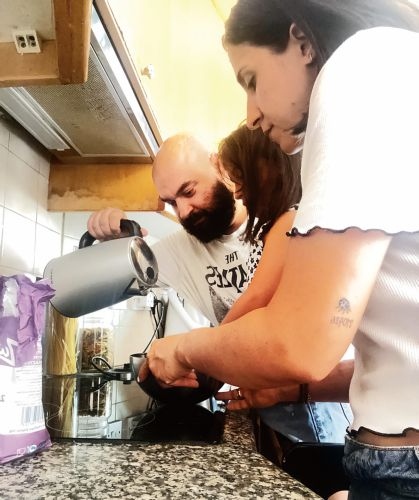
We mention that they met while they were both studying Culinary Arts at HHIC – the Higher Hotel Institute of Cyprus that offers hotel and food education programs at the tertiary level. We asked Evangelia how she would deal with her relationship with Andreas, if at the beginning of their acquaintance she found out that he was a man... of the "traditional school"? Her answer was immediate, as she looked at her husband with a smile, who smiled back at her: "I don't think I would deal with it well... I certainly wouldn't take it to a more serious level in marriage as well..."
