
Fancy solar-powered sea chairs mean nothing if you get stuck in the parking lot
Over the last seven years, Cyprus has taken various steps to make its beaches more accessible to people with disabilities. Yet, getting into the sea is only part of the equation. True access depends on practical infrastructure like parking spaces, ramps, walkways, spacious changing rooms, and proper restrooms. The experience shouldn't end at the sand, either. Entertainment options matter. The cafes, restaurants, and hotels surrounding the beaches need to accommodate people with disabilities too.
"We need shaded areas where we can hang out, and we need access to beach cafes. We want to choose a place where we can relax after swimming, just like everyone else," Marianna Pafiti, president of the "Neofytos" Culture Organization, told "K".
"There should be a municipal employee at the beach who is explicitly responsible for managing the accessibility infrastructure."
Dimitris Lamprianidis, president of the Cyprus Organization of Paraplegics (OPAC), pointed out major gaps in the surrounding infrastructure. "We have a serious problem with the entertainment venues around the beaches and shortages in our hotels," he said, pointing to a lack of suitable rooms that can safely accommodate wheelchair users and their families.
Recognizing the progress
The current push for inclusion follows a 2018 investigation by the Ombudsman’s Office regarding beach accessibility. That investigation led to an update of the Protection of the Beach Law in 2019, which aimed to make beaches more inclusive. Since then, the Ombudsman's Office reported that the State has responded well to the findings and implemented the official recommendations.
Both Mr. Lamprianidis and Ms. Pafiti clarify that they do not want to discredit the hard work of the Municipalities and the Deputy Ministry of Tourism. They recognize the changes made so far. However, they describe the overall pace of these inclusion efforts as incredibly slow.
56 accessible beaches
According to a 2025 report by the Deputy Ministry of Tourism, Cyprus currently features 56 beaches with accommodations for people with mobility challenges. Out of these 56 locations, 44 are fully accessible and 12 are partially accessible. For context, Cyprus has more than 180 organized beaches in total.
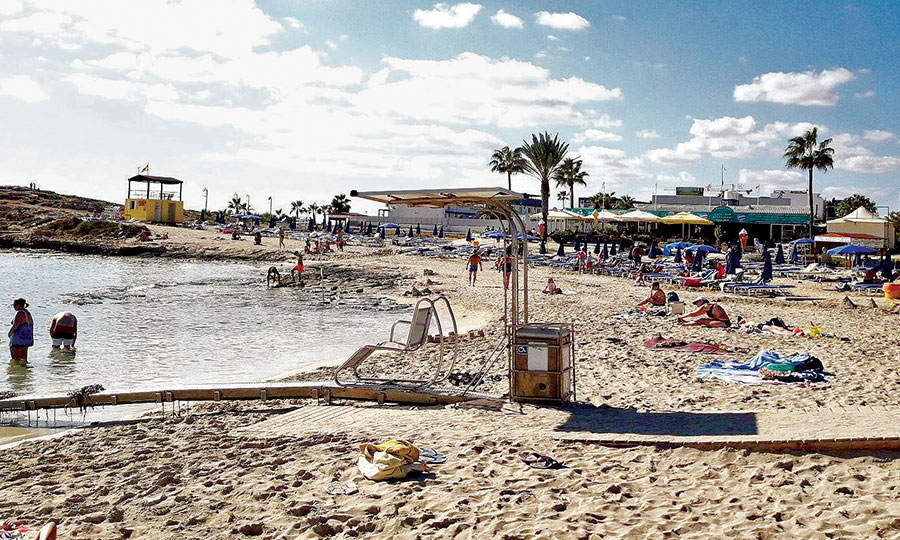
The 44 fully accessible beaches offer direct access to the water via wooden ramps or plastic walkways, allowing wheelchair users to roll straight into the sea. They also provide accessible restrooms and dedicated parking spaces. Ten of these beaches feature the autonomous Seatrac system. This system uses a solar-powered tower to move a special seat along a rail, lowering the user into the water at a depth of about two feet. Additionally, 42 beaches offer a floating amphibious wheelchair designed for moving across sand and floating in the water. Both the Seatrac and floating wheelchairs are completely free for the public to use, and local lifeguards usually provide information on how to operate them.
The remaining 12 partially accessible beaches feature ramps or walkways that let wheelchair users get onto the beach, but these tracks do not extend all the way into the water. While they do offer accessible restrooms and parking, only one of these 12 beaches has a floating wheelchair available.
The Deputy Ministry of Tourism stated that it actively supports better beach access as part of its ongoing efforts to upgrade coastal services. Mr. Lamprianidis mentioned that OPAC actually purchased many of these systems through co-financed projects and handed them over to local Municipalities free of charge.
Managing and protecting the equipment
Polys Pallikaros, president of the Cyprus Lifesaving Federation, clarified that managing the Seatrac and floating wheelchair equipment is the responsibility of the Municipalities, not the lifeguards. Even so, lifeguards frequently step in to help and guide users. A representative from the Central Beach Committee of the Union of Cyprus Municipalities told "K" that where a beach manager is present, they handle the equipment.
The complaints OPAC receives usually involve broken equipment, though Mr. Lamprianidis noted these issues aren't incredibly frequent. "We believe that the Municipalities need to be more diligent in managing this equipment," he said. "Since beaches generate revenue for these Municipalities, they should reinvest that money into infrastructure to better serve all visitors." He added that high-quality restrooms and changing rooms benefit everyone, whether they have a disability or not, emphasizing that equipment needs to be maintained, not just installed. "Walkways on the sand need to be well-placed, maintained daily, and repaired without delay," he said.
Mr. Lamprianidis also brought up the placement of beach loungers. "It is crucial to have sunbeds placed directly on the wooden walkways because wheelchairs can't roll through loose sand," he said. People with disabilities need loungers on wooden platforms that they can reach easily and safely. To make transfers easier, these loungers also need to be raised higher, an issue Municipalities haven't focused on enough yet.
Accessibility systems are not toys
Disability organizations want to send a clear message to beachgoers: do not use accessibility equipment as toys. Treat this gear with respect. Many malfunctions happen because people without disabilities mishandle the equipment. When a system breaks, technicians have to come out to fix it. This leaves individuals who rely entirely on these systems unable to swim for days at a time.
Autonomy is a right, not a privilege
Marianna Pafiti pointed out that having equipment available doesn't automatically give everyone independence. She questioned whether every individual can manage the equipment alone, given that not everyone has a companion to help them. "Family and friends often step in to help someone enjoy the sea, but not everyone has that support system," she said. She urged the State to protect the right to autonomy and independence for people with all types of disabilities.
Because lifeguards are not officially responsible for the equipment, Ms. Pafiti believes beaches need a dedicated staff member on-site to manage everything. Mr. Lamprianidis agreed, noting that having a municipal employee assigned to beach infrastructure is an upgrade Municipalities can and should make.
Inclusion drives tourism
"We are an island surrounded by beautiful beaches," Ms. Pafiti said. "How many tourists with disabilities actually visit us? Disabilities take many forms." She noted that senior citizens often have mobility needs very similar to those with disabilities. "As a tourist destination, we should do better across all levels of the hospitality industry. If we offer an excellent, seamless package, we can become a model for accessible tourism. But doing that requires a real vision and comprehensive planning."
