
It has been 20 years since the presence of the alien invasive species of the pufferfish in the seas of Cyprus without any recorded attacks on bathers, while the only effects on humans were caused by poisoning after consumption of this species.
Lately there has been intense discussion, which often borders on panic on social media, but even in publications, which caused upset among the general public. In fact, in Greece, incidents of attack by pufferfish on bathers seem to be recorded with the latter last Sunday on a beach in Patras.
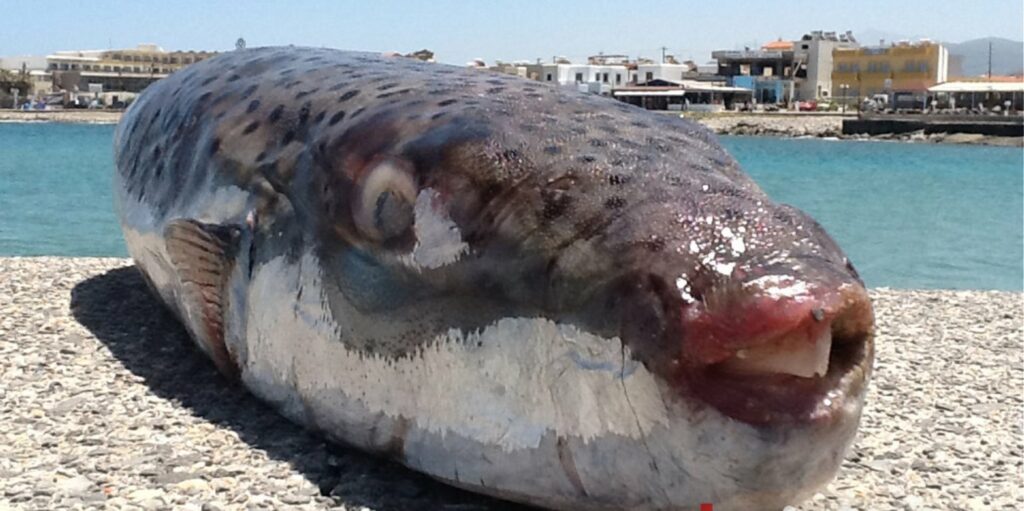
The data of the Department of Fisheries and Marine Research (DFMR) highlight the real dimension of the problem that concerns a serious ecological and economic threat to coastal fishing, since it significantly affects professional fishermen, as it causes damage to both fishing gear and catch.
According to DFMR, from 2000, when it first appeared, until the rapid increase and spread of its population in 2006, the fish has now settled and been fully integrated into the local ecosystem. The Department of Fisheries clarifies in the most categorical way that in its many years of presence, absolutely no attack on bathers on Cypriot beaches has been recorded, refuting the concerns that are recklessly reproduced.
Although bathers are safe on the beaches, the risk to human health is real and is found exclusively in the consumption of fish. The pufferfish is a highly toxic fish of Indo-Pacific origin, which entered the Mediterranean through the Suez Canal and is considered one of the most harmful invasive species mainly due to:
(a) Its rapid spread.
(b) Its ecological properties, since it is a species with a wide range of nutrition.
(c) The ability to adapt to different environmental conditions and limited natural predators in our area.
(d) The neurotoxin it contains in its body, which makes it unsuitable for consumption.
(e) The impact it has on fisheries and marine biodiversity in general.
Its tissues contain the powerful neurotoxin tetradotoxin, which causes severe food poisoning, and can even lead to death, as there is no antidote to date. In the history of the Cypriot authorities, there is only one recorded incident of poisoning of two people in 2016, which, fortunately, had a happy ending. The marketing and consumption of the item is strictly prohibited by law.
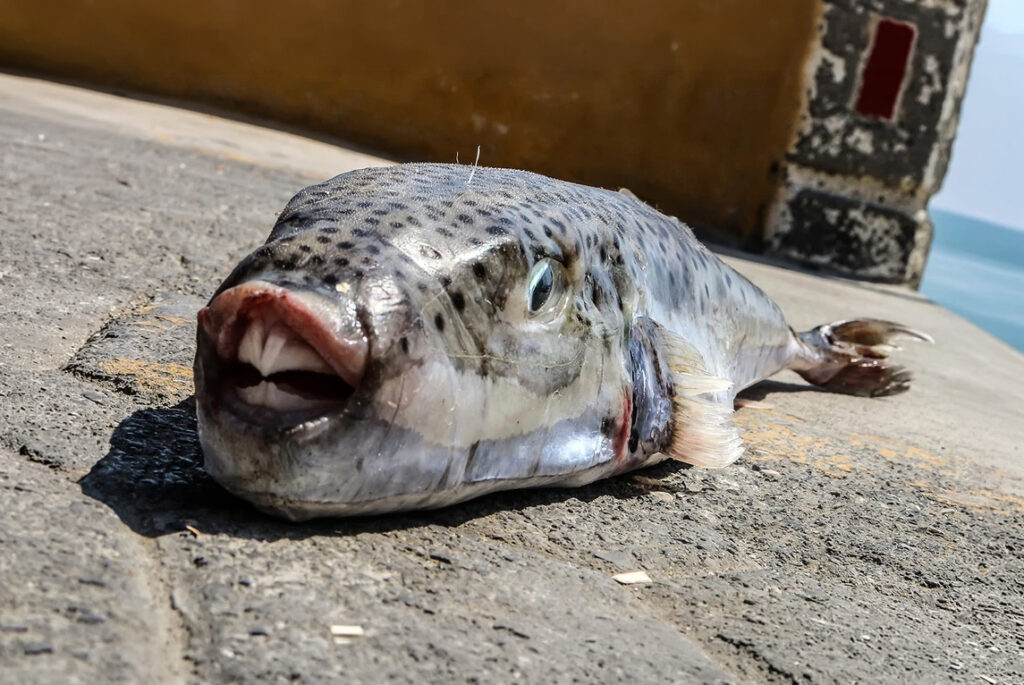
At the same time, the fish is easily recognizable by the following characteristics: its elongated and partially laterally flattened body, the green-brown spine and black equal-sized and normally arranged spots, a silver stripe from the mouth to the tip of the tail, a white belly and a silver dot in front of each eye.
Its jaw is also characteristic, with four very powerful teeth, two upper and two below, which come together to form a kind of beak. Because of these very strong and fused teeth that look like a hare, it also got the name pufferfish.
Also, the pufferfish has the ability to significantly inflate its body, absorbing water or air. Characteristic is the loud noise during bloating, which comes from the friction between the teeth of the upper and lower jaw.
Daily nightmare for fishermen – Sponsorship Scheme 2024-2029 by DFMR
If for the general public the pufferfish is just a topic of discussion, for professional fishermen it is a daily nightmare. It is a keen predator with a wide range of diets and few natural predators in the waters of the Mediterranean.
According to the DFMR, the pufferfish systematically attacks fish caught in the stationary fishing gear (nets and longlines) of fishermen. Using its powerful beak, it destroys both the catch itself and the gear, dealing a major blow to the Cypriot fisherman's income. The DFMR conducts almost daily collection of fisheries data in the fishing shelters of the island, recording the continuous complaints and damages. According to the competent Department, fishermen have now adapted to its presence, know how to protect themselves from this species, carefully free it from fishing gear and now fish it systematically by participating in the Sponsorship Scheme to limit its spread. In this way, fishing pressure is exerted on the pufferfish and at the same time the profession of fisherman is supported.
The DFMR, recognizing the magnitude of the threat to marine biodiversity and the fishermen's economy in a timely manner, has been implementing mitigation plans for years. Corresponding programs have already been completed during the programming periods 2007-2013 and 2014-2020.
As of June 2024, the new "Grant Scheme to limit the spread of pufferfish in the coastal waters of Cyprus" is in full force, which will last until the end of 2029. Its total budget amounts to €1,395,000, co-financed by the European Maritime, Fisheries and Aquaculture Fund (EMFAF) and the Republic of Cyprus.
The aim of the plan is not to completely eradicate the species, which is considered biologically unfeasible, but to mitigate its effects through intense and targeted fishing pressure, which focuses mainly on large breeding individuals. Beneficiaries are professional fishermen (holders of A, B or Multipurpose licenses), who are compensated with the amount of €4.73 per kilogram of caught pufferfish.
To date, 11 collective groups (about 150 fishermen) are participating in the project, having already withdrawn about 103 tons (103,000 kg) of the species from the sea, collecting a total of €487,000.
Hellenic Red Cross: What to do if you are bitten by a pufferfish
Pufferfish contains a strong neurotoxin (tetrodotoxin), which makes its consumption extremely dangerous. Because the distribution of the toxin varies, no part of the fish is considered safe to eat. Although the bite of the pufferfish is not toxic, its particularly strong jaws, which look like a beak, can cause serious injuries and heavy bleeding, notes the Health Sector of the Hellenic Red Cross, which recommends:
• Immediate cleaning of the wound with plenty of running clean water and soap. Do not use topical antiseptics without a doctor's instruction.
• Apply constant pressure with clean gauze or clean cloth. If the bleeding is severe, maintain constant pressure on the wound, holding the limb up.
• Be sure to seek medical help, the wound from the bite will need specialized care, anti-tetanus serum, perhaps even stitches if the wound is deep.
• In case the incident occurs in a remote area or the bleeding is intense, citizens should immediately call the National Emergency Aid Center (166) or the European Emergency Number (112), providing the appropriate First Aid until the arrival of specialized assistance.
