
A new action of the Cyprus Addictions Authority (AAEK) aimed at ridding Cypriot schools from smoking will begin to be implemented from the new school year, as announced by the president of the Authority, Dr. Christos Mina, speaking on Monday, May 25, 2026 at a press conference at the Ministry of Health in Nicosia as part of the actions for World No Tobacco Day, which is the 31st May of each year. He stressed that according to research data at an international level, at least 40 million children aged 13-15 currently use a tobacco product, while 15 million adolescents use e-cigarettes.
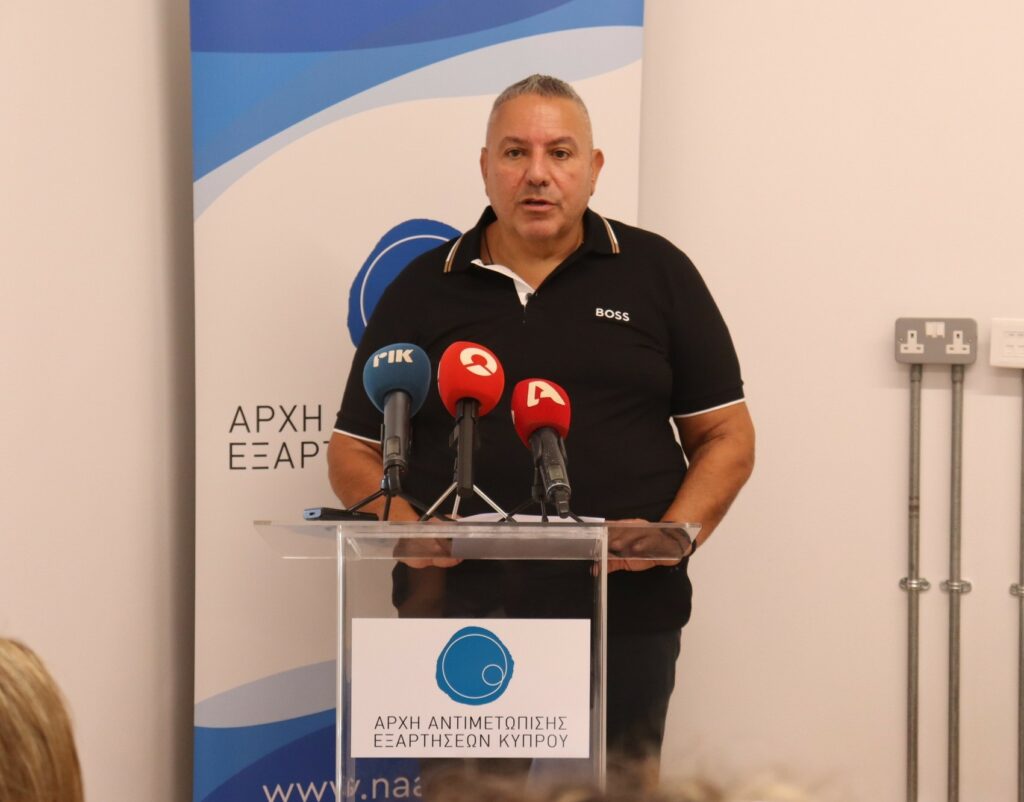 The president of AAEK Dr. Christos Mina
"This day is an important reminder of our collective responsibility to protect public health from the serious consequences of smoking and nicotine dependence," Health Minister Neophytos Charalambidis said in a speech at the event. "As the Ministry of Health," he added, "we remain firmly committed to the implementation and strengthening of integrated policies for the prevention, information and cessation of smoking.
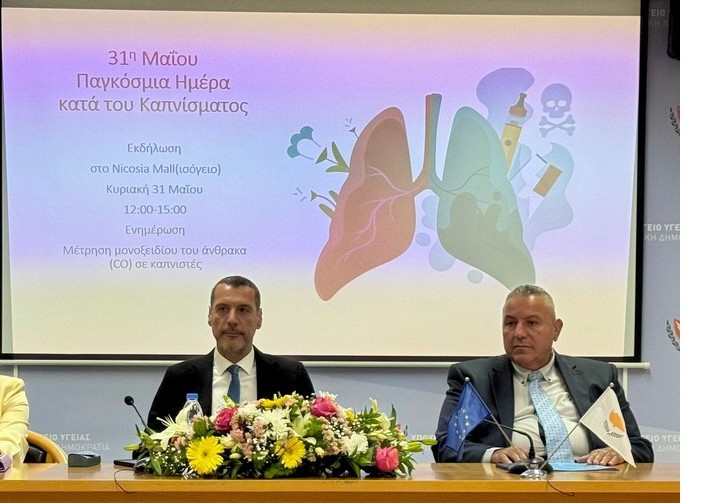 Neophytos Charalambides and Dr. Christos Minas at the press conference on smoking
At the same time, we continue to consistently implement anti-smoking legislation and promote awareness-raising actions, with the aim of ensuring a safe, healthy and quality environment for all citizens." It is noted that the National Strategy 2021-2028 of AAEK includes the creation of 100% smoke-free environments, the enhancement of the availability of cessation programs and the protection of young people from new tobacco products. It is emphasized that "the evaluation and treatment of nicotine dependence is an ethical and medical obligation of every health professional, while its omission constitutes bad clinical practice".
Health promotion in the school environment
As Dr. Christos Mina mentioned, AAEK's new initiative against smoking is undertaken in collaboration with the Ministries of Health and Education and will be promoted in Secondary and Technical Education schools. He said that "the purpose of this action is, through a "list of key observation points", to record whether the management and staff of the school unit are implementing specific measures of prevention, health education and supervision in the school environment. This tool will act as a guide, highlighting the practices and measures that should be implemented, so that each school space truly functions as a "space free of any tobacco product". The form will be completed and signed jointly by the Administration of the school unit and the Scholar or Health Visitor visiting the school. We consider the role of the Scholar and the Health Visitor in this process to be particularly important, as they can contribute substantially to the promotion of health within the school environment. The form will be sent to AAEK, while at a later stage there is an intention to highlight and publicize "good examples of smoke-free schools". The implementation of the action is expected to start with the new school year, after the issuance of a relevant circular by the Ministry of Education to all school units.
Unmasking attraction, dealing with addiction
The president of the Cyprus Addictions Authority underlined that "through coordinated prevention, information and awareness actions, we must all strengthen our efforts to ensure a future free of tobacco and nicotine for future generations. This year's World Health Organization's campaign on the occasion of World No Tobacco Day 2026 on "Unmasking the appeal – countering nicotine and tobacco addiction" focuses on the practices used by the tobacco industry to attract children and adolescents through scents, attractive packaging and social media advertising. AAEK, as the highest coordinating body of Cyprus in the field of legal and illegal addictive substances, joins its voice again this year with the World Health Organization and all its partners, in the joint effort to tackle smoking. The aim is to raise awareness among young people about the harmful effects of tobacco products and to protect them from the interventions of the tobacco industry. The tobacco industry systematically targets youth, seeking to replace consumers they lose either due to smoking cessation or deaths related to it. To this end, it invests in attractive products, modern advertising practices and a strong presence on social media, particularly affecting children and adolescents."
The publication of a Guide to Smoking Cessation
The publication of a Guide with clinical guidelines for smoking cessation is also a new action of AAEK to which Dr. Christos Mina referred. "We have proceeded - he said - to develop clinical guidelines to promote smoking cessation which is based on appropriate treatment based on scientific evidence and best practices. The necessity of having these guidelines is defined in the World Health Organization's Framework Convention on Tobacco Control (FCTC).
Through these instructions, it will be possible to train health professionals, while they will be a trigger for the creation of new prevention and treatment programs. The clinical guidelines are available immediately to all those involved in the field of smoking cessation for their use."
The publication of the Guide with the clinical guidelines for smoking cessation was presented by the pulmonologist Dr. Michalis Toumbis and the clinical psychologist Dr. Maria Karekla at a previous press conference on the occasion of the World No Tobacco Day organized by AAEK on May 18 at the "Center for Creative Engagement" in Salina Park in Larnaca. At the conference, reference was made to the pan-Cypriot free smoking cessation program of the Mental Health Services, which in the province of Larnaca is hosted at the "Center for Creative Engagement".
The presentation was made by clinical psychologist Dr. Mary Ioannou. In addition, Pola Proestou from the Center for Social Innovation (CSI) presented the European program RELIEF in which AAEK participates and which focuses on vaping in school-age children. The third important action of AAEK, which was referred to by the president of the Authority, Dr. Minas, is the promotion of the amendment of the legislation concerning the inclusion of non-nicotine products. As he pointed out, "products/devices that do not contain nicotine do not fall under the definitions as contained in the Health Protection (Tobacco Control) Law of 2017, because in order for a product to fall under the definition of an electronic cigarette, it must contain nicotine or tobacco as defined by law, which is missing from some electronic devices. While this law has incorporated the provisions of the European Directive on the regulation of nicotine-containing e-cigarettes, it leaves open to the member states how to regulate nicotine-free e-cigarettes. On the basis of the above and because the use of nicotine-free products by minors poses very serious risks to public health, AAEK in collaboration with the Ministry of Health and the stakeholders, promotes its proposal to extend the scope of national legislation to e-liquids that do not contain nicotine".
Electronic cigarettes and hookah are toxic
Referring to the situation in Cyprus regarding smoking, Dr. Christos Mina stressed that "the most recent AAEK data from the General Population Survey (AAEK 2023) highlight the long-term stability at the age of onset of smoking (18 years). He added: "About 4 in 10 smokers (38%) report having smoked an e-cigarette in the last month. The highest rates of use have been reported by young people aged 15-34. New tobacco products, such as e-cigarettes, contain harmful and toxic substances. The main substances found in e-cigarette liquids and aerosols include nicotine, solvent-carrier metals, aromatic hydrocarbons (PAHs), flavourings, tobacco alkaloids and medicines.
Vape products may also contain harmful chemicals that are not listed on the packaging and so the user does not know what they are consuming. It is important to mention that vaping can be addictive. In particular, nicotine consumed while vaping can cause changes in the brain that make people, especially young people, crave more nicotine. As far as the use of hookah is concerned, the legislation is clear: it is a tobacco product and it is forbidden to sell or make available to people under 18 years of age. Its use by young people is linked to various factors, while there are still misconceptions that it is less harmful than cigarettes. However, hookah smoke is just as toxic, as it contains high concentrations of harmful substances, such as carbon monoxide, heavy metals and carcinogenic compounds, while water does not filter toxic substances as is often believed."
The RELIEF program and vaping in minors
"Reducing exposure to and use of emerging tobacco products among young people is the main goal of the European RELIEF program focused on vaping in school-age children," said Pola Proestou, an officer of the Center for Social Innovation (CSI), which is a partner of the project in Cyprus. The Cyprus Addictions Authority participates in the program, which lasts from November 2025 – October 2028 (36 months). He added that "RELIEF arose because the use of e-cigarettes and emerging tobacco products is rapidly increasing among minors, which makes immediate intervention necessary. There is, he stressed, a serious lack of information about the health risks posed by the use of e-cigarettes and newly emerging tobacco products at a young age. Parents and teachers play a crucial role in dealing with the problem.
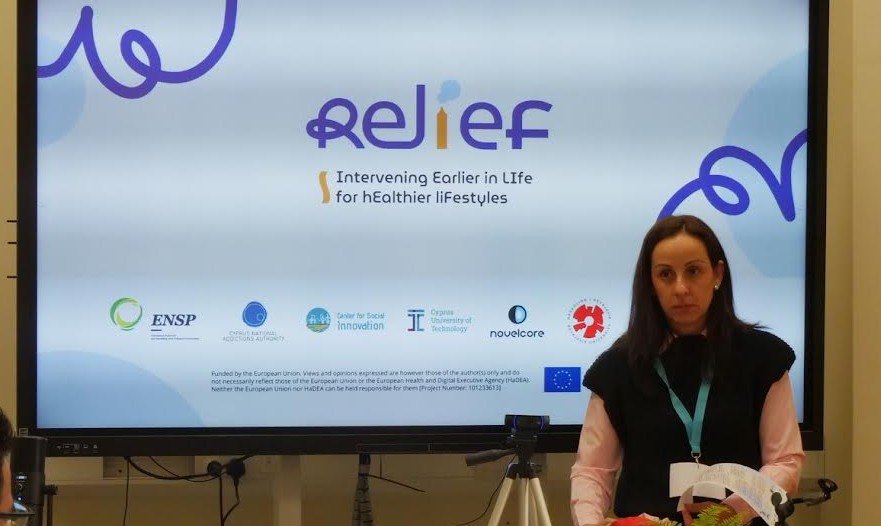 Pola Proestou presents the RELIEF program
We need to support them in formulating attitudes and improving understanding. In the framework of the project, a survey will be carried out with children, parents and teachers in order to understand perceptions, knowledge gaps and attitudes towards the newly emerging tobacco products. Existing European Union initiatives will also be listed. The project will include a digital platform designed for knowledge sharing and training, which will act as a central hub where teachers, parents and professionals can access resources, educational materials and current information from across Europe. Awareness campaigns will be designed to inform children and adults, using messages based on scientific evidence. Our goal is not to cause concern, but to inform and empower. We seek to offer the necessary skills to resist peer pressure."
We note that in the publication of the Guide with the clinical guidelines for smoking cessation presented by the pulmonologist Dr. Michalis Toumbis and the registered clinical psychologist Professor of the University of Cyprus Dr. Maria Karekla, it is stated that "medications are not indicated as a first-line option (lack of research) for adolescents, except in cases of severe, documented dependence. Cognitive-behavioural psychological therapy (CBT) has shown the greatest effectiveness in successfully quitting smoking. In particular, the new digitized CBT interventions are more attractive to young people." Making recommendations for the implementation of the Smoking Cessation Guidelines, they particularly stressed the need to inform and educate all involved groups of professionals and to evaluate current activities in relation to the proposed guidelines.
As they said, "it is necessary to identify the bodies that need to change their ways of working and to identify the key areas that need help in order to be able to implement the guidelines".
