
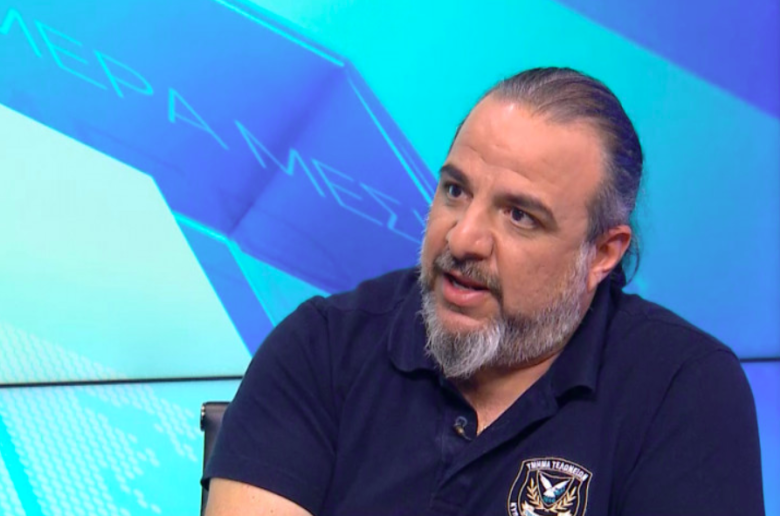
From the wild animals and snails in 2003 that were illegally traded through the occupied territories when the barricades were opened, we reached tons of tobacco products, fuel and animal products to undeclared cash. The seizures of cigarettes, drugs, cash by the Customs Department have skyrocketed in the last three years, whether they concern airports or barricades. A typical case is the case of cigarettes and heated (vaping) where, while in 2023, 3.6 million cigarettes were confiscated. pieces reached 23 million. pieces in '25, that is, in two years. The spokesman of the Customs Department, Giorgos Konstantinou, was revealing in an interview with "F", after he spoke about networks with four branches behind the trafficking of tobacco products that leave the occupied territories and end up in Europe.
At the same time, vehicles through special routes end up in the EU without paying customs duties, while the fear of the Customs is the import of complex drugs unknown until now.
– Recently, there has been an intense activity of the Customs Department in many areas of action. What is the reason for this, the increase in illegalities or the more intense activation of the Department?
– First of all, we should note that the Department of Customs in general is a government Department with a multifaceted task, which deals with the safeguarding of public revenues (in duties, consumption taxes and import VAT) on the one hand and the service of legal trade in combination with the safety and protection of society on the other (through targeted controls of products imported or exported to and/or from our country). Therefore, over time, the Department of Customs has shown a rich field of action and significant results, with the difference that in the last 2-3 years it has a stronger presence in the media and social media with the aim of communicating with the people and publicizing and communicating this work to society.
However, it should also be noted that the significant results demonstrated by the Department on a daily basis are due to a combination of factors related to the development of techniques for information collection and evaluation and risk analysis, the continuous education and training of the Department's staff, the use of modern technological means as well as the daily cooperation at national, European and international level with other competent services, law enforcement agencies and authorities.
– The blows of the customs officers are on many fronts, which shows an unprecedented increase in illegalities, mainly through the occupied territories. Where is this attributed?
– The Customs Department has a 24-hour presence, 7 days a week at all entry and exit points of the Republic of Cyprus, in order, as I mentioned above, to ensure public revenues as well as the protection and safety of society. In order to achieve this goal, it is imperative that the necessary checks are carried out, as provided for by national and European legislation, on air and sea cargo of goods as well as passengers passing through the points of entry and exit of the Republic of Cyprus. These checks include both document checks and accounting ex-post checks as well as physical checks of cargo, baggage and means of transport and in many cases even checks of premises and/or houses (with the relevant issuance of search warrants, where required).
Since 2003 and with the gradual opening of various crossing points from the occupied to the free areas of the Republic of Cyprus, our Department, in addition to the traditional usual controls carried out by all Customs Offices in the world, has been designated as the competent authority for the supervision and proper implementation of the Green Line Regulation, which determines the rules and approved points for the passage of goods, persons and vehicles from the areas that are not under the effective control of the Republic of Cyprus. It is therefore understood that always motivated by money, easy profit and economic benefit, the occupied areas are a more easily accessible market, for people involved in smuggling, for the supply of tax-free and duty-free tobacco products and fuel mainly and their illegal distribution and marketing then in the free areas. It should be further emphasized that our presence at the approved crossing points, in addition to safeguarding public revenues, has the capacity of ensuring the passage of only those goods provided for by the Green Line Regulation and which do not endanger the safety and health of the citizens of our country. For this reason, the officers who staff the crossing points carry out daily checks to determine that no narcotic substances, animals or animal products, specific agricultural products that are considered dangerous for the transport of diseases, pesticides, products that violate Intellectual Property Rights (imitations), products that are considered dangerous to the environment, goods that do not meet specific European safety standards, etc.
– Animal smuggling with the occupied territories has always been at the forefront. What efforts are being made in view of foot-and-mouth disease?
– The effort made by the Customs Department is at least at the approved crossing points, where it has a continuous presence, to carry out all the necessary checks to prevent the passage of animals or animal products through the occupied areas, as expressly prohibited by the Green Line Regulation. However, recent experience has shown that due to the nature and volume of these products or animals, it is very difficult for someone to channel them through the approved crossing points, which is why this form of smuggling seems to be carried out from non-approved points, the storage of which does not fall within the competence of our Department.
– A "wound" that remains concerns the passage of Greek Cypriots to the occupied territories for the supply of fuel for commercial reasons. What actions are you taking and what are the consequences of a person who has been proven to do so for commercial purposes?
As I mentioned earlier, fuel, as well as tobacco products, as excise goods, are the most frequently seized goods on a daily basis. The controls are more intense and targeted especially at commercial vehicles (trucks, buses, vans, etc.), which have a larger amount of tanks than usual and there is greater consumption due to the commercial use of the vehicles. In such cases, both the vehicle and the fuel are confiscated and accordingly, either a case file is filed and the case is brought before a court, or a proposal by the person involved for an out-of-court settlement with the payment of high fines for the offenses, depending on the quantity and frequency of the violations, but also for the return of the confiscated vehicles, is accepted. It is pointed out that the fuel is in no way returned to those involved, it is removed from the tanks and follows a destruction or recycling process in cooperation with licensed companies for this purpose.
Movement of cash from country to country
– Recently, we have seen an intensification of efforts for a new type of illegality, which concerns the transfer of cash from the occupied territories to the areas controlled by the Republic. How did this type of customs offense come about, which may also refer to other types of offenses?
– It is understood that the risk of transferring cash, which may constitute proceeds from illegal activities, is particularly high when they are transferred from the occupied areas. For this reason, on the first point, on which the Republic of Cyprus can exercise effective control, the responsibility lies with the Customs Department for the detection and investigation of such illegal cash flows.
We should underline the obligation of citizens who transport sums of money equal to or greater than the value of €10,000, in cases where they have transferred them from the closed ports and airports of the Republic of Cyprus to the occupied territories, during their movement from the occupied to the free areas, to declare them to the officials of the Customs Department and to be able to justify the origin, but also their intended use with relevant supporting documents or documents that support their claims. When these are detected by the officials of the Customs Department and are not declared, they are confiscated and a relevant investigation follows.
The control and presentation of relevant supporting documents and documents also concerns cash transferred by persons who have acquired them in the occupied areas. In the event that satisfactory explanations are not given or relevant testimony is not provided about their legal origin, they are withheld for further investigation, which is carried out in cooperation with other law enforcement authorities.
– Similar cases were discovered at airports, i.e. the transfer of undeclared thousands of euros that may be a source of money laundering. What steps is the Customs Department taking to identify such cases and whether MOKAS was also involved?
– The control of the movement of cash has been carried out since the establishment of the Republic of Cyprus. Illicit and illegal transactions are carried out in cash and those involved in them try to transfer them from the countries where the transactions take place to the countries where the organized criminal groups are located and operate, trying to conceal the illegal source of the proceeds by trafficking from country to country. For this reason, the Customs Department carries out checks at the entry and exit points of the Republic to identify such cases, i.e. undeclared cash reserves, as well as to record and process the data on cash declared by passing passengers at ports and airports, for possible future investigations. In cases of undeclared cash and/or suspicious transfer declarations, in which they are not supported by accompanying documents indicating their source and intended use, the cash is withheld or confiscated and an investigation process is followed in cooperation with other services such as MOKAS and the Police.
The financial profit behind the smuggling of tobacco products
-We can say that the number 1 type of smuggling today concerns tobacco products. What are the consequences if someone is found to be in possession of quantities illegally and why, despite the cases, do smugglers of this kind continue undeterred?
– If the measure of comparison is the number of cases or the number of seized goods, then perhaps yes, this assumption that cigarette smuggling is perhaps the main form of smuggling of the Customs Department can be accepted. Taking into account in particular the special situation of our country with the illegal supply of tobacco products from the occupied areas, there has been an upsurge in this type of smuggling in recent years. There are two phenomena or two trends with the flows of smuggled cigarettes from the occupied areas:
One flow concerns the individual cases of people who go to procure small quantities of tobacco (1-5 cigarette boxes) for personal use and who are handled at the crossing points by the respective officers with the confiscation of tobacco products and the out-of-court settlement of the offenses committed.
The second flow concerns the activity of organized smuggling groups with four different circuits: One channels illegal duty-free tobacco products to the market of the free areas of the Republic of Cyprus through organized networks of their supply, transport (mainly from unapproved crossing points) and distribution. The second seems to be systematically active with the organization and transport of tobacco products through Larnaca and Paphos airports to illegal markets, mainly in the United Kingdom, in travel luggage. The third ring also channels duty-free tobacco products from the occupied territories through packages of courier or post companies to various countries in Europe and the United Kingdom. Finally, the fourth ring, which has been observed for the last 2-3 years, seems to be channelling tobacco products from the occupied areas to the illegal market of Israel, by transporting the tobacco products in boats and ships from the coast of the Republic of Cyprus to the coast of Israel.
In all of the above cases, when large quantities of tobacco products are identified and confiscated, an investigative process is initiated which is completed with the preparation of a case file for the parties involved to appear before a court. During this process, the parties involved have the opportunity to propose an out-of-court settlement of the case with the payment of a monetary payment as a compromise amount, which the Director of the Customs Department has the discretion to accept or reject in accordance with the Customs Code Law and after taking into account a set of factors related to each case separately, such as the quantity and types of confiscated tobacco, the frequency of involvement of suspects in cases, the conditions of seizure, etc. It is noted that means of transport are also confiscated, in cases used for the distribution and transport of tobacco items, which can later be returned to the owners with the payment of an additional amount of return in contrast to the confiscated tobacco, which follow the destruction procedure in companies licensed for this purpose. To your question why smugglers continue to do so undeterred, despite repeated seizures, the reason is easy financial gain.
The illegal and clandestine purchase of tobacco from the occupied territories unfortunately provides the possibility of obtaining a great financial benefit to those who commit it and that is why they continue their activities even if they pay large amounts of fines in cases of detection and conviction by the Court.
The scam is not limited to luxury cars from Britain
– Recently, the Customs Department informed the European Public Prosecutor's Office about a racket with luxury vehicles from Britain. What exactly was found and where is the case?
– The racket of luxury (and not only) vehicles from Britain has two aspects. The first main one concerns the serious undercutting of vehicles, which takes place when they are first imported into other Member States (mainly the Netherlands and Bulgaria) and the second also serious aspect concerns the submission and use of false and/or false documents and supporting documents for the payment of duties and taxes in another Member State. Because the offences have not been committed in Cyprus and essentially involve a loss of revenue in the European Union, the Customs Department informed both the European Anti-Fraud Office (OLAF) and the European Public Prosecutor's Office (EPPO) from the first moment this fraud was detected. The case is still under investigation. It should be mentioned that the scam is not limited only to luxury cars from Britain but also to common vehicles (saloons or SUVs) that often circulate on the roads of the Republic of Cyprus.
-An attempt to make Cyprus a cemetery of old vehicles from Britain was also established, that the Department prevented. Customs?
– This is a phenomenon directly related to the previous question, since it is done in combination with the devaluation of vehicles that exceed 5 years from the first registration, which after their import in other Member States follow a registration procedure in other EU countries (mainly Bulgaria), now acquiring an EU character and thus circumventing the existing national legislation on the prohibition of importing vehicles beyond 5 years from third countries. This matter falls within the competence of the Department of Road Transport.
We are concerned about the increase in drugs
– The Department's successes in combating drug trafficking are almost daily. Together with YKAN large quantities are identified. Has it established what is the profile of those who transport drugs to our country?
– The smuggling of drugs and the prevention of their import from the entry/exit points of the Republic are high on the priorities of the Customs Department, since it is also one of the most important challenges facing society which we must protect. The close, intense and daily cooperation that has been developed with YKAN in recent years seems to be paying off significantly, since through the exchange and evaluation of information, but also through joint actions and operations that we carry out on various fronts, it seems to lead to a sharp increase in seizures of both the Customs Department and YKAN. Cyprus, through the seizures recorded, seems to continue to remain a destination mainly for traditional drugs, such as cannabis and cocaine, however in recent years we are concerned about the detection and circulation in the Cypriot market of new synthetic psychotropic substances in various forms that are very difficult to detect and confiscate. As for the profile of the transporters, it is difficult to outline, since the transports are carried out by persons of all genders, ages and nationalities, so as an element alone it does not help to identify. What is done is a combination of data and information that is collected, analyzed and processed and with the necessary coordination between the two services, dangerous loads and suspicious passengers for transport are identified and checked.
