
FORMER DEPUTY CHIEF OF THE NATIONAL GUARD 'GREEE TOOK TURKEY BY SURPRISE' - ASSOCIATE PROFESSOR MARIOS EFTHYMIOPOULOS ANSWERS HOW CYPRUS CAN REMAIN SAFE - Filenews 8/3 by Ernest Moussas
When last Sunday night the Prime Minister of the United Kingdom announced the granting of permission to the United States to use the British Bases to strike Iranian missile depots, the questions that hovered were many. Before Keir Starmer's statement was even interpreted, an unmanned aerial vehicle hit Akrotiri Base, causing damage, the true extent of which we may never know.
The following days proved that the incident was not isolated, nor did the drone arrive in Cyprus due to a mistake or failure of those directly involved in the war in our neighbourhood. A little over the clock and a little later, the interception of two more drones heading to the Bases in Akrotiri followed, while the sirens in the area sound almost daily.
The situation in Cyprus is unprecedented. Despite the long-standing concern about the presence and role of the British Bases in Cyprus, this is the first time that it has been a direct military target for hostile forces in the region.
Developments have brought the issue of the Bases back to the forefront, since the Republic of Cyprus, without having the slightest involvement in the Middle East conflict, is exposed to risks that go beyond its own intentions and decisions.
The former Deputy Chief of the National Guard, Lieutenant General Loukas Hatzimichael speaks to "F tis Kyriakis" about how Greece surprised Turkey and managed to fill the power vacuum in Cyprus after the developments of the last week.
For his part, Associate Professor of International Security & Strategy at Vytautas Magnus University in Lithuania and Director of the Strategy International (SI) think tank, Marios P. Efthymiopoulos, responds to how Cyprus can ensure its security, since the war now threatens even its own territory.
European mobilization
Tensions in the region have prompted an unprecedented mobilization of European forces around Cyprus, following performances by Nicosia, which currently holds the EU presidency.
Greece made the start, showing the way to other friendly countries towards Cyprus. The Greek government of Kyriakos Mitsotakis has sent to Cyprus two pairs of F16 Fighting Falcon fighter jets, which are stationed at the Andreas Papandreou Air Base in Paphos. About 24 hours later, the pride of the Greek navy, one of the best frigates in Europe, the "Kimon", arrived in Cyprus, accompanied by the frigate "Psara". Combined, the two frigates offer a multi-layered defense grid, with "Kimon" covering long-range air defense and "Psara" enhancing protection against drones and shorter-range threats.
The United Kingdom has announced the dispatch of the destroyer HMS Dragon to the Eastern Mediterranean and its arrival is expected within the next week, while it has also sent the AW159 Wildcat helicopters for surveillance and support missions. The mobilization of the British is clearly aimed first and foremost at the defense of the Bases, but by extension the defense of the Republic of Cyprus is also favoured.
France's mobilization was also noticeable, with Emmanuel Macron announcing in a speech on Tuesday the dispatch of the frigate FS Languedoc, which has already arrived in the region. At the same time, Paris has ordered the aircraft carrier Charles de Gaulle to sail to the Mediterranean, as part of the strengthening of France's military presence due to developments in the Middle East.
Other European countries are moving in the same spirit. Italy, Spain and the Netherlands have announced that they will send naval assets in the coming days to strengthen security around Cyprus, Italian Defense Minister Guido Crozetto said.
Already, following a French request, the Netherlands is considering sending the frigate HNLMS Evertsen as an escort to the French aircraft carrier. At the same time, the Spanish Ministry of Defense announced the mission of the frigate Cristóbal Colón, which will participate in protection and air defense missions, while it will also be able to contribute to possible operations to evacuate civilians from the area.
It is worth noting that the coordination of the operations of the European military forces located in Cyprus will be undertaken by the General Staff of the National Guard (NGGS). The British will be guided by the Bases.
This mobilization creates an informal network of deterrence around Cyprus, which until a few days ago seemed unthinkable. The presence of European warships and aircraft strengthens deterrence in the Eastern Mediterranean, but at the same time comes to remind us of the close connection between the security of the Republic of Cyprus and the activities of the British Bases, which are territorially located in Cyprus, but practically do not account to anyone.
Lieutenant General Lucas Hadjimichael: "Cyprus is no longer lying long"
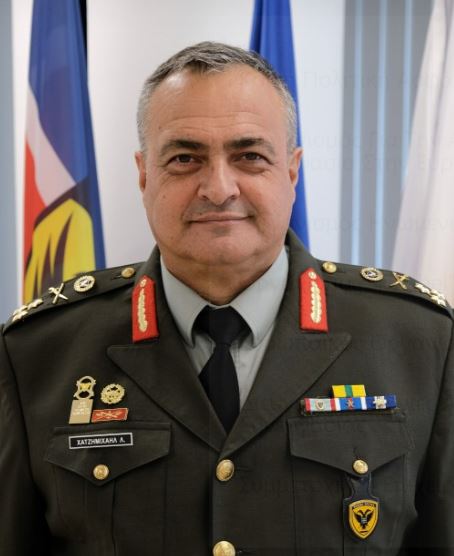
"We have hopefully entered an era in which we are experiencing unprecedented events, both in Cyprus and in the wider region of the Eastern Mediterranean and the Middle East. Events, which for some, were more or less expected, for others, more romantic, were delayed by a few decades.
And I am certainly not referring to the joint decision of the USA and Israel to end once and for all, on the one hand, Iran's nuclear program, and on the other hand, one of the main, permanent threats in the entire region and beyond, transforming, if possible, a strictly theocratic Islamic state into a secular one, which it had until 1979, but to the fact that "Cyprus is no longer lying long", without of course overlooking the silent partial application of Article 42.7 of the EU Treaty, which is, by the way, a consequence, but also a significant success, of the diplomatic skill of the Republic of Cyprus, of which the Cypriot Government itself remains the representative. At the same time, he highlighted, in a largely desperate era for Cyprus and a personality, which, if nothing else, gives real hope in ensuring the territorial (that is, what is left) integrity of the Republic of Cyprus and makes everyone known, who fully understands geopolitics and who, are simply content to comment from the safety of the sofa.
Cyprus is a European territory and at the same time a strategic hub of the West. In geopolitics, especially in today's era, there are "player" states, which determine or guide developments. There are no gray areas. There are spheres of influence and between them, a power vacuum is sometimes created. And the gap is always occupied by someone else or if you want by the most case-by-case, decisive "player", who in the end shapes the framework.
But let's take what is happening, on the basis of a chronological development. As part of the reaction of Iran and its few, active allies for the time being, to the air invasion of the US and Israel, Iran through Hezbollah struck the British Bases in Akrotiri with a drone on the night of March 1.
Greece, reacting immediately, did what all serious states do. It produced deterrence! It made use of the dusty Greece-Cyprus Doctrine, abandoned from the beginning of the21st century, and entered the game with great determination, before others did. It sent to Cyprus two pairs of F-16 fighters and two of its very important weapon systems, the frigates "KIMON" and "PSARA". And most importantly, it erased before they were even created, any thoughts of protecting the vacuum that would be created in Ankara. This time, Turkey, even one of the few, was taken by surprise. And he was surprised by the determination and immediate reaction of the Greek Prime Minister Mr. Konstantinos Mitsotakis.
At the same time, it forced Europe to follow, intentionally or not, Article 42.7 (if a member state is attacked with an armed attack on its territory, the other member states must provide it with all the means at their disposal). After Greece, France, Germany, Italy, Spain, the Netherlands and panting Britain, sent or expressed their intention to send their forces to protect Cyprus.
History has always proven something very important. When you are absent from the crises that are formed or shape the correlations of forces, you trap yourself in the non-aligned and neutral and you are subject to any negative consequences, your neutrality incurs. Of course, historically, there have also been astute neutrals (see Turkey), who have been fortunate enough to receive a significant geostrategic and geopolitical upgrade (at least until today), but the rule remains unchanged.
For Greece, it is important that it is now shaping situations. For Cyprus, it is even more important that, after the era of the unforgettable Konstantinos Karamanlis, "Cyprus lies long", it has finally passed, hopefully irreversibly, into the hopeful era of Mitsotakis-Dendias of "lying near".
Dr. Marios Efthymiopoulos: How Cyprus ensures its security when war comes to its region

"The escalating crisis around Iran has radically changed the operational and geopolitical environment of the Eastern Mediterranean. Missile attacks, unmanned systems, targeted strikes and increased military mobility create a highly fluid environment. The spillover of the conflict is not limited to the states directly involved; It affects maritime routes, energy flows, transport insurance premiums, investment climate and broader regional stability. In this context, Cyprus, due to its geographical location and the existence of strategic infrastructure, cannot be considered a neutral observer. Even if it does not choose to engage, the war can affect it directly, indirectly or hybridly.
The answer cannot be fragmentary or circumstantial. A holistic national security strategy with a long-term horizon and institutional consistency is required. Strategy first — then armaments. The strategy must precede and define doctrine, force structure, readiness levels, training standards and procurement directions.
The upgrade must concern all forces: military, police, port, civil protection and intelligence services. The preparation must cover both conventional and non-conventional scenarios. The modern threat includes drone saturation operations, missile threats, cyberattacks on critical infrastructure, disinformation operations, and economic coercion.
A key tool is the institutionalization of systematic strategic forecasting. The state must operate with multi-layered scenarios: supply chain disruptions in fuel, food and pharmaceuticals; pressure on wealth-producing sources and energy facilities; a crisis of water resources and desalination infrastructure; mass migration or humanitarian flows.
Security is now interdisciplinary and cross-sectoral. It connects logistics, energy, water, economy and defense into a single grid of state resilience. Without a resilient supply base and energy sufficiency, no military capability can function effectively.
At the same time, military adaptation is required: strengthening of anti-aircraft and anti-drone defenses, interoperable command and control (C2) systems, joint exercises and the adoption of NATO standards at the level of doctrine, training and equipment. Interoperability is an operational necessity.
The creation of a National Security Council, the upgrading of clearance procedures in critical positions and a multi-year budget that supports technology and skilled human resources are the foundations of sustainable security.
In the new era, deterrence is not just military power. It is the ability of a state to continue to operate under pressure, protect its infrastructure and maintain its institutional cohesion. For Cyprus, security is a matter of national survival and strategic maturity."
The British Bases and the "Mauritius" gun
The debate on the status of the British Bases in Cyprus is now more relevant than ever. Keir Starmer's statement that his country has granted the US permission to use British bases for operations against Iranian missile depots put the territorial integrity of Cyprus at risk and reminded us all of the consequences that their operation can have. The scenario of the Bases leaving Cyprus is not realistic, for many reasons explained by various analysts in the 24 hours that followed the drone strike in Akrotiri. What seems feasible is to raise the issue of renegotiating the status of the Bases and the modernization of the conditions under which they will be able to operate on the territory of Democracy. This is what the former Attorney General of the Republic, Costas Clerides, proposes.
Nicosia even has a very important tool in its hands, which could act as an important lever of pressure. The opinion of the International Court of Justice in The Hague on Mauritius, which was ratified by the General Assembly of the United Nations. Mauritius faced a similar situation after the colonial period, when the United Kingdom kept control of the Chagos archipelago. The Hague Tribunal in 2019 ruled that the country's decolonization was not legally completed, as the UK retained control of the Chagos. This was followed by a resolution of the UN General Assembly calling on London to end the colonial administration of the archipelago. Although the issue has not yet been fully resolved, international pressure on Britain has increased significantly.
The case of Cyprus is yet another example of incomplete decolonization, as defined by the UN bodies. And everything we have been experiencing in the last week reminds us of it in the most inelegant way.
