
FERTILITY RATES ARE GETTING LOWER AND LOWER IN EUROPE - WHICH COUNTRIES HAVE THE BIGGEST DROPS AND THE POSITION OF CYPRUS - Filenews 24/3
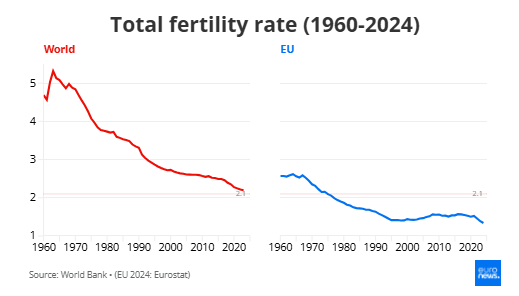
The overall fertility rate in the European Union, which reflects the number of births per woman, has fallen to its lowest level in more than six decades. The rate has almost halved in the last 60 years, falling from 2.62 in 1964 to 1.34 in 2024.
The overall fertility rate fluctuates widely across Europe in 2024, ranging from 1.01 in Malta to 1.72 in Bulgaria within the EU. Cyprus is in 26th place on the list out of a total of 42 countries, with the number of births per woman at 1.38.
So which countries have the highest and lowest Total Fertility Rates (TFR) in all of Europe?
Which countries have seen the biggest declines in fertility rates? What factors lead to these reductions?
TFR in the EU has been below the replacement level of 2.1 births per woman since the mid-1970s, according to the World Bank.
The EU is not alone: A global decline in fertility
"What we are seeing in the EU in terms of TFR reduction is generally what would be expected based on the theory of demographic transition, according to which access to education, contraception and a range of other interdependent variables affect fertility trends and population composition over time," a World Health Organization (WHO) spokesperson for Europe told Euronews Health.
The spokesman stressed that the EU is not an isolated case, according to euronews.
The number of countries and territories worldwide with a fertility rate (TFR) below the replacement level of 2.1 is projected to increase from about half in 2018 (103 out of 204) to 155 by 2050 and to 198 by 2100, exceeding 97%.
According to Eurostat, of the approximately 40 European countries on the list, all are below this level as of 2024.
Montenegro has the highest fertility rate with 1.75, followed by Bulgaria (1.72), Georgia (1.69), Albania and Serbia (both with 1.64).
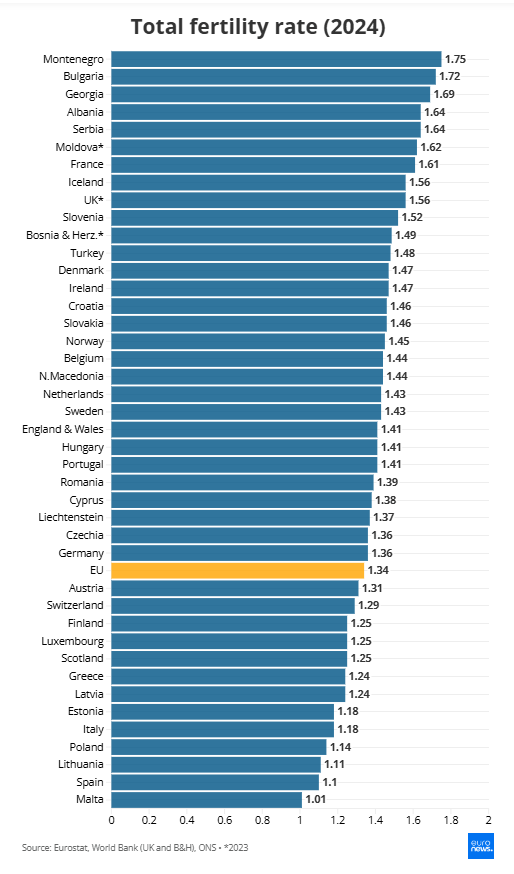
France has the highest fertility rate among Europe's major economies, at 1.61.
The UK (1.56) is close to this level, although the most recent data available is from 2023 and may be lower for 2024. In England and Wales, the figure is lower, at 1.41, according to the ONS.
Germany is just above the EU average, at 1.36.
Spain (1.10) has the lowest fertility rate not only among the largest economies, but also the second lowest overall, closely followed by Italy (1.18).
In Turkey, the most populous country among EU Member States and candidate countries, the fertility rate stands at 1.48 after a significant decline over the past decade.
In the Nordic countries, Iceland (1.56) ranks first, followed by Denmark (1.47), Norway (1.45) and Sweden (1.43). Finland (1.25), however, has a lower rate, which is below the EU average.
Among other countries, the number of births per woman is 1.24 in Greece, which places our country in 8th place from the bottom.
Why do fertility rates differ in Europe?
"Explaining transnational differences in fertility remains difficult, especially since many factors that previously explained differences between countries seem to have faded in recent years," said Dr. Julia Hellstrand from the University of Helsinki.
"For example, Nordic countries with comparatively generous family policies have also seen a very sharp decline in fertility, suggesting that political support alone cannot explain current trends."
Do policies help maintain high fertility rates?
The WHO Europe representative noted that, in addition to education and access to contraception, factors related to affordable housing, housing size, mortgages, the cost of having and raising a child, the ability to balance work and motherhood, among other socioeconomic parameters, influence people's reproductive decisions.
Many governments have implemented multidisciplinary policies to allow people to realize their fertility preferences.
Examples include direct payments for having children, tax benefits, subsidised childcare and parental leave.
"However, data on the extent and consistency of the effects of these interventions on the total fertility rate (TFR) across Europe is uncertain," the spokesperson said.
Age difference of first birth across Europe
Hellstrand also pointed out that in Northern and Western Europe, the decline in fertility below the replacement level and the postponement of childbearing began earlier, as early as the 1960s, and these countries now have a relatively high average age of first birth.
In contrast, many Eastern European countries experienced these changes later and still have a somewhat lower average age of first birth.
Change in fertility rate in the last 10 years
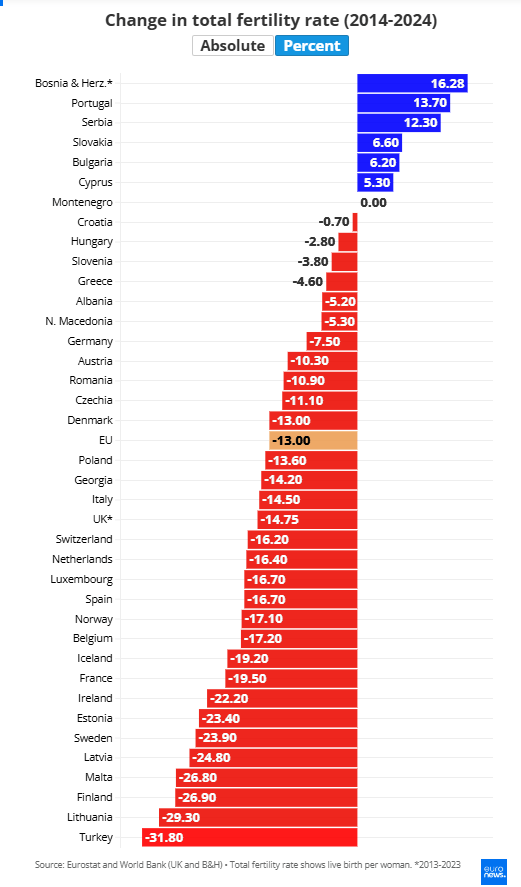
Looking at how fertility rates have changed over the past decade, from 2014 to 2024, only a few countries recorded increases, while many experienced significant decreases. In the EU, the index fell from 1.54 to 1.34, a decrease of 0.20 in absolute terms.
Turkey stands out with the largest drop, by 0.69 in absolute numbers, or 32 percent, falling from 2.17 to 1.48.
The drop also exceeded 0.35 in several countries, including Finland and Lithuania (both 0.46), Sweden (0.45), Ireland (0.42), Latvia (0.41), France (0.39), Iceland and Malta (both 0.37), and Estonia (0.36).
"In Finland, fertility has suffered one of the steepest declines in Europe, a development that is often seen as puzzling, given the country's relatively strong family policy framework," Hellstrand said.
"The ideals of not having children have become more common"
He stated that between 2010 and 2024, the decline in fertility was mainly due to the decline in first births, which account for about 82% of the total decline.
"At the same time, ideals of living without children have become more widespread, although research evidence suggests that many individuals end up having fewer children than they would ideally prefer," he added.
The absolute decrease was 0.27 in the United Kingdom, 0.22 in Spain, 0.20 in Italy and 0.15 in Germany.
"Some countries, such as those in Southern Europe, already have such low birth rates that it is difficult to reduce much more," Professor Eva Beaujouan, from the University of Vienna, told Euronews Health.
Over the same period, Bosnia and Herzegovina recorded the largest increase, by 0.21, followed by Serbia (0.18), Portugal (0.17) and Bulgaria (0.10).
