
In a development that causes intense concern to local authorities and the tourism industry, the Environmental Authority issued a negative opinion on the grandiose plan for the protection and improvement of the coastal front "Pantahou – Glyki Nero".
This decision essentially freezes the construction of the planned breakwaters, leaving the popular beach of Ayia Napa exposed to the phenomenon of erosion.
This negative development directly affects the part of the coast where some of the largest hotel units in the area operate. In particular, the lack of protective works leaves the coastal front in front of the hotels unprotected: Karousos Beach, Grecian Bay Hotel, Melissi Beach Hotel, Grecian Sands Hotel, Atlantica Sungarden Beach, Alion Beach.
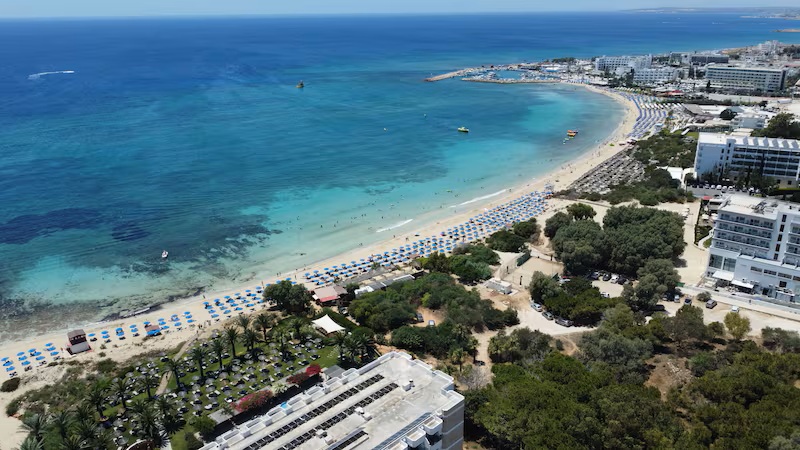
According to the Department of Public Works, the area, which extends over a length of 1.6 kilometers, already shows serious signs of gradual sand drift and retreat of the coastline, resulting in the revelation of pebbles and rocks, which degrades the tourist product.
The study area consists of two sub-areas, Sections A and B.
• Section A (west): It is 800 m long and extends from the Ayia Napa fishing shelter to the Grecian Sands Hotel.
• Section B (east): It is 800 m long and extends from the Grecian Sands Hotel to the eastern boundary of the study area.
Section A consists of a sandy shore (from the fishing lodge to the Grecian Sands Hotel) and shows a gradual drift of the beach sand, resulting in the retreat of the coastline and the appearance of pebbles and small stones.
Section B is the rocky shore from the Grecian Sands Hotel to the eastern boundary of the study area, which due to its geological composition, shows stability over time and only small point collapses of slope pieces. The radius of potential influence was defined as a distance equal to 1 km.
The main thorn that led to the rejection of the plan is the protection of biodiversity and specifically the Mediterranean Monk Seal (Monachus monachus).
According to the Special Ecological Assessment report issued in February 2025, the construction of the breakwater reef is likely to have significant and irreversible effects on the Natura 2000 site "Cape Greco". The project is only 400 meters from sea caves used by seals for breeding and resting. "The implementation of the project cannot proceed, as the conservation objectives of the Mediterranean monk seal are in immediate jeopardy," the opinion states.
In addition to environmental concerns, the project also ran into practical obstacles. The Geological Survey Department informed the Authority that the huge quantities of aggregates required (approximately 29,100 m3 of natural boulders and thousands of cubic meters of sand – 23,500 m3) are no longer available from the quarries in the area (e.g. Xylofagou), making the design economically and technically suspended.
The Environmental Authority emphasizes that the plan was based exclusively on harsh projects that conflict with the Protocol on Integrated Coastal Zone Management and modern European directives. Therefore, he urges the Department of Public Works to return with a new proposal based on modern European directives for mild interventions, ensuring that the protection of the coast will not be at the expense of nature.
What did the Plan provide?
The "best solution" that was rejected provided:
Breakwater reef 470 meters long at a depth of -2.5 meters. Artificial replenishment of the beach in a length of 710 meters with coarse sand to restore the width of the coast. Total cost of €3.3 million.
With the current situation ("Solution 0"), erosion is expected to continue unabated. Figures show that between 1963 and 2014 the region already lost 22,500 m2 of coastline. Local authorities are now called upon to look for alternative, milder methods of protection that are compatible with the strict protection framework of Cape Greco, in order not to permanently lose the "golden sand" of Ayia Napa.
The 12 reasons for rejection by the Environmental Authority >Environmental risks, technical failures and absence of viable solutions behind the negative opinion
The decision of the Environmental Authority (March 13, 2026) to give a negative opinion on the plan for the protection of Pantachos – Glyki Nero beach is based on 12 specific axes related to the ecological disaster and the failure of the proposed design.
Essentially, the Environmental Authority gives a negative opinion due to the significant, direct but also indirect, long-term, irreversible and cumulative environmental impacts that may arise from the implementation of the proposed Plan.
1. Irreversible impact of marine habitats. The construction would destroy a total of over 16,500 m² of protected habitats, including sandbanks, reefs and valuable Posidonia (Posidonia oceanica) meadows.
2. Danger to the Mediterranean monk seal. The area is adjacent to the sea caves of Ayia Napa, crucial refuges for Monachus monachus. The change in sediment transport (sand movement) may affect the suitability of caves for breeding and lactation.
3. Excavation and bottom disturbance. It was planned to remove 33,000 m³ of material, which would cause massive and permanent destruction of endobenthic and invasive organisms living on the seabed.
4. Alteration of morphology and landscape. The projects would radically and definitively change the physical image and structure of both the seabed and the coastline.
5. Absence of soft solutions. The study focused almost exclusively on "hard" projects (cement/stones), omitting to look at nature-based solutions that are more environmentally friendly.
6. Excessive dimensioning of projects. The proposed reef-breakwater was judged to be too large (20m wide and 4.5m high), requiring huge amounts of natural boulders and sand.
7. Indirect effects from quarrying materials. The need for huge quantities of materials would cause an environmental burden in other areas, while it was found that the existing quarries in the area do not even have the available quantity.
8. Need for constant and harmful maintenance. The plan envisaged continuous sediment extraction from the seabed for the maintenance of the beach, a practice that would be in constant conflict with the marine ecosystem and the balance of the coast.
9. Burden from existing constructions. Already existing illegal or non-illegal structures within the Beach Protection Zone create wave reflections that exacerbate erosion, rather than resolve it.
10. Bird fauna influencing. The area is an important corridor for migratory birds. The works and the change in the environment would affect species that use the rocky coast (SPA area).
11. Destruction of the coastline. Excavating and breaking the natural coastline would destroy the only natural mechanism the area has to stabilize and protect itself from the waves.
12. Increase of sea anemones. There is a serious possibility that the creation of the breakwater will favour the excessive spread of sea anemones, altering the local biodiversity
