Filenews 8 February 2026 - by Marios Demetriou

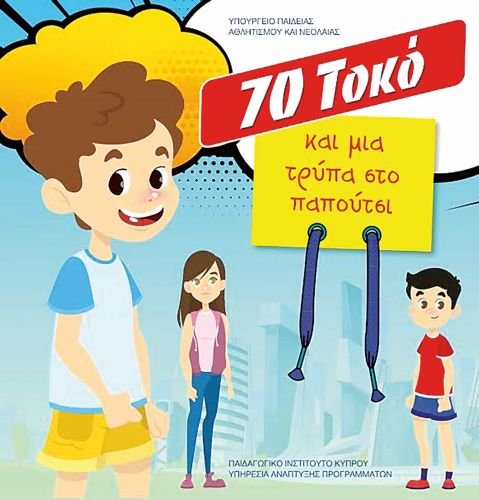
"Through the course of Health Education, the fairy tale "70 Interest and a hole in the shoe" with its educational activities, is expected to be a valuable financial education tool for sixth grade teachers," said Dr. Andreas Milidonis, Professor of Finance at the University of Cyprus Chairman of the Department of Accounting and Finance and member of the Cyprus Committee on Financial Literacy and Education (KEHAP). He was speaking at the training seminar entitled "The "Toko" in the classroom: A workshop on Financial Literacy" held at the ceremony hall of the University of Cyprus (75 Kallipoleos Street, Nicosia) on January 22, 2026. About 150 Primary Education teachers actively participated in the reflection and discussion.
The conference aimed to strengthen financial education in primary education and the pedagogical utilization of the recently published fairy tale "70 Toko and a hole in the shoe" written by the educational writer Maria Loizidou. The professor, who has also contributed decisively to the development of the educational material presented at the conference, added that "the development of skills from a young age related to the prudent management of money (the difference between need and desire before spending), the savings culture and the loan repayment culture, is expected to contribute to the formation of responsible individuals and households for the future". He went on to say that "the political will of the Minister of Education, Dr. Athena Michailidou, to proceed with a significant addition to the Primary School, is expected to change the new generation for the better in relation to the prudent management of money. I also hope for the implementation of the most important action of the National Strategy, the introduction of an independent compulsory course in secondary education. That is, where the contact of students with money becomes more frequent and substantial." We note that the conference was organized by the Corporate Social Responsibility Office of the University of Cyprus in collaboration with the Pedagogical Institute and the Directorate of Primary Education of the Ministry of Education. In addition to Dr. Andreas Milidonis, interventions at the event were made by Menelaos Menelaou, Director of Administration and Finance of the University of Cyprus, the Minister of Education Dr. Athena Michaelidou, the author of the fairy tale Maria Loizidou and Dr. Soula Ioannou, associate inspector of Primary Education Health Education. During the presentation of activities based on the fairy tale, presentations were made by Nikos Nikolaidis, officer of the Pedagogical Institute, Filio Savva, Health Education Consultant and Antonis Papageorgiou, Health Education Consultant. There was also an exchange of experiences from the implementation of the fairy tale in the classroom with teacher Chrystalla Kyriakou as a speaker, coordinated by Theodora Michael Mousioutta, EDE of Primary Education.
Compulsory independent course
The Public Relations Officer and Head of the Corporate Social Responsibility Office of the University of Cyprus, Fotini Panayi, who coordinated the conference, pointed out that "since 2015, the Department of Accounting and Finance and the members of the Teaching and Research Staff of the University of Cyprus have highlighted the importance of financial literacy in a timely manner, with particular emphasis on young men and women. The University of Cyprus – he said – was the first university in the country to approve and include in its curriculum a Financial Education course since September 2020.
This course, an initiative of the Department, was designed by the professors of Finance Stavros Zenios, the late George Nisiotis and Professor Andreas Milidonis with the aim of addressing financial illiteracy and enhancing the financial literacy of students. The educational material developed by Professor Milidonis has already been adopted as a compulsory independent course or workshop in 16 private secondary schools and has also been included as a compulsory independent course in the Mitsi Commercial School in Lemithou, Limassol. As of 2024, an interventional workshop based on this material is taught in all high schools with a duration of 3 hours for A and B Gymnasium and 6 hours for C Gymnasium. The fairy tale "70 Interest and a hole in the shoe" is the first intervention in Primary Education, offering children early knowledge and experiences of financial education.
In this way, the experience and approach of the University of Cyprus smoothly expanded from secondary to primary education, ensuring a cohesive course of financial education for all levels." We note that Professor Milidonis, together with Fotini Panayi as his associate, represented the University in the Ad-Hoc Committee headed by the Central Bank of Cyprus for the formulation of the "National Strategy for the Promotion of Financial Literacy and Financial Education in Cyprus", which was approved by the Council of Ministers in June 2022.
A pound every Monday for 10-year-old Menelaus
The greeting of the Director of Administration and Finance of the University of Cyprus, Menelaos Menelaou, was marked with a personal reference. "I read the book over the weekend and gave it to my 12-year-old son," he said and added. "Reading awakened a childhood memory in me. My mother, Mrs. Rodothea, gave me 20 cents every morning to get something from the canteen. At about 10 or 11 she told me from this year I will give you 1 pound every Monday and do your thing. I must not have listened to the second half of the proposal and at noon on Monday I was joyfully announcing that I had brought change from the pound! I soon discovered that this change should be enough for me for the rest of the week. So sometimes financial education arises through suffering that – at best – becomes lessons. So it is better to learn as much as possible as a procurer in the safe environment of the classroom, rather than in the most difficult way of reality."
The Minister of Education, Dr. Athena Michaelidou, in her own greeting conveyed on her behalf by the Director of the Cyprus Pedagogical Institute, Dr. Elena Hadjikakou, stressed, among other things, that "the cultivation of Financial Education cannot be treated as a fragmented intervention. On the contrary – he added – it requires systematic planning and a long-term approach.
In this context, Cyprus has adopted a National Strategy for Financial Education and Financial Literacy in which the Ministry of Education, Sports and Youth actively participates, both in the planning and implementation of actions related to the school. In the school environment, this strategy is reflected in pedagogical practices that enhance equal opportunities, inclusion and social responsibility, bringing learning closer to children's real-life experiences and supporting the development of life skills from an early age. Today's conference is also of particular importance in the light of the Cyprus Presidency of the Council of the European Union during the current semester. The Presidency highlights education as a key pillar of social cohesion and citizen empowerment, while Financial Education is part of the wider European concern for the formation of active, critically thinking and socially responsible citizens. Today's conference is also a typical example of how the educational policy of our ministry can be implemented in practice through substantial collaborations with institutional bodies such as the University of Cyprus, with the common goal of providing scientific and pedagogical support to teachers. The use of children's literature as a pedagogical tool is of particular value.
Through fairy tales, children can approach complex social issues in an experiential and pedagogically safe way, without being stigmatized, but encouraged to reflect and think critically. In this way, children's ability to understand social phenomena, to take a stand on issues of justice and to form attitudes based on knowledge and reflection and not on stereotypes is strengthened. Teachers are at the heart of this effort. With their pedagogical judgment and their daily role in the classroom, they contribute decisively to the formation of a school that recognizes inequalities and addresses them with respect, sensitivity and pedagogical responsibility."