Filenews 4 January 2026 - by Marios Demetriou

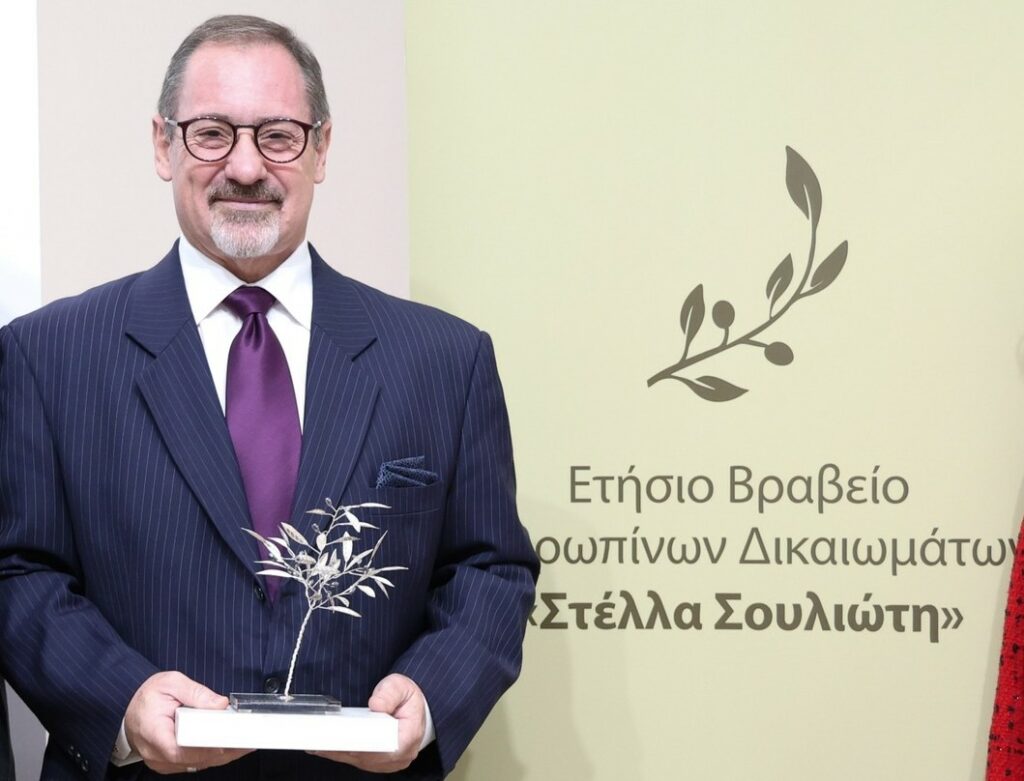
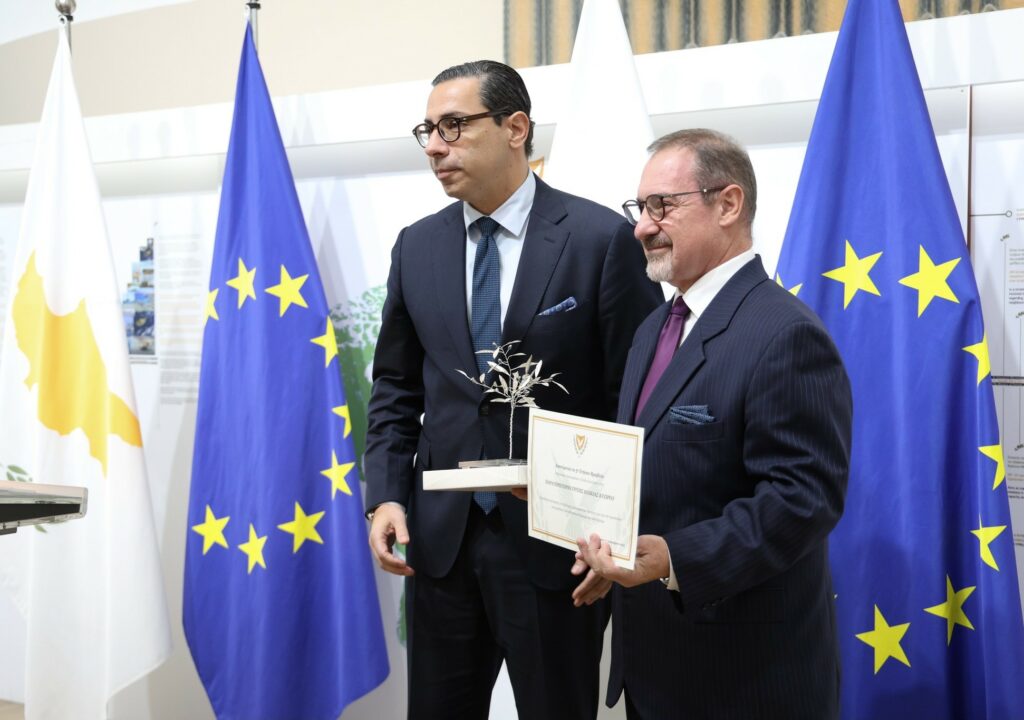
"The Cyprus Observatory for the Elderly is committed to continuing with greater responsibility to advocate for policies that protect, empower and include – for a Cyprus where age does not diminish rights, where the elderly will not be afraid to speak out, abuse will not be silenced, hate speech will not go unpunished, health and rehabilitation will not be the privilege of the few, The mountainous areas will not be abandoned, the generations will not "fight", but will walk together. And, above all, a Cyprus where respect for the elderly will not be an occasional "tribute", but a daily practice of justice. This is the bet of our time. And it's a bet worth winning TOGETHER." The above was emphasized in an interview with "F" by the president of the Observatory, Dimos Antoniou, on the occasion of the awarding of the "Stella Soulioti" Human Rights Award for 2025 to the Cyprus Observatory for the Elderly. The award took place during an honorary event on December 17, 2025 at the Ministry of Foreign Affairs, which established this annual award for the last five years, recognizing and honouring every year, persons and organizations that have distinguished themselves for their contribution to the protection of human rights in our country.
''The Observatory dedicated this award to the elderly of Cyprus, to the parents, to the grandparents, to the people who set up society as we know it and are entitled to age safely, with care and active participation, without fear, without exclusion and without having to constantly prove that they are "worthy", Dimos Antoniou told us. As Foreign Minister Konstantinos Kombos stated, among other things, in his greeting at the award ceremony, "the Cyprus Observatory for the Elderly has dedicated ten years of action and contribution to the elderly, to our parents, grandparents, teachers and mentors, to those who founded the Republic of Cyprus, Cypriot society, the country's economy". He added that the Observatory "has achieved significant results, significantly improving the quality of life of the elderly, to the extent of its capabilities, enhancing the sense of security, dignity and the sense of continuation of their active participation in society".
An institutional reminder to assert rights
As the Municipality of Antoniou pointed out speaking to "F", "the rapid aging of the population has highlighted in recent years more intense issues that should not be addressed piecemeal: ageism racism, exclusion, loneliness, neglect, abuse, difficulty in accessing health and social care services, but also institutional gaps that leave the elderly unprotected against discrimination, whether it manifests itself in the market, either in public space, or even in their own home." He added that the award of the Observatory, which is a non-profit, non-profit and non-governmental organization based in Limassol, "is not a 'finishing point'. It is an institutional reminder that the rights of the elderly are not a secondary social issue, but the essence of our democracy. It is a call to action for dignity, equality and respect for the elderly, because, quite simply, human rights have no age; they do not end when someone retires; they do not shrink because the steps are slower. These rights are not allowed to be lost in silence, nor to fade away behind closed doors."
''It doesn't matter", "that's life", "don't interfere"...
In his greeting at the award ceremony, Dimos Antoniou particularly thanked "the members of the board of directors of the Observatory, the employees and all our partners and volunteers, the whole team that built this course, that learned to persevere, to listen, to work quietly and to bear an incredible burden, without asking for anything in return". He added: "Ten years ago we started with a simple but imperative observation: that many elderly people, while they have given everything – family, work, effort, values – often, even today, end up feeling invisible and often invisible. Loneliness, exclusion, age discrimination, fear, neglect, abuse, economic exploitation. And sometimes, truths that hurt us as a society... Realities that are not easily told, but exist. They exist in our homes, in our neighbourhoods, in the "it doesn't matter", in the "that's life", in the "don't interfere". From then until today, we have tried to do something very specific: to turn sensitivity into action. To give care a structure, support a voice and an answer to human need. To shed light on the dark side of aging – not just to denounce, but to change situations, to inform, to prevent, to empower the elderly, but also to their families. To create spaces and opportunities for participation, creativity and contact, because social connection is not a luxury, it is a prerequisite for mental health and dignity. And if you ask me what our greatest achievement is, I will not just talk about actions, programs or numbers. I'm going to talk to you about that voice on the phone that shakes and says "finally someone heard me." I'm going to talk to you about that woman who smiled again through a group, an activity, a hug. For that man who felt, even late, that he was not a burden. It's history. It's a value. It is presence. And this is, in its purest form, a human right: to be seen, to be respected, to be taken into account."
Hate speech, prevention and health issues
The President of the Observatory expressed his satisfaction with the recent submission of a bill to the Parliament aimed at amending the Law on Combating Certain Forms and Manifestations of Racism and Xenophobia through Criminal Law, so as to criminalize incitement to violence or hate speech against people due to age or disability. This amendment – he said – is a long-standing claim of the Observatory and we welcome this development, as an essential step for a society that does not tolerate the normalization of humiliation, targeting and devaluation." In relation to the issue of prevention, Mr. Antoniou told us that "the Observatory seeks to expand and geographically expand its programs, so that they are accessible to more citizens, starting with the Municipality of Larnaca, in the context of a decision of the National Committee for the Health of the Elderly. This prevention program will operate in the coming months on a pilot basis, following the standards of what the Observatory operates in Limassol." Regarding health issues, he said that "the Observatory cooperates with organized organizations of patients and people affected by chronic diseases, such as OSAK and KISOA, to institutionally raise issues where decisions are made. Health issues – he continued – are not just technical, but concern the right to access, quality, care without financial extermination and ensuring that age or vulnerability will not act as a 'filter' of exclusion from necessary rehabilitation services."
Vehicle insurance: "No" to age penalty
The Observatory calls on the parties to vote for the amendment of the legislation and "not to succumb to pressure from third parties" regarding access to vehicle insurance for older drivers. As Mr. Antoniou underlined in our newspaper, "when a person is financially punished or excluded simply because he is older, then we are not just talking about "insurance policy". We are talking about discrimination with real social consequences. What do we claim as a society of justice? With full respect for the functioning of the market and the need for risk management, the Observatory insists that risk management cannot be turned into a "generalization" and punishment of age. For this reason, at the parliamentary and institutional level, it considers necessary policies that ensure transparency in the criteria for calculating premiums and in the justifications for increases/rejections, evaluation based on real data (driving history, violations, accidents) and not just age limits. A grievance and oversight mechanism with fast-track procedures for the citizen must also be set and rules against indirect discrimination and measures in favour of safe driving (e.g. training programmes, stricter medical/functional assessment) must be set up so that the state enhances safety, without taking away rights. The solution is not to find the "easy culprit", i.e. the elderly driver, but to build a fair framework that protects public safety and at the same time does not lead to social exclusion."
Ageing in the countryside is a geography penalty...
Referring to the "complex challenges" faced by the mountainous and remote areas of Cyprus, the Municipality of Antoniou spoke to us about "fewer services, more difficult movement, greater risk of isolation, difficulty in accessing health and social care and often limited support networks. Ageing in the countryside – he added – should not be equivalent to a "penalty" of geography. Even in European data, it is recorded that older citizens often report a better state of health in urban environments, compared to those living outside cities, an element that highlights the need to close the gap in access to services and infrastructure." Mr. Antoniou presented us with the main recommendations of the Observatory for the mountainous areas, concerning the operation of mobile primary care units for regular visits to communities, with particular emphasis on chronic patients and people 75+, telemedicine and digital support with practical training of the elderly to take advantage of remote appointments (combined with physical presence, where necessary), "neighbourhood" and volunteer networks for vulnerability monitoring and early intervention in cases of danger, with the use of modern safety tools and finally, strengthening mobility (local transport, cooperation with community councils) so that access to a doctor/pharmacy does not depend on a private vehicle. The goal of the Observatory – he concluded – is clear: to avoid a "dipole" between urban citizen and rural citizen, in rights and security."
Documentation and accountability for abuse and discrimination
The president of the organization also referred to the report of the Cyprus Observatory for the Elderly, which records and documents the harsh daily life of many elderly people in our country, speaking to "F". The report concerns, as he told us, "the abuse, neglect, economic exploitation and obvious ageism in Cyprus. The responsibility – he added – is collective and must be assumed by everyone. The state must create protection and early intervention mechanisms, services must have adequacy, training and coordination, society must not "turn a blind eye" and families must seek help in a timely manner and do not allow the burnout of the caregiver to turn into a danger for the elderly. In this context, we have publicly called for the development of mechanisms against violence and mistreatment of the elderly and the institutional shielding of their protection. The Observatory reminds daily that there are forms of abuse that leave no obvious signs, such as neglect, indifference, psychological violence and isolation, and systematically calls for an awakening, because it is not a private issue, but an institutional and social problem, which is often covered up or not recorded. The mistreatment of the elderly in Cyprus is a painful reality that should not be silenced."
Bridging the Generation Gap through Education
Describing intergenerational cohesion as "the backbone of fairer and more sustainable societies", the president of the Observatory recalled his specific proposals to the Minister of Education, with the aim of combating age discrimination through education. "Our proposals," he said, "include a comprehensive framework, such as the inclusion and strengthening of thematic age discrimination in the school curriculum with experiential actions, the training of teachers for age awareness and intergenerational cooperation, the promotion of intergenerational learning with mentoring programs, joint projects of students and the elderly and school events with the participation of people of all ages, the revision of educational material so that to avoid negative stereotypes, digital empowerment programs for the elderly with the participation of younger people in the teaching of basic skills, the creation of digital collaboration platforms that unite generations in common cultural and educational projects".
