Filenews 4 January 2026 - by Andrea Christodoulou

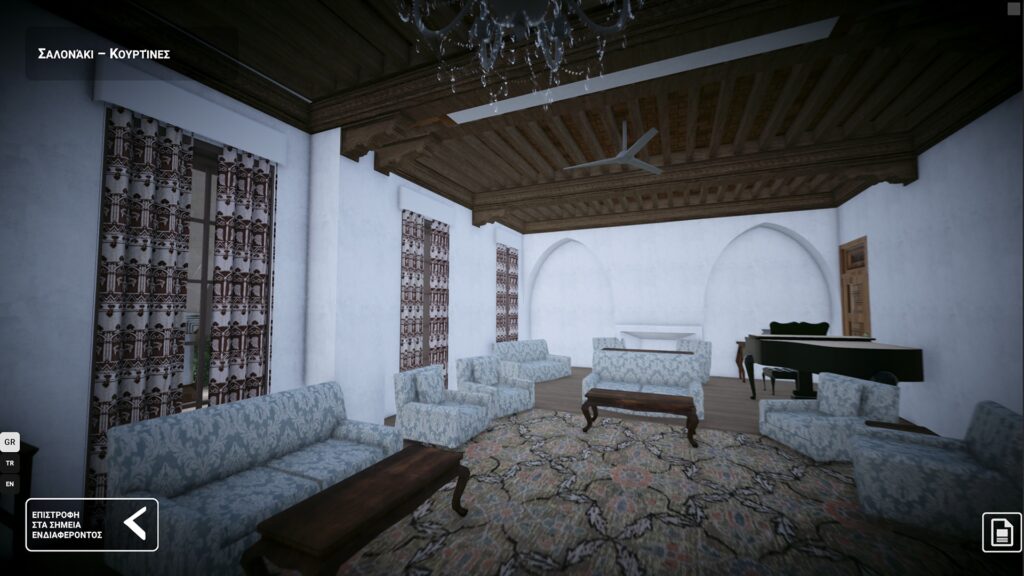
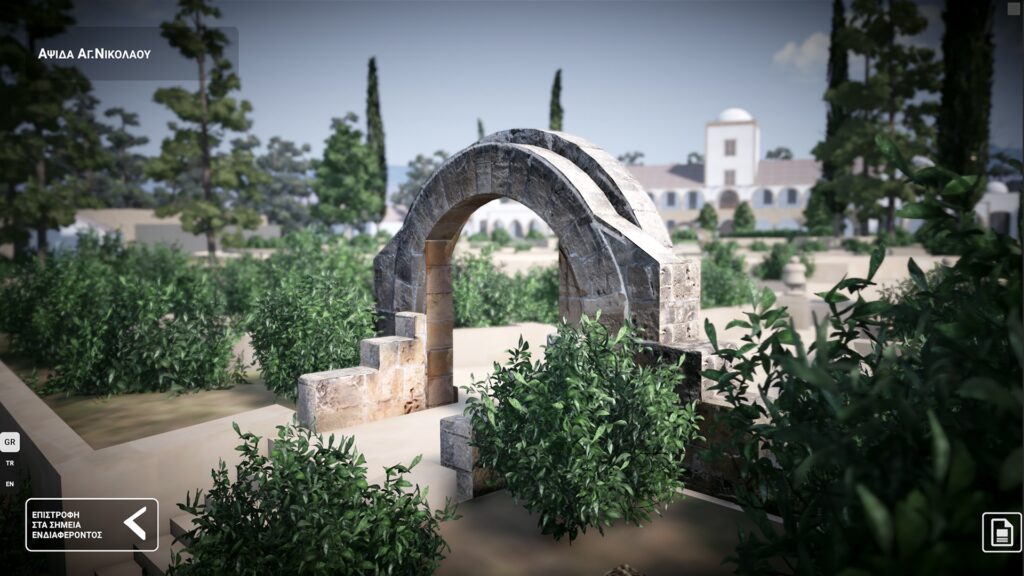
An impressive journey with people and events that determined the course of our country and our people, was created by the experts of the Virtual Environments Laboratory of the Cyprus Institute, who captured the history of the Presidential Palace, from 1878 until today. The creation of the virtual time machine was based on extensive historical research into the architecture of the present Presidential Palace, but also of the Government Palace, which was previously located in the same location.
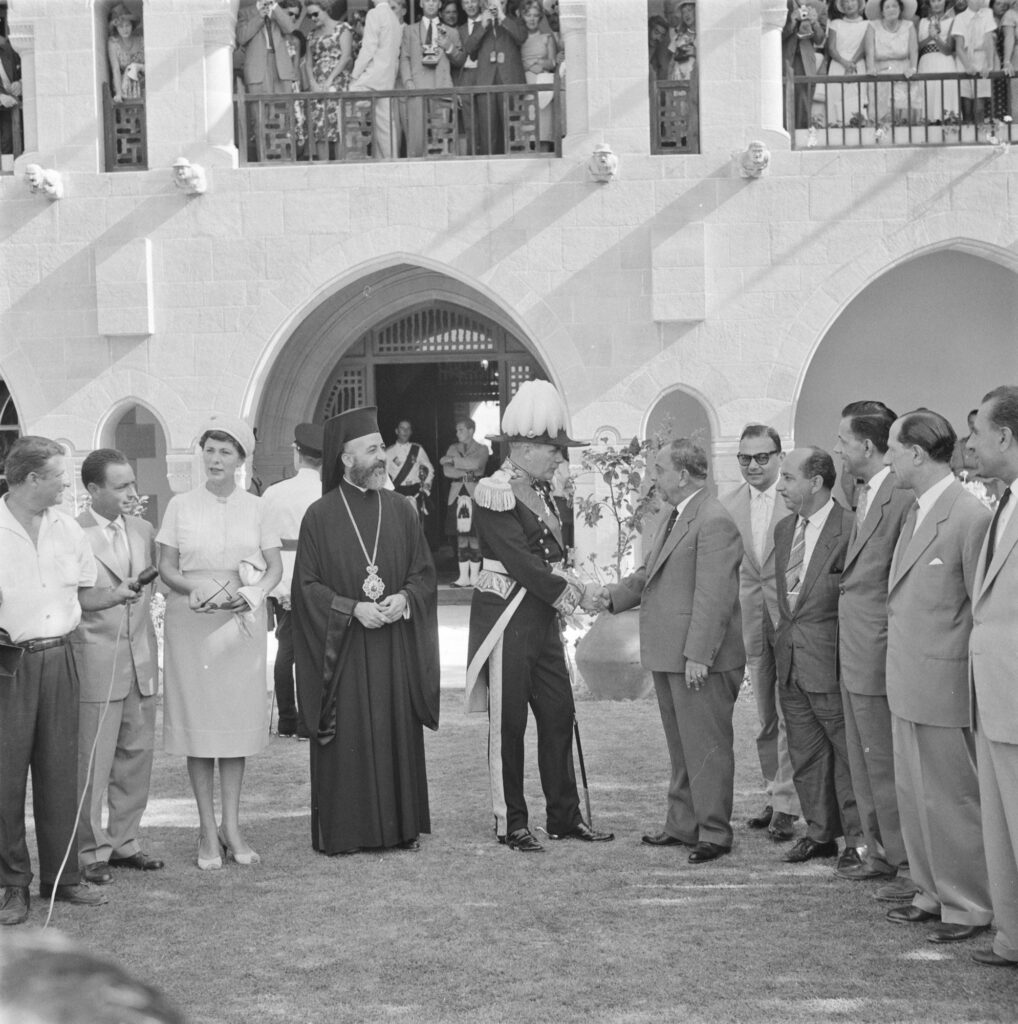
The first English High Commissioner, Sir Garnett Wolsley, who came to Cyprus in July 1878, lived temporarily in the Metochi of the Kykkos Monastery. He then resided in the Commissioner's Office, which was a wooden house imported from abroad and placed in the area where the Presidential Palace is located. In 1925 the Commission was renamed the Government House. In the uprising of 1931 with the main demand for union with Greece, the Government House was destroyed by fire and it was decided to build a new building, based on traditional architectural elements of the place.
The design of the new Governor's House, today's Presidential Palace, was made by a British house and its construction was undertaken by the government Department of Public Works of Cyprus. This was preceded by visits to various traditional buildings in Cyprus, where remarkable local traditional architectural elements were highlighted and copied.
The row of columns on the ground floor and the upper floor are based on a similar construction in the Monastery of Acheiropoietos near Lapithos. The carved capitals and column bases were chosen from designs from Kythrea, Lampousa, and Nicosia. The proportions of the tower in the center of the building are taken from the Castle of Kolossi. In the original plan, the roof of the castle was planned to be made of pyramid-shaped tiles, but for practical reasons and in order to have an additional Byzantine element in the building, it was replaced with a dome.
On the south side of the building there are two rows of four peculiar gutters. The lower four represent human figures. They personify the general foreman of the project, the architect, the master carpenter and the "unknown" worker, in honor of those who worked for the construction of the building. The other four gutters, located higher, represent the then basic animals of Cyprus – the ox, the donkey, the camel and the sheep. For the general construction of the building, cigar stone was used by Gerolakkos for its pale gray-yellow color, but mainly for its hardness and durability. In the interiors (fireplaces, stairs, etc.) limestone from the Limassol area was used.
A lot of attention was also paid to the construction of the Governor's House in terms of timber. Wood from the Cypriot forests (eucalyptus, pine, plane tree, cypress, walnut, sycaminia) and from various parts of the then British Empire, such as Burma and Canada, was used. The door of the main entrance of the Governor's House was modeled after the door of the Monastery of Agios Chrysostomos, located in the Pentadaktylos mountain range. Each leaf was formed from at least 288 small wooden pieces from six different trees, joined together without the use of nails or screws, to prevent them from being distorted. The carved beams and the reed mats of the roof were purely of Cypriot origin. The supports of the roof beams in the main rooms had been removed from an old house that had been demolished. Some decorative elements within the building, and especially on the staircase leading to the upper floor, were copies of ancient objects, while the curtains were hand embroidered with Cypriot decorative elements. After the independence of Cyprus and the departure of the English Governor in 1960, the Governor's House was established as the official Presidential Palace of the Republic of Cyprus.
The Presidential Palace was destroyed on July 15, 1974, during the coup d'état against President Makarios. Everything was burned, except for the standing walls which were damaged but did not collapse. The Presidential Palace, in its current form, was rebuilt a few years later with financial sponsorship from Greece and since 1979 it has been used as the office and residence of the President of the Republic.
The protagonists
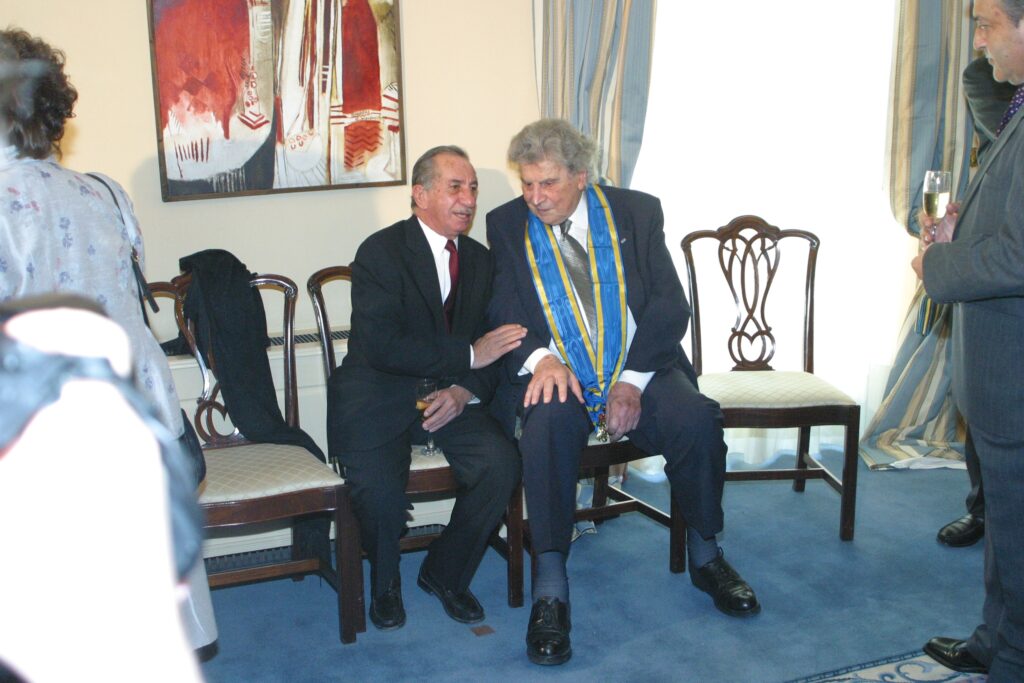
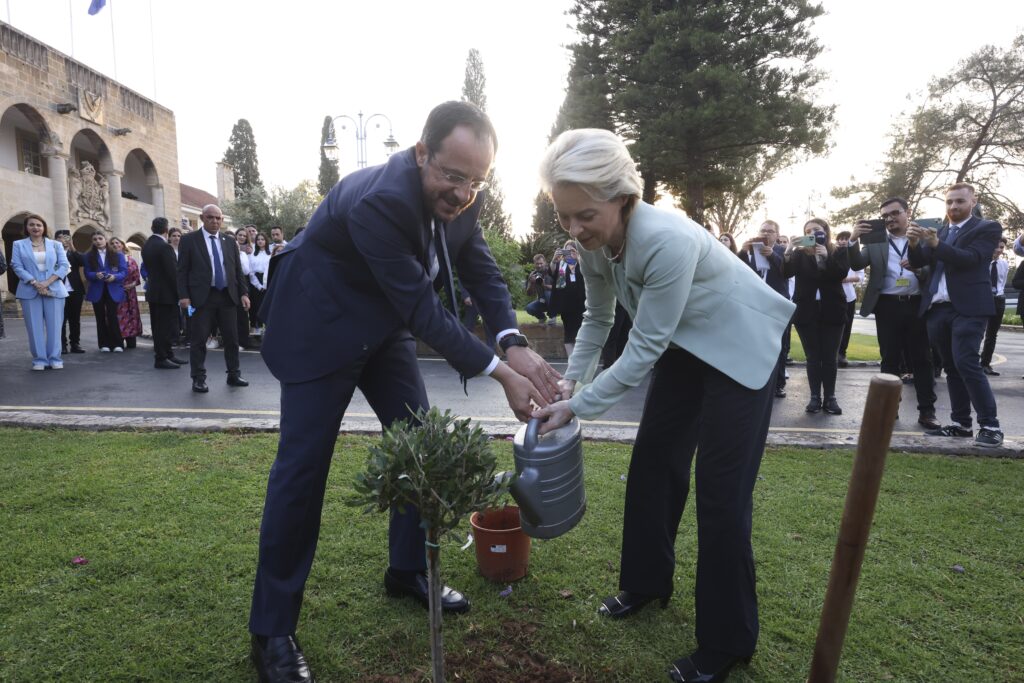
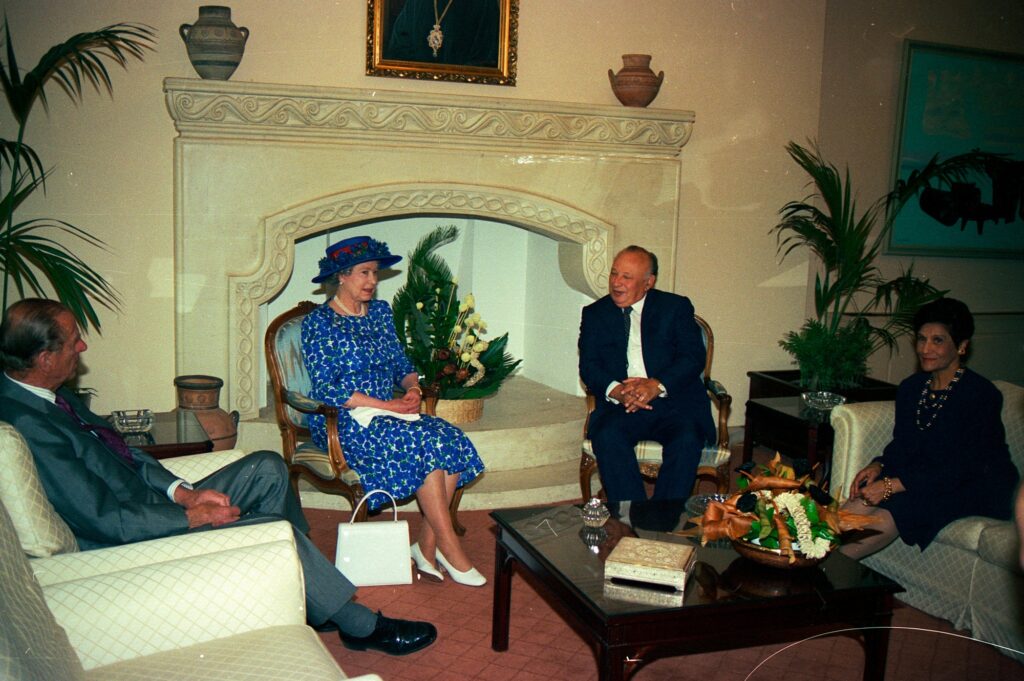
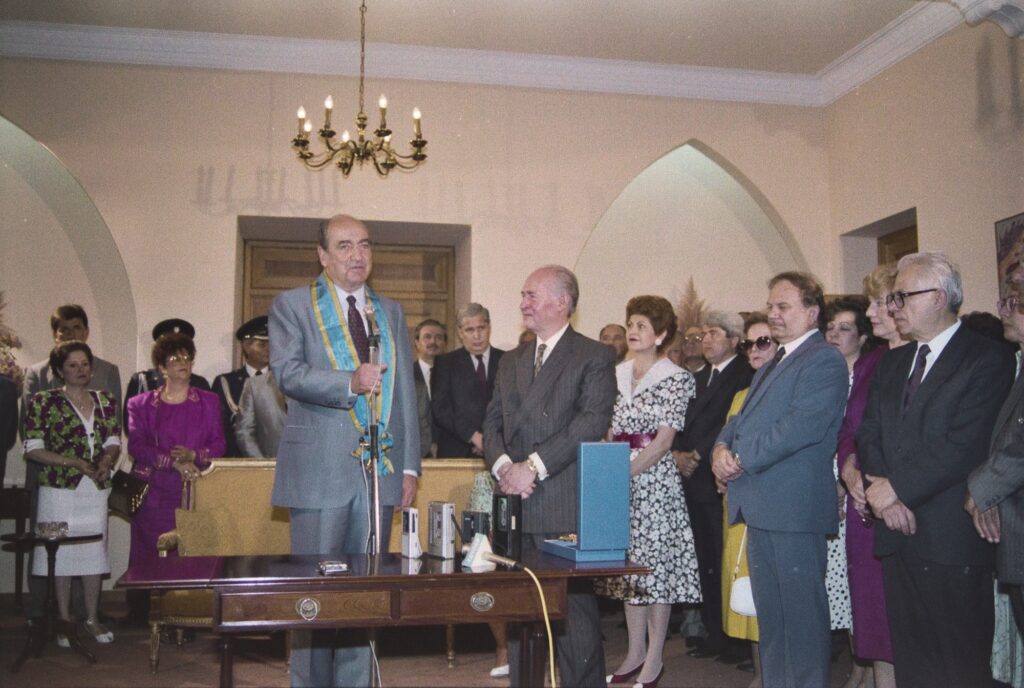
In addition to the information about the building itself (architecture, construction and decoration), the virtual time machine was enriched with several interesting facts about the eight Presidents of the Republic so far, the First Ladies, as well as important visits that took place from 1960 until today. The project team made use of archival material from the Presidency, the Press and Information Office, as well as other sources.
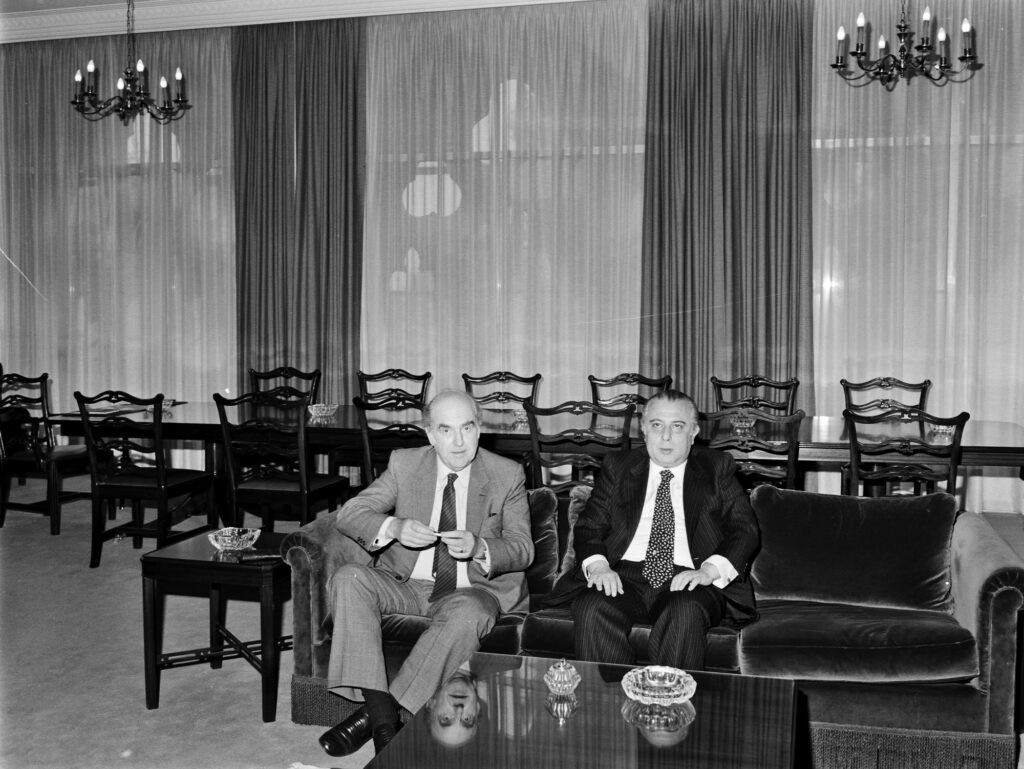
Through this unique material, important events are also highlighted, perhaps forgotten for the older or even completely unknown to the younger. For example, one of the most historic meetings hosted at the Presidential Palace was the tête-à-tête held on May 7, 1974, by the then US and Soviet Foreign Ministers, Henry Kissinger and Andrei Gromyko, on the Middle East.
Kissinger was in Jerusalem for negotiations between Syria and Israel after the war that broke out in October 1973, from the surprise joint offensive launched by Syria and Egypt against Israel. The conflict took on the dimensions of a serious international crisis involving the two superpowers of the time, the USA and the USSR, which supplied their warring allies on a large scale. The talks between Kissinger and Gromiko in the room where the Council of Ministers now meets lasted three hours and led to an agreement on the Middle East a few days later. However, two months later the clouds covered Cyprus with the Presidential Palace becoming the first target of the coup plotters, and a week later the Turkish invasion followed.
"An inspiring experience"
For the creation of the interactive application, innovative techniques of three-dimensional architectural modeling, reconstruction and visualization were used for the creation of a new visual museological study, utilizing the large volume of historical archives and photographic collections of the Press and Information Office and other archives. The virtual tour takes place on a screen placed in the reception room of the Presidential Palace, and is part of the project "CYPRUS: the World, the Place, the Word, the Matter", which was implemented on the initiative of the First Lady, Filippa Karsera Christodoulides. "Our goal is for every person who enters this building, students, citizens, foreign leaders and officials, to learn something meaningful," says the wife of the President of the Republic. "Not in the context of a typical tour, but an experience that will inspire foreign visitors and make our citizens proud," he concludes.
Stavros Malas: A living witness of modern history
"The Presidential Palace is not just a building. It is a living witness to the modern history of the Republic of Cyprus, its institutions, crises and achievements. With the virtual reality platform we have developed, we seek to make this story immediately accessible, experiential and alive for everyone – and especially for the younger generation," says the President of the Cyprus Institute, Stavros Malas, who notes that the initiative to create the time machine is part of a wider effort by the Cyprus Institute to leverage the cutting edge of science and technology to promote our cultural heritage. "Virtual and augmented reality, digital documentation of monuments, three-dimensional models, are not just impressive tools. It is a new "bridge" between citizens and History, between education, research and society.
Mr. Malas noted that the completion of the project coincides with the 20th anniversary of the establishment of the Cyprus Institute. "The virtual reality platform for the history of the Presidential Palace is, in a way, symbolic of our course: it combines high know-how, respect for history, creative collaboration with institutions, and, above all, the desire to offer something meaningful to society."