Filenews 31 January 2026 - by Angelos Nikolaou

The Electricity Authority of Cyprus (EAC) Power Generating Station (IS) in Dhekelia is entering a critical turning point for Cyprus' energy security and green transition. With an ambitious investment plan of €180 million, EAC is proceeding with the installation of new power generation units and storage systems, aiming at the modernization of the area and the definitive withdrawal of old, polluting steam turbines.
The Environmental Impact Assessment (EIA) has already been put before the public and the competent bodies, with the public consultation process to be completed on February 28, 2026.
The expansion of the plant provides for the installation of a new production unit, consisting of two to three Open Cycle Gas Turbines (OCGT), with a total capacity of 60-115 MWe. The characteristic of the new units is their flexibility, as they will have the ability to burn both oil (diesel) and natural gas, as soon as the latter becomes available. Although the project concerns natural gas/diesel, OCGT technology is the transition stage towards cleaner forms of energy.
The new OCGT plant will help increase production capacity, as well as the safety of the power generation system, while reducing the environmental carbon footprint. The ultimate goal is the gradual cessation of the existing operation of the steam turbines (Dhekelia Station B), resulting in the reduction of the concentration of emitted air pollutants.
For the comprehensive and holistic evaluation of the proposed project in the wider study area, the environmental study includes the assessment of both its impact (OCGT unit) and the cumulative effects from the overall operation of the HS, including the Battery Energy Storage Unit (BESS), which is to be installed within the Dhekelia HS.
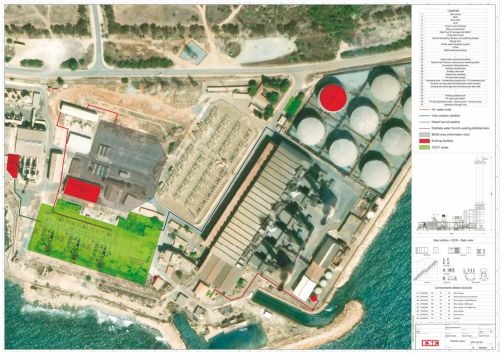
The location of the new OCGT unit will be done exclusively in pieces of development of the infrastructure of the Dhekelia HS. The Dhekelia HS is located east of the British Bases area and is about 270 m from the EAC settlement. The Dhekelia HS is included in the provisions of the SEVESO regulations. The proposed project is fully compatible with the industrial character of the area, not bringing about any change in the existing land uses and the current spatial and urban planning regulations.
At the same time, the design includes: A battery energy storage system (BESS) with a capacity of 160 MWh, which will provide the necessary stability to the grid for the further penetration of Renewable Energy Sources (RES). The System will be classified into battery units, of the iron-lithium phosphate type or other equivalent type. Each unit will be placed in a prefabricated house, which will be equipped with a cooling, fire detection and fire protection system.
The units will be equipped with a Selective Catalytic Reduction (SCR) system, which aims to clean the emitted exhaust gases from Nitrogen Oxides (NOx).
The Natural Gas supply system is intended to be installed on the west side of the station, north of gas turbine 1. At this stage of architectural design, sufficient space is provided. With the availability of Natural Gas, the Monitoring and Pressure Reduction Station (PMRS) will be built
The project will be financed from the Authority's reserve, with significant support from the European Investment Bank (EIB) through sponsorships. This move is considered strategic, as it allows the upgrading of infrastructure without burdening the public debt, while it is expected to lead to a reduction in the price of electricity for households and businesses.
Due to the nature of the fuel, the station is subject to the strict SEVESO regulations. The study assures that the worst effects in the event of an accident are limited within the fenced area of the EAC, while all fire protection and waterproofing measures have been taken to avoid leaks to the ground or sea.
The environmental study deals with the investigation of the potential impact on the environment from the imminent expansion and upgrading of the operation of the EAC Power Station, in Dhekelia. The purpose of the implementation of the projects is to increase the production capacity of the penetration of RES, as well as to ensure the stability of the system. The ultimate goal is the gradual shutdown of the steam power units of the Dhekelia B station.
The supply of diesel oil to the unit will be achieved through tanker trucks at the Unloading Station. One of the existing fuel oil storage tanks, with a capacity of 12,000 cubic meters, will be used as a storage tank.
Covers 1/3 of EAC's electricity needs
The Dhekelia HS currently produces about 34.5% of the EAC's total electricity. The plant consists of six steam turbines, each with a capacity of 60 MW, as well as two internal combustion units (codenamed MEK 1 and MEK 2), with a total capacity of 100 MW. The fuel is the heavy fraction of oil (HFO/fuel oil).
The Dhekelia station has been operating for the production of electricity since 1953. The first pan-Cypriot power plant, known by the code name Dhekelia A station, consisted of seven steam power plants with a capacity of 2X7 and 5X14 MW, a total of 84 MW. Each unit had a boiler, steam turbine, and generator. As fuel, the heavy fraction of oil (fuel oil) was used. The condensers in steam turbines were cooled directly by a water cooling system. The water was pumped from the bay of Larnaca, channelled to the condensers and then discharged into the sea. The operation of Dhekelia A was interrupted in the early 90s and eventually, the station was demolished.
The construction of the Dhekelia A HS was succeeded by the construction of the Dhekelia B HS (80s), which was carried out in three stages. Two steam turbine units with a capacity of 60 MW were installed at each stage. In total, the Dhekelia B HS consists of six conventional steam power plants, with a total capacity of 360 MW. The mode of operation of the Dhekelia B HS is similar to that of the Dhekelia A HS. The fuel oil is supplied via a ship.
After the demolition of the Dhekelia A Emergency Station, some of its buildings continue, to this day, to serve the needs of the Dhekelia B Police Station.
In order to meet the ever-increasing energy needs, two additional units were built (MEK 1 and MEK 2). In these units, there are three internal combustion engines, each with a capacity of 17 MW. The heavy fraction of oil (fuel oil) is also used in this case, as fuel.
However, it is also possible to run on diesel. The fuel oil is supplied through an existing pipeline from the station of Dhekelia B to MEK.
