Filenews 3 January 2026 - by Andreas Pogiatzis

The large operational activity of Cyprus in the return of third-country nationals, during the first half of 2025, is recorded in the new evaluation report of Frontex. Our country occupies the first place in the increase in returns and the second place in real numbers of returns carried out with the support of Frontex, behind only Germany and ahead of Belgium, France, Sweden, Italy, Switzerland and Spain.
According to the report, in the period January – June 2025, repatriations of third-country nationals from Cyprus with the support of Frontex reached 4,230, recording an increase of 14% (509 more returns), compared to the previous six months. As noted in the Frontex report, which records the data of member states' national initiatives for returns, this is one of the largest increases in the EU, along with Spain and Germany. The total number of returns that concern the whole of the European Union has increased, but at a more moderate pace, the report states.
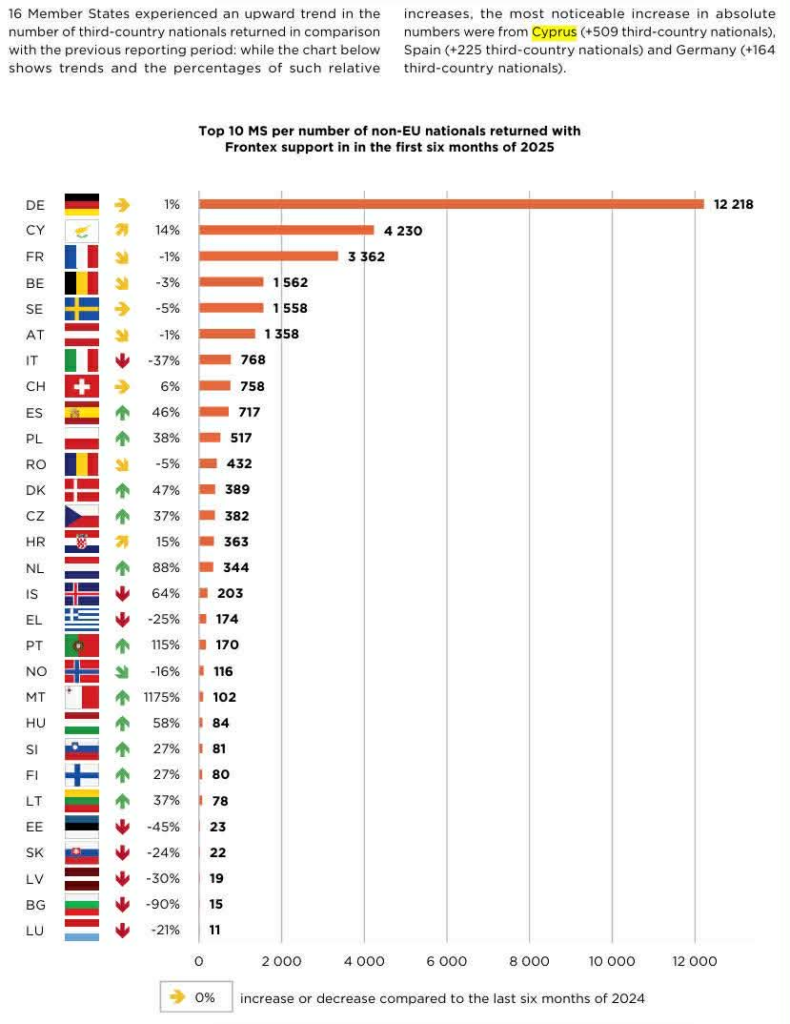
Information from "F" states that Cyprus participated in 19 Frontex flights for 2025, where about 150 people were repatriated. The rest of the repatriations were carried out with procedures of the Cypriot authorities.
The Deputy Minister of Migration and International Protection, Dr. Nicholas A. Ioannides, speaking on the issue to "F", commented that from January 2025 until today, almost 12,000 people have left Cyprus, either as repatriations or as relocations, exceeding the departures of 2024 (almost 11,000). "In its first annual report on Asylum and Migration, the European Commission notes that, between July 2024 and June 2025, Cyprus issued the most return decisions across Europe, in proportion to its population and GDP," said Nicolas Ioannides.
Member States in total repatriated 30,136 third-country nationals in the first half of 2025, an increase of 2% compared to the second half of 2024 and by 12% year-on-year. On average, 5,023 returns were made per month.
According to the report, of the total refunds for the whole of the European Union:
> 64% (19,290 people) concerned voluntary returns.
> 36% (10,841 people) were implemented through forced procedures (deportations).
> 82% were carried out by scheduled commercial flights and only 18% by charter flights.
Although the high rate of returns is mainly the result of the hard work done by the Deputy Ministry of Migration and International Protection (YMDP) and the Aliens & Migration Service (IAM) of the Cyprus Police, Cyprus is characterized in the report as a country with a high degree of utilization of the tools offered by Frontex. Despite its small size, it appears at the top of the relevant list, which reflects not only the large migratory load it has received, but also the determination of the authorities to resolve the migration problem.
According to Frontex, 71% of all voluntary returns were made by three member states, Germany (34%), Cyprus (21%) and France (16%). This is an important element for our country, as voluntary returns are explicitly promoted by the EU and Frontex.
Cyprus is the champion in the returns of Syrians
According to information from "F", between March 17 and October 31, 2025, 17 EU member states repatriated a total of 4,659 Syrians. 75% of these returns of Syrians were made by Germany (30%) and Cyprus (45%), which is confirmed by Frontex and proves the hard work done and the cooperation of the services of the Asylum Service and Migration Department with the Police and the Ministry of Justice, for returns. From December 2024 to early December 2025, around 4,200 Syrians have returned from Cyprus to Syria, while over 4,500 Syrian nationals have withdrawn their asylum claim or renounced international protection status. This success of Cyprus has prompted many EU member states, in their bilateral contacts with Cyprus, to discuss forms of cooperation to increase returns.
The role of Larnaca Airport and FRESO
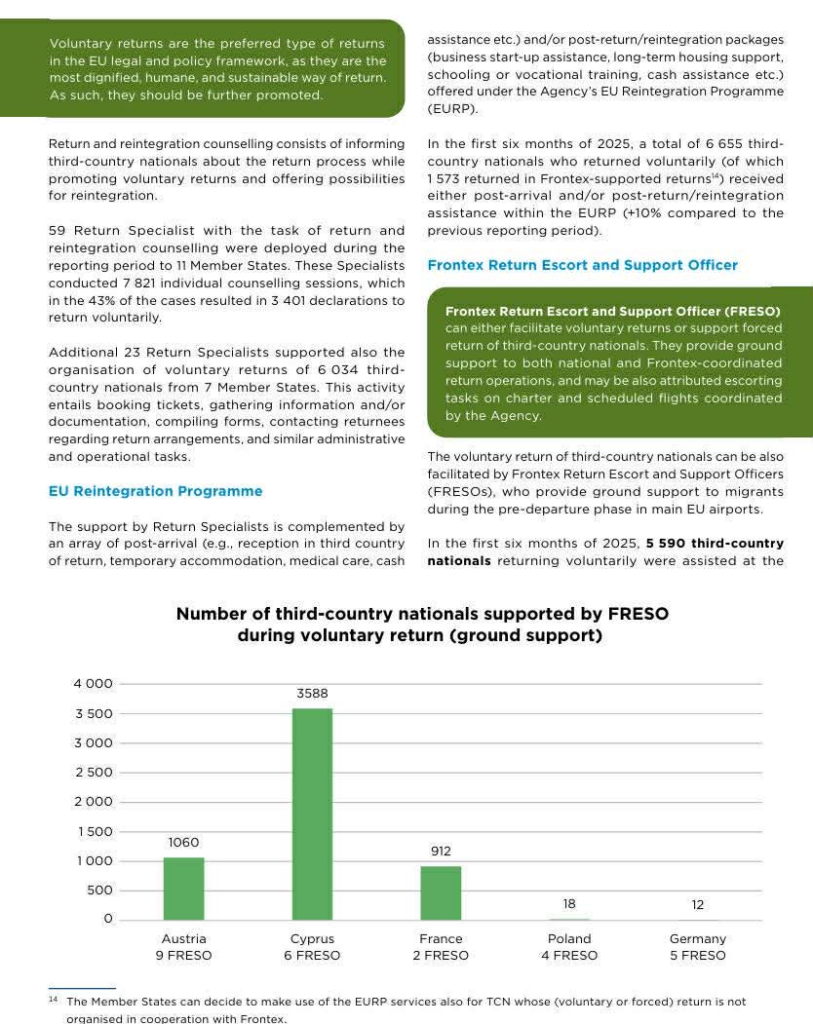
Elsewhere in the report, it is stated that a central role in Frontex's operational model is played by Frontex Return Escort and Support Officers (FRESO), who provide support on the ground during the departure stage. In the first half of 2025, 5,590 people who returned voluntarily received such support in five member states, including Cyprus.
According to the report, six FRESO executives were deployed in Cyprus, who supported 3,588 returns, mainly at Larnaca airport. Frontex notes that the scope of support varies by country, depending on national procedures, with Cyprus limiting assistance mainly to the final stage of departure.
Diplomatic upgrade for Cyprus, the effective handling of the migration issue
In the highest chambers of the European Union, where the ministers responsible for migration consult, such as the work of the Justice and Home Affairs Council (SDEY) of the European Union, Cyprus is now an example. For the sake of truth, on the sidelines of the informal SDEY last July in Copenhagen, Dr. Ioannidis presented the successful return program implemented by the Republic.
In fact, the intervention of the Swiss, Hendrick Krauskopf, Director of International Relations of the Swiss Deputy Ministry of Migration, to the Deputy Minister Nicolas Ioannides, during the signing of a framework agreement for the implementation of the second phase of the 2nd Swiss contribution, is interesting, where, referring to the example of the Voluntary Returns Program of Cyprus (AVR – Assisted Voluntary Returns), he characteristically stated that "you used to come to learn from us, while now we come to learn from you."
Nicolas Ioannides also referred to the Cyprus Presidency of the EU, saying "we will emphasize the strengthening of returns by all member states, through the Regulation on Returns that we will negotiate with the member states, the European Parliament and the European Commission".
The scene for Cyprus' accession to Schengen is changing
Regarding the accession of Cyprus to the Schengen zone, Mr. Ioannides explained that the effective management of irregular/illegal migration flows is one of the conditions taken into account to judge the readiness of a state for accession. "The Republic of Cyprus, in the last three years, has shown a significant improvement in the migration issue, which is reflected in the sharp reduction in flows and the unprecedented increase in returns," he said.
On when developments are expected on this, the Deputy Minister stated that "in combination with the excellent work done by all the competent Services regarding the other criteria, under the coordination of the Ministry of Foreign Affairs, our country is ready from a technical point of view and further developments are expected within 2026 in relation to our full accession to Schengen".
On whether the increase in the number of returns will continue, Nicolas Ioannides assured that "our goal for 2026 is to continue to increase returns, in order to deal with illegal residence in Cyprus, to reduce the pressure on the asylum system of the Republic and to ensure social cohesion, but also public order and national security".
He added that "anyone who is not entitled to asylum or does not have a residence permit will be repatriated through accelerated procedures. The numbers of returns during the Christodoulidis government confirm what we are saying, as we translate our declarations into actions."
Regarding Syrian migrants, he said that the rejections of asylum applications that have been submitted continue, "as well as the removal of international protection status from Syrian nationals, as many no longer meet the criteria of international and European law to be entitled to asylum. Therefore, in addition to voluntary returns to Syria, many Syrians will have to return home in 2026."
Technology also played an important role in successfully dealing with the migration problem. As Mr. Ioannidis explained, "the radio signalling systems (radar) available to the Republic are able to detect smugglers' boats carrying migrants in a timely manner. Also, the cameras along the Green Line provide an image to both the National Guard and the Cyprus Police to detect movements of traffickers who attempt to channel migrants from the occupied territories. At the same time, the National Guard's drones provide assistance both on land and at sea."
Regarding the government's future plan for immigration, Mr. Ioannidis commented that "we should keep in mind that immigration is a timeless phenomenon and is not going to stop. After all, legal immigration is essential for our economy and that is why we are working to rationalise it, so as not to create social tensions and to meet the real needs of the economy. The government's policy in the last almost three years has resulted in bringing under control the irregular/illegal immigration that created most of the problems previously. However, we remain vigilant to further reduce irregular/illegal flows and increase repatriations. At the same time, with the Strategy for the Integration of Legally Residing Foreigners, we aim at the smooth integration of third-country nationals who have the right to stay, through the learning of the Greek language, the development of skills and the avoidance of ghettoization. With the combination of these measures, we are unloading the state's infrastructure, ensuring social cohesion and maintaining a sustainable asylum system only for those who are entitled to international protection."
