
By Marc Champion
There are at least two acceptable reactions to accusations that a group of high-ranking Ukrainian officials has siphoned off $100 million from contracts to repair and protect their country's critical energy infrastructure, even as Russian attacks plunge Ukraine into darkness and cold. One is despair, the other, to recognize a reason to celebrate. The second, as strange as it may sound, makes more sense.
This incident takes us to the core of why Ukrainians are fighting. The war began in 2014, after then-President Viktor Yanukovych was overthrown by mass protests against the large-scale corruption and vassalism it created in Moscow. Corruption has been the glue with which the Kremlin has kept its neighbour in check since the collapse of the Soviet Union in 1991, infiltrating its security services, manipulating its leaders and weakening its military.
It is recalled that it was an agreement with Europe – which threatened the entire mechanism – that ultimately led Vladimir Putin to resort to violence. And Putin knew his "man" well. He offered Yanukovych $15 billion to resign from the agreement with the European Union, triggering the so-called Maidan revolution when Ukraine's leader finally agreed not to sign. This was followed by the flight of Yanukovych, the annexation of Crimea by Russia, the start of a hybrid war in Eastern Ukraine and, finally, the full-scale invasion.
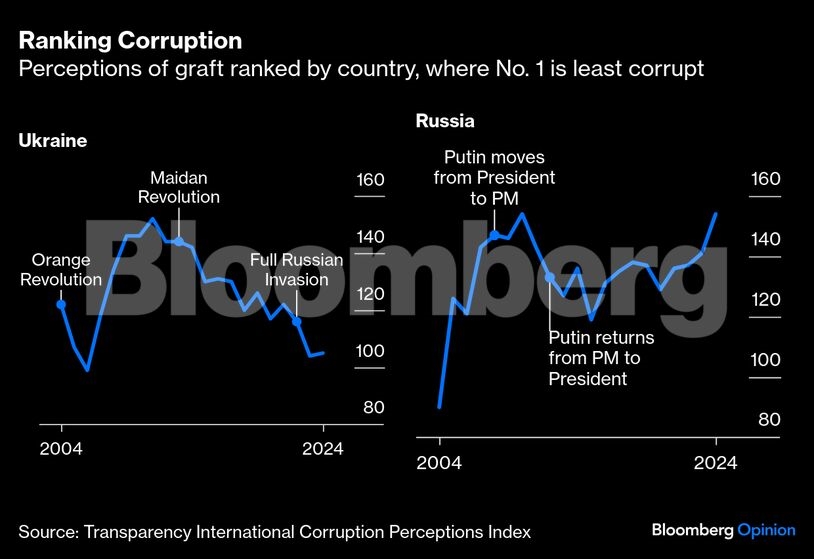
It should come as no surprise that the system of bureaucracy created in the midst of such systemic corruption has now reportedly found ways to make money from the war. Likewise, we should not be surprised if it turns out that there was Russian involvement in the operation. According to statements by Ukraine's National Anti-Corruption Bureau (Nabu) and the Specialized Anti-Corruption Prosecutor's Office conducting the investigation: Andrei Derkach, who fled to Moscow shortly after the February 2022 invasion, was charged in absentia with treason the following year and became a senator in the Russian legislature in 2024. His office is now accused of laundering the stolen money.
It should not be surprising if the alleged leader of this plan turns out to be the businessman close to the current president, Timur Mindich, who owns Kvartal, the production TV studio he founded together with Volodymyr Zelensky. This is the company that created Servant of the People, the successful satire of endemic political corruption in Ukraine, which catapulted Zelensky to the presidency, with life following art. Nabu did not name Midih and did not present any evidence against him. However, the agency conducted an investigation into his assets, leading Ukrainian media to identify him as involved in the case. According to these reports, he left the country shortly before the raids began.
Russia's propagandists, trolls, bots and like-minded people will rejoice. Because here, certainly, there is proof that Ukraine is not worthy of help, that the money given will be stolen, that – despite the grandiose statements about democracy – it is not better or different from the aggressor. Kiev's request for EU membership, certainly, has just taken a big step back.
However, the real surprise should be the fact that an alleged scam was uncovered to embezzle $100 million from the country's superhuman efforts to maintain the supply of electricity and heating to its residents. On top of that, the revelation was official and made public after a 15-month investigation into the activities of the state-owned nuclear energy company JSC Energoatom.
Nabu and the prosecutors conducting the investigation are independent. Their offices were set up after the anti-corruption protests on the Maidan in 2014 and under intense pressure from the US and the EU. These are the same organizations that Zelensky tried to "decapitate" and take control of in July, when information about the current investigations was leaked. Immediate protests in the streets – even in the midst of war – forced the president to back down and allow the investigation to continue. The president may have thought that the war would discourage people from taking to the streets, but that did not happen.
This time, Zelensky approved the Nabu investigation and ordered government agencies to cooperate. "There must be convictions," he said on Monday. And this is what EU candidacy requires – not the absence of corruption, but the government's support for an independent judiciary to fight it, no matter where that leads.
Prosecutors have not alleged that Zelensky or other senior members of his staff may have been involved in the Energoatom fraud or others to come, as Nabu has hinted. That can change. The services claim to have amassed 1,000 hours of recorded conversations, so we can expect more revelations and turmoil. But I can mention a few important NATO and EU countries whose governments either managed to control the courts and investigators who were tasked with exposing their corruption, or tried to discredit judges and arrest prosecutors for doing their job.
Zelensky was unable to stop Nabu because the institutional counterweights of Ukrainian democracy are not based on its fundamental institutions. They are based, instead, on the certainty that its leaders have – based on repeated experiences – that if they try to interfere in the outcome of the election or overturn hard-won achievements, such as the creation of a truly independent law enforcement agency, Ukrainians will take to the streets by the millions.
This is not an ideal model that any society would willingly create or should emulate. It is an expression of deep distrust of the state, it is chaotic, explosive and ineffective. But it is the reality of Ukraine, it prevents tyranny and, at least for now, it works.
