
Western media and governments are criticized for not paying enough attention to Sudan – and rightly so. The war in Ukraine is bigger and the war in Gaza is more intense, but when it comes to the scale of civilian suffering, the Horn of Africa has no equal.
The civil war in Sudan has been raging since 2023 and we are ignoring it because it is very difficult to find a solution. However, we turn our gaze away at our own risk, for this conflict offers a foretaste of the armed chaos that seems to characterize the world's transition from U.S. domination. This does not mean that we should wash away the centuries under the Americans, and before them, the Europeans. Their actions play a central role in the violence that unfolds, from the imposition of arbitrary borders, to the most recent interventions in Iraq or Libya.
However, Sudan's post-Western era looks just as colonial, as the struggle between two generals for power and loot attracts the rising powers that today demand to have a say in who will rule, exploit the mines or trade the region's products. The biggest role in fomenting the unrest in Sudan is played by the rich Gulf states – notably the United Arab Emirates, but also Saudi Arabia and Qatar – as well as Egypt. Profits include agriculture, gold, water, and Red Sea ports. China, Eritrea, Iran, Libya and Russia are also participating.
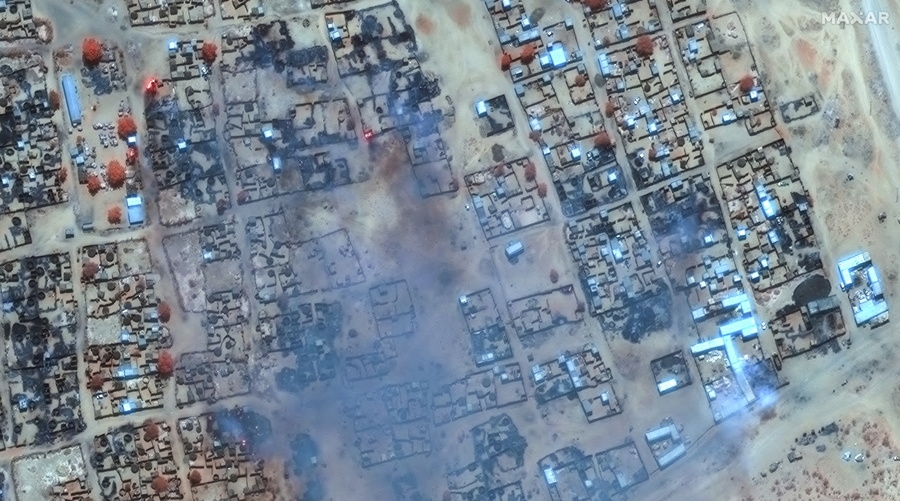
The UAE, despite denials, supports, finances and equips the Rapid Support Forces (RSF), led by General Mohammed Hamdan "Hemeti" Dagalo, which have recently made headlines due to the violence against civilians in Darfur's capital, El Fasser. At the same time, it deals with – and thus indirectly finances – the RSF's rival, the Sudanese Armed Forces (FAS), under the leadership of General Abdel Fattah al-Burhan. Gold plays a huge role. According to Sudan's central bank, the UAE bought nearly 97% of Sudan's official gold exports in 2024, which only refers to that sold by the internationally recognized government of Burhan. However, RSF mines and sells gold, so the country's actual production is much higher than the official figure of 64.36 tons reported for 2024, and the UAE buys most of it.
Ten or twenty years ago, the U.S. would have tried to bring together the warring parties in Sudan, and the United Nations would have proposed sending peacekeepers. However, Washington's involvement was, at best, lukewarm. This is because, in order to do more, Donald Trump would have to confront important allies and business partners in the Gulf, while he needs their support on issues involving Israel and Iran. But it's unclear whether Trump's America would want to get involved, even if that wasn't the case. The so-called "Responsibility to Protect" – a principle according to which the international community should prevent governments from massacring their own citizens – emerged in the heyday of the US "liberal world order" in the 1990s and early 2000s, but the "fashion" has now passed. Identity politics and the right of the powerful to control their own spheres of influence dominate our days.
Nothing could sum it up better than Trump's decision not to say anything about the international outcry caused by the massacres of civilians in El Fasser – including 460 people killed in a hospital. Instead, he continued the apparent preparations for an attack on Venezuela, closer to his homeland, and announced that he was considering intervening in Nigeria if it did not stop the killings of Christians by Islamic terrorists. It doesn't matter that there hasn't been any recent such atrocity to explain Trump's move, or that the vast majority of people killed by Islamist terrorist violence in Nigeria are Muslims.
No one really knows how many civilians have been killed in the war in Sudan, but estimates range from tens to hundreds of thousands. The UN says the war has displaced 12,3 million people. The World Food Programme reports that 24.6 million people are facing acute hunger. As Will Brown, senior policy researcher at the European Council on Foreign Relations' Africa program, told me: "The only countries that have even the approximate amount of power required are China and the United States, but China doesn't seem to care, and Sudan isn't even on Trump's list of priorities."
At the moment, the most likely outcome of the war seems to be the division of the country into two parts, with the western part of present-day Sudan controlled by the RSF and the eastern part by the FAS. It wouldn't be the first time. In July 2011, the southern part of Sudan seceded to form an independent state after years of conflict, taking the country's oil reserves with it. But would further fragmentation solve anything? Both the RSF and FAS fight alongside cumbersome alliances of local militias, many of which represent distinct ethnic or territorial interests. Once they focus on the interior, they are likely to turn against each other – exactly what happened in South Sudan.
This instability cannot be in anyone's interest – with the possible exception of Russia's predatory mercenaries, who profit from the chaos. The Gulf states' plans to diversify and develop their economies require regional stability. Europe is politically threatened by the prospect of further waves of asylum seekers. China's plans to connect Africa's natural resources to its homeland through the "Belt and Road" require investment in safe transportation. The U.S. should be concerned about the impact that the disposal of Sudan's Red Sea ports will have on maritime trade and security, even if the current administration does not seem to feel that way.
I have no brilliant new solution to propose. But if we want to avoid a return to a 19th-century Hobbesian dispute over power and resources in our new "multipolar" world, reaching an agreement between the many foreign actors in Sudan, which they can sell to their warlord clients, would be a good starting point.
Adaptation – Editing: Lydia Roubopoulou
