Filenews 12 October 2025 - by Marios Demetriou

The occupation regime has only recently criminalized the crime of trafficking in human beings and does not have fundamental structures for the protection of victims and the criminal prosecution of perpetrators, unlike the Republic of Cyprus, which has a well-developed legislative framework and national mechanisms against trafficking in human beings, as shown by a thorough, joint report they wrote in the previous months, the researchers Christina Kaili (MIGS) and Mine Yucel (Prologue Consulting).
Their research lasted from April to July 2025 and was carried out in the framework of the United Action Program against Trafficking in Human Beings, funded by the European Union and implemented by the Turkish Cypriot civil organization Refugee Rights Association and the Greek Cypriot Caritas Cyprus.
The report of the two authors aims to map and strengthen policies and mechanisms, both in the free and in the occupied areas, for the recognition, protection and support of victims of trafficking, but also for the improvement of criminal procedures, with an emphasis on inter-communal cooperation, as underlined. It is emphasized, however, that "the particular political situation and the unresolved conflict on the island continue to hinder cooperation, which could better prevent human trafficking and protect its victims.
Political realities create additional barriers, but the human rights imperative requires harmonized, victim-centered, and gender-sensitive responses. A common strategy is essential to combat human trafficking across the island." We note that the report was based on desk research and six semi-structured interviews (three in the free areas and three in the occupied territories), with key stakeholders involved in current anti-trafficking practices, policies and frameworks.
A model that is unsustainable, incomplete and inadequate
"The present assessment underlines the need and the intrinsic value of a harmonised approach against trafficking in human beings in Cyprus, given the political situation and the ever-changing characteristics of trafficking in human beings. After all, it is a crime that thrives when structures and mechanisms are absent and/or inadequate.
It is therefore of the utmost importance to build common standards and meaningful cooperation, despite the political realities, because victims of human trafficking cannot wait and deserve immediate action." Regarding the occupied territories, it is pointed out that "the northern part of Cyprus remains inadequately equipped to effectively deal with human trafficking, due to legal, institutional and political shortcomings. Civil society – it is added – has taken on roles that are usually undertaken by state bodies, but this model is unfunded, unrecognized, unsustainable, incomplete and inadequate. Through targeted reform of the legal text, institution-building and rights-based victim protection measures, the northern part of Cyprus can start to fulfil its responsibilities under international and EU human rights law. The creation of a functioning infrastructure against human trafficking is not only a legal obligation, but also a moral imperative."
As far as free areas are concerned, the findings of the survey reveal that "while the Republic of Cyprus has made significant steps in strengthening its anti-trafficking mechanisms, gaps in implementation, coordination and victim-centred support and care jeopardise the effectiveness of the system. Urgent needs for expanded psychological, psychoeducational services, legal aid, inter-communal coordination and accessible pathways to justice remain.
In addition, data collection should be strengthened and made available in the official languages of Cyprus and information should be made available to the affected communities in an understandable language(s). The National Reporting Mechanism in the Republic of Cyprus (the system of cooperation between state agencies and non-governmental organizations, for the identification, protection and assistance of victims of trafficking in human beings), in addition to its contribution to education, community awareness and structural reforms, is necessary to better support victims of trafficking in human beings, across the dividing line and to prevent future exploitation, especially when we are working towards a single and common framework.
There is an urgent need, such as the Bi-communal Technical Committees on Crime and Gender Equality, to take a more active role in prevention actions, facilitating knowledge sharing, as well as in supporting law enforcement/enforcement efforts. Given the comprehensive legal and political framework established by the Republic of Cyprus, what is lacking is coherence and implementation in all areas. Even more important, is the substantial political and institutional will to address action and policy against trafficking in human beings, not only as a law enforcement or migration issue, but also as a human rights issue."
Prostitution of women in nightclubs
In relation to the legal framework in the occupied territories, it is pointed out that "in the northern part of Cyprus, there is no comprehensive legal text, Action Plan or Reference Mechanism to combat trafficking in human beings. Human trafficking was defined as a crime, only in 2020, with the addition of "Article 254 to the Criminal Code", which criminalizes forced labour and human trafficking, providing for penalties of up to 16 years in prison. However, its practical application is severely limited.
Victims do not receive any legal or social protection and the "police" often deport them, due to expiration of "visas", despite the relevant protection provisions in the "articles". The absence of shelters, legal aid and services for victims further exacerbates the problem. Non-governmental organisations, with limited funding and the possibility of housing victims, remain the only support systems available.
As a result, victims often choose not to report the abuse, fearing deportation and further harm. The legislation on nightclubs allows the "police" to confiscate the passports of women who work in such places, and this is a violation of international human rights law.
While the penal code prohibits prostitution in nightclubs, it is an open secret that prostitution exists in these places, since the legislation on nightclubs essentially allows this, imposing regular medical checks for "sexually transmitted diseases, especially for women employed in such places, thus institutionalizing their exploitation, under the pretext of regulating public health.
Forced labour and "debt slavery" are common practices in nightclubs, which are also not recognized and punished." In relation to the legal and institutional framework in the Republic of Cyprus, it is pointed out, among other things, that "migrants and asylum seekers, especially women, face the risk of human trafficking, sexual exploitation and re-injury" and that "many of the alleged victims were identified among asylum seekers who were exploited in the northern part of the island. According to the GRETA report (2025), there has been a significant increase in the number of asylum seekers identified as victims of trafficking in human beings or at risk of victimisation, in particular girls and young women from Syria and women and men from African countries, mainly Cameroon and Nigeria."
The non-prosecution of criminals
As noted in the report, this focuses on the triptych framework "Prevention, Protection and Prosecution" on both sides, while the findings concerning the prosecution – or better, non-prosecution – of traffickers in the occupied territories are of particular interest. Among other things, it is stated that "in the northern part of Cyprus, the "police" often claim that it is "impossible" to prove the existence of human trafficking cases and avoid referring the cases to the prosecutors, leading to non-prosecution, even of obvious cases of human trafficking.
The absence of a specialized police unit to combat human trafficking leads to a lack of institutional knowledge and "investigative capacity". Interviews with experts suggest that there is a lack of awareness of human trafficking among the "police", "prosecutors" and "judges", and reluctance by the "police" to refer human trafficking cases to the "prosecutor's office".
To date, only one conviction has been recorded, and even in this case, the victim was eventually deported. There is an urgent need for gender-sensitive, victim-centred training in all relevant organisations, including the 'police', 'social services', the local employment body, 'prosecutors' and 'judges'.
However, the interviews reveal resistance to such training, especially among members of the "judiciary" and the "prosecutor's office." Without guaranteed rights and protection, victims are unlikely to show up. Experts report that many people (up to 80%) who initially ask for help, later withdraw, due to fear of deportation. As one expert noted, "we used to find it difficult to get victims of violence to speak out, but once we secured convictions and favourable court outcomes, trust began to grow.
It is similar with victims of human trafficking. An operating system is necessary for this trust to take root." This underscores the critical importance of a comprehensive legal text, against trafficking in human beings, that includes formal identification and reporting mechanisms and provides interpretation, psychological and medical support, and legal assistance to victims. The current law enforcement approach not only fails to protect victims, but often injures them again."
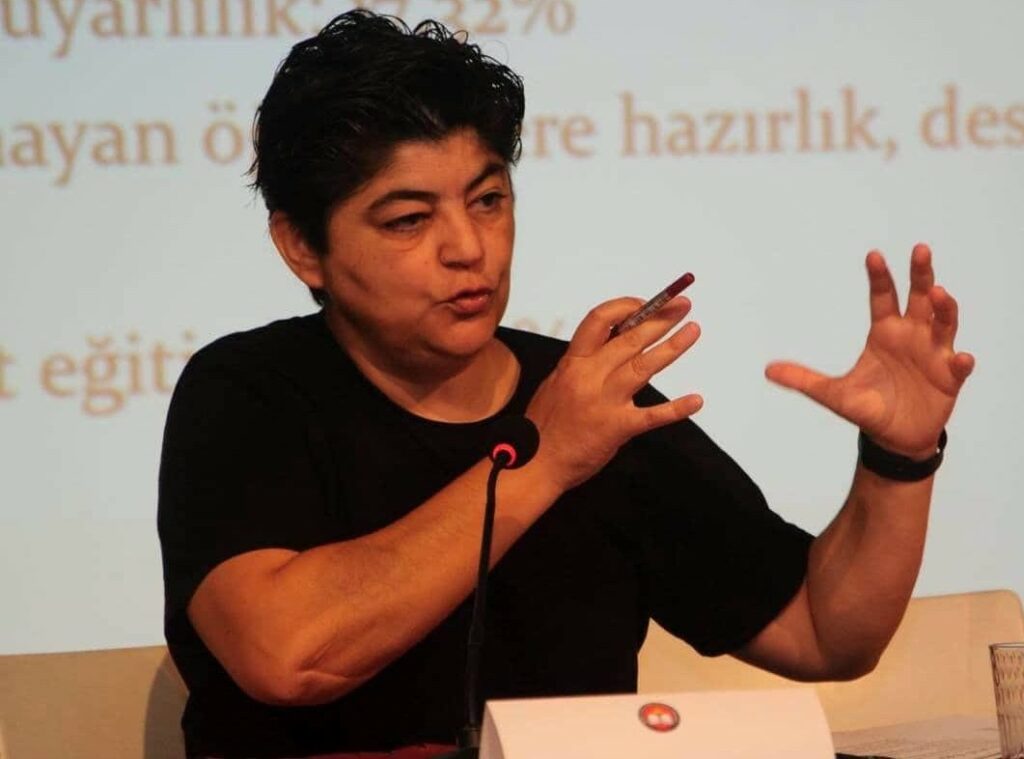
* We note that the exhibition was presented by its two authors, Christina Kaili and Mine Yucel, the day before yesterday, Friday, October 10, 2025 at an event at Chateau Status, next to the Ledra Palace roadblock in Nicosia, ahead of the European Day Against Trafficking in Human Beings, which is October 18 each year. Introductory remarks were made by Mihai-Florin Stoleru, director of the European Union's Aid Programme for the Turkish Cypriot community, and the heads of the organizations implementing the exhibition – Damla Kodan from the Refugee Rights Association and Elizabeth Kasini from Caritas Cyprus. Mrs. Kasini expressed to "F" her disappointment for the fact that no MP member of the parliamentary Committee on Human Rights and no member of the Multidisciplinary Coordination Group against Trafficking in Human Beings attended the event, even though they were all invited, as she told us.



*The entire report, at the link https://mhdkibris.com/upload/files/mhdfile-assessmentreport.pdf
