Filenews 17 August 2025 - by Evagora Prokopiou

Cyprus, following the international trends for sustainable development, has dynamically entered the era of ESG ratings with the implementation of the ESG Interbank Project. It is an initiative that is characterized as pioneering at the European level and aims to create a common, unified and transparent framework for the evaluation of Cypriot companies based on environmental, social and intergovernmental criteria.

The need for the implementation of such a project arose from the ever-increasing European and international supervisory requirements for sustainability, transparency and effective risk management, aiming at the compliance of banks and businesses with modern standards of corporate responsibility.
The partnership that brought innovation
The implementation of the project is the result of a collaboration between Artemis Credit Bureau, the Cyprus Banking Association, its member banks and its strategic partner CRIF S.p.A., through its subsidiary ICAP CRIF. The Artemis-CRIF consortium submitted the successful proposal to the relevant tender of the Cyprus Banking Association, proving, as noted by Dimitrios Mourpoulas, ESG Project Leader of Artemis, that "we were able to meet the high technical requirements of banks and offer an integrated solution for the collection, processing and comparability of ESG data".
He emphasizes that the aim of the project is to unite banks with businesses, with the Artemis Credit Bureau acting as a business hub and reference point for data management.
Synesgy: The global platform that became a Cypriot tool
For the implementation of the project, the Synesgy platform was chosen, an international tool that already operates in 160 countries, supports 20 languages and has sent over 620,000 certification invitations to businesses worldwide.
Its choice was not accidental: Synesgy is fully compliant with the most recognized international and European standards, such as the Global Reporting Initiative (GRI), the UN Sustainable Development Goals, the EU Taxonomy, the European Sustainability Reporting Standards (ESRS), the Corporate Sustainability Reporting Directive (CSRD) and the Corporate Sustainability Due Diligence Directive (CSDDD).
The platform offers four structured questionnaires depending on the size of the organization — from micro to large enterprises — and allows for ESG Certification, ESG Score, and a personalized action plan for improvement. "The cost of the annual evaluation, just 200 euros, is essentially a strategic investment for the company, since it is accompanied by tangible improvement tools," explains Mr. Bourpoulas.
Transparency, comparability and effectiveness
One of the key innovations of the project is that a company cooperating with more than one bank receives a single call for evaluation and completes a common questionnaire. The results are shared with all banks, ensuring data comparability and cutting red tape.
The Artemis Credit Bureau manages the sending of the calls and, in cooperation with ICAP CRIF, provides full support to businesses when completing the questionnaire.
The review of the first year
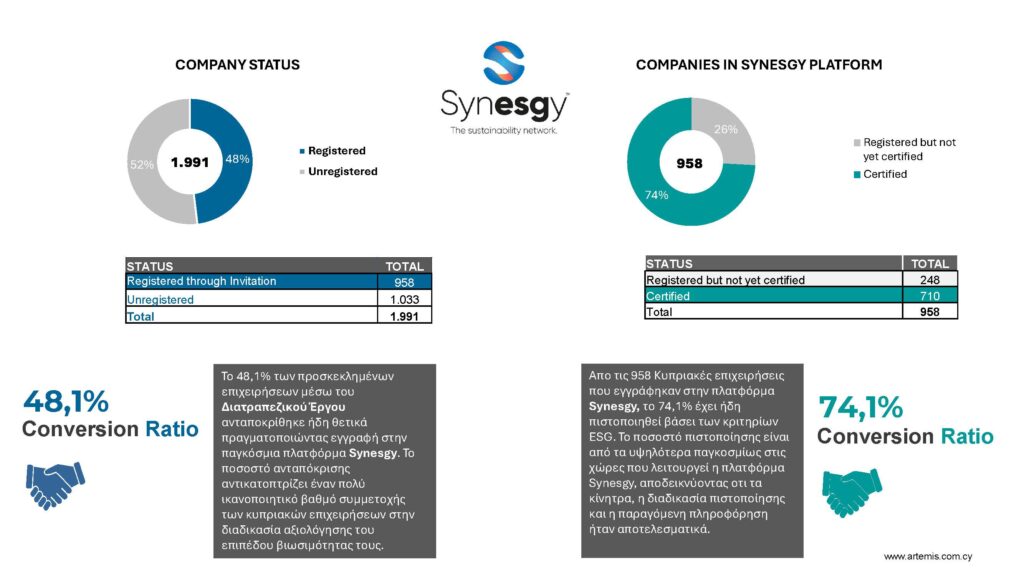
The data of the first year of operation of the project are encouraging:
- 1,018 Cypriot companies responded positively to the invitation.
- 74% of these (754 companies) have already been certified.
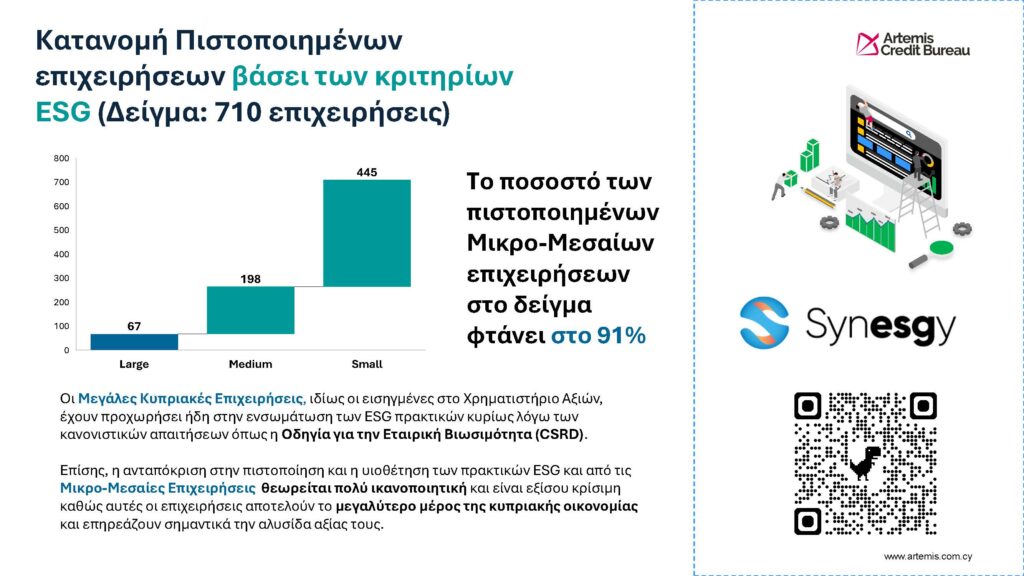
- 91% of those certified are small and medium-sized enterprises, despite the lack of regulatory obligation.
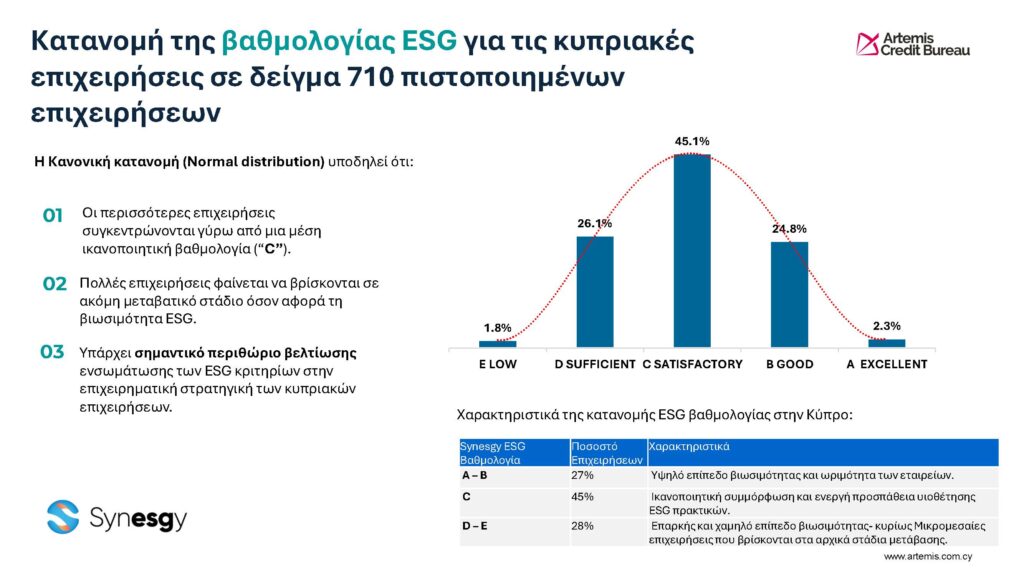
General Sustainability Assessment: The distribution of the ESG score for Cypriot businesses follows the Normal Distribution. On a five-point scale ("A" to "E") in which "A" corresponds to Excellent and "E" to Low, the majority of companies (45%) rank on the "C" scale (Satisfactory). The normal distribution with a "C" average indicates a sound start and interest in ESG practices in Cyprus by businesses.
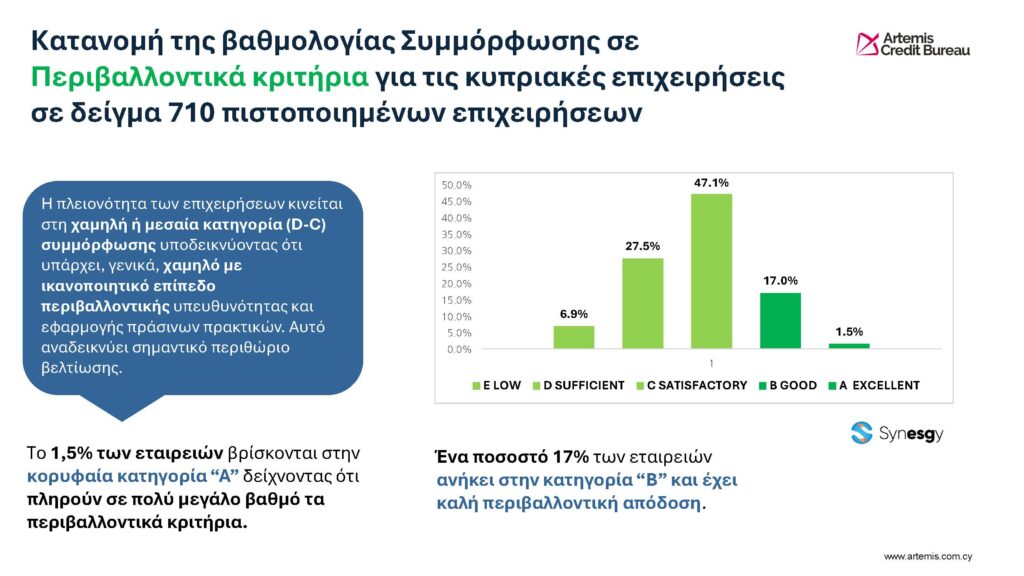
Environmental Criteria: The majority of enterprises (74.6%) move to the medium or medium to low category ("C"-"D", Satisfactory and Adequate). 1.5% of companies are in the top category "A" while 17% of companies belong to category "B", having good environmental performance.
Social Criteria: 77.8% of enterprises have moderate to low social performance ("C", "D", "E") with a lack of action in relation to social issues. The remaining 22.2% of enterprises meet the social criteria to a satisfactory degree ("A"+"B") by adopting good practices in the workplace.
Corporate Governance Criteria: 5.9% of companies demonstrate very satisfactory governance standards (score "A"+"B"). 70.7% of companies are underperforming or underperforming ("D"+ "E") – this is likely due to limited resources, informal administrative structures and/or a lack of relevant specialist knowledge in the field of corporate governance.
Small and medium-sized enterprises at the forefront
The active participation of SMEs is a positive sign of growing awareness. Although they are not required by regulations, they responded dynamically to the invitation. "This shows maturity and intention to prepare for the future, which will give them a competitive advantage," underlines Mr. Bourpoulas.
The critical role of banks
Banks act not only as financiers, but also as guides for businesses in the transition to sustainable standards. Through ESG assessment, they can offer more favourable financing terms to high-performing companies, while contributing to the formation of ecosystems of partnerships with good ESG practices.
Training and dissemination of good practices
Since the start of the project, Artemis has worked with business operators and banks, training over 600 frontline banking executives. At the same time, it co-organized conferences, such as the first on Credit Risk Management in 2024, while the second annual conference is scheduled for October 23, 2025 at Hilton Cyprus.
Strategic objectives 2025-2026
Mr. Bourpoulas points out that our main goal is to increase the number of Cypriot companies that will be certified based on ESG criteria on the Synesgy platform. He emphasizes that the Cypriot banks are the helpers in this effort, which have supported the Interbank project from the very beginning. In terms of communication, we will continue to promote the Interbank project through targeted communication actions in the Mass Media.
With the increase in the number of certified companies, we will be able to process the data in greater depth, he notes and points out that our goal is to create sectoral benchmarks so that companies can compare their performance with the average of their industry.
It also notes that another, fixed goal is the continuous servicing and support of the needs of banks within the framework of the Project, both at a technocratic and operational level. At the technocratic level, the investment of our strategic partner in the ESG project of CRIF S.p.A. helps us, as the questionnaires and the Synesgy platform itself are constantly updated and upgraded.
At the same time, as Artemis Credit Bureau, it undertook a parallel initiative with the Interbank Project to strengthen the role of Cypriot businesses as managers of their own value chain. Through the Synesgy platform, they are given the opportunity to evaluate the performance of their suppliers, partners and customers. In this way, the ESG ecosystem in Cyprus is strengthened and transparency is promoted.
Finally, at this stage, the creation of ESG training programs for businesses through the Synesgy platform is being studied, which will be specifically designed for small and medium-sized enterprises with limited resources and/or relevant know-how. In general, the Synesgy platform is constantly being upgraded, responding to the needs of businesses, worldwide.
The next two years include:
- Increase in the number of certified businesses.
- Creation of sectoral indicators for benchmarking.
- Training programs for SMEs with limited resources.
- Extend the evaluation to suppliers and partners.
Omnibus proposal: Extension but no change of course
Mr. Bourpoulas clarifies that the Omnibus proposal simplifies and postpones companies' ESG reporting obligations, without changing the EU's strategic orientation. "Businesses need to continue to implement their sustainability strategy. The postponement is an opportunity for better preparation, not for inaction," he points out.
