Filenews 19 July 2024

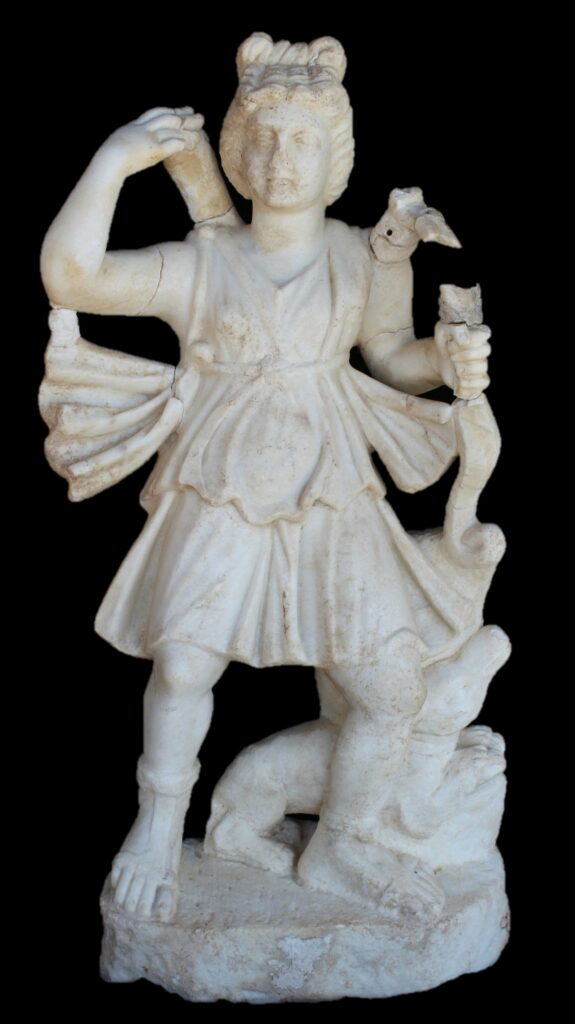
A marble statue of Artemis, twin sister of Apollo, was found during this year's excavation season in the ancient city of Kourion.
Particularly important were the findings during this year's excavation of Building 4, a large and imposing building near the "House of the Earthquake".
The statue, which dates back to the 4th century. AD completes the couple born from the coupling of Zeus and Leto, since in 2022 a marble statue of Apollo-Harpocrates had been spotted in the same room.
Artemis has a height of 80 cm. and appears standing in an active position with slightly bent knees and one leg in front of the other. She wears an airy tunic tied at the waist and sandals with straps. Her right hand touches over her shoulder where she finds the quiver, while with her left hand she holds her bow. She is accompanied by a sitting dog resting on her left knee.
On her lips there are traces of red colour, which means that she would have originally been painted in bright colours. It seems that the upper part of the arch, between the left shoulder and the left hand, would have broken in three places in ancient times and was then repaired using iron ligaments and lead sheets.
The Department of Antiquities has announced the end of the 2024 excavation season of the Kourion Urban Space Project, under the direction of Thomas G. Davis, Deputy Director of the Lanier Centre for Archaeology at Lipscomb University, Laura A. Swadek (Assistant Professor of Anthropology, Phoenix College) and Lucas Grimsley (Lanier Center for Archaeology). The mission also collaborated with the Australian Institute of Archaeology and the University of Cyprus.
During this year's excavation season, the research team completed the excavation of Building 4, a large and imposing building near the "House of the Earthquake" in the ancient city of Kourion. Building 4 is estimated to have been destroyed by the earthquakes of the mid-4th century that struck Kourion and other Mediterranean cities. It is obvious from the deposits of broken objects and the accumulation of building material found above Building 4 that it had never been repaired after its collapse. Instead, it was buried with rubble resulting from the city's clean-up efforts after the earthquakes, when other parts of Kourion were being rebuilt.
The team excavated a total of nine interior rooms in Building 4. Of particular importance is the room located on the east side of the building, which would probably have public use. This room was surrounded by a large outer wall in which tanks were inserted for the storage of fresh drinking water. It had a mosaic floor, marble walls and would have been decorated with two marble statues.
The mosaic floor consists of white mosaics which are framed by two strips of black colour. Between these bands is inserted a reticular motif in black, which is divided into medals. In the corners, the mosaic is decorated with geometric shapes in red and blue. One of the walls of the room would bear marble. When the earthquake struck that destroyed the building, most of the marble collapsed from the walls and broke to the floor.
In 2022, the statue of Apollo-Harpocrates is located in this room and during this year's excavation season the marble statue of Artemis.
Bones of four earthquake victims
During this year's excavation season, the bones of four people who were victims of the earthquake were also found, who presumed to have fallen from the second floor. Among the skeletal remains were found three bronze coins of the 4th century, dated to the reigns of the Roman emperors Constantius II and Valens. On two of the coins traces of cloth survived, probably from their proximity to a cloth pouch or pocket.
Also, along with the skeletal remains, two metal keys and two lampswere found, one of which was decorated with a galloping horse. The victims of the earthquake in Building 4 brought their personal jewelry, including a pair of gold eartags with glass and pearl, and a pair of gold eartags with sintefion votes. A gold eartag with a chain and a gold necklace with crystal votes and an ornate clasp were also found.
The detection of lamps with the victims of the earthquake and personal belongings such as jewellery, coins and keys probably indicates that the earthquake had struck in the evening when people had already withdrawn to their homes or in the early hours of the morning when they were preparing for their day.
Under the debris of the walls in many of the rooms of Building 4, hundreds of fragments of frescoes were found. Motifs with black and red bands decorated some of the rooms of the building and there were more elaborate designs in red, aquamarine, blue, orange, black, brown and white. Among them was found a fragment of a mural bearing part of a human head in profile, which means that at least one of the rooms of Building 4 had a mural with a scene. Further study and reconstruction of the fragments will give more details about this scene.
The excavation of Building 4 has contributed significantly to the understanding of life in Kourion during the 4th century AD and the events that took place during the deadly earthquake after which the character of the city had changed. Although the findings of this year's research period were particularly important, the skeletal remains of earthquake victims leave us with most information about the human experience of living and dying in a Late Roman city in Cyprus.
