Filenews 28 February 2024

The competent Ministry took stock of what the Ministry of Interior has implemented and launched over the last year for the management of the migration issue.
Specifically, as stated by the Minister of Interior, Constantinos Ioannou, assessing the situation and aiming to create better management of migration, the Government of Nikos Christodoulides immediately adopted a new strategy, with a holistic approach, which is based on four central axes, which concern:
- reducing arrivals of new asylum seekers;
- speeding up procedures for examining asylum applications;
- improving accommodation infrastructure and reception conditions, and
- increasing the number of returns
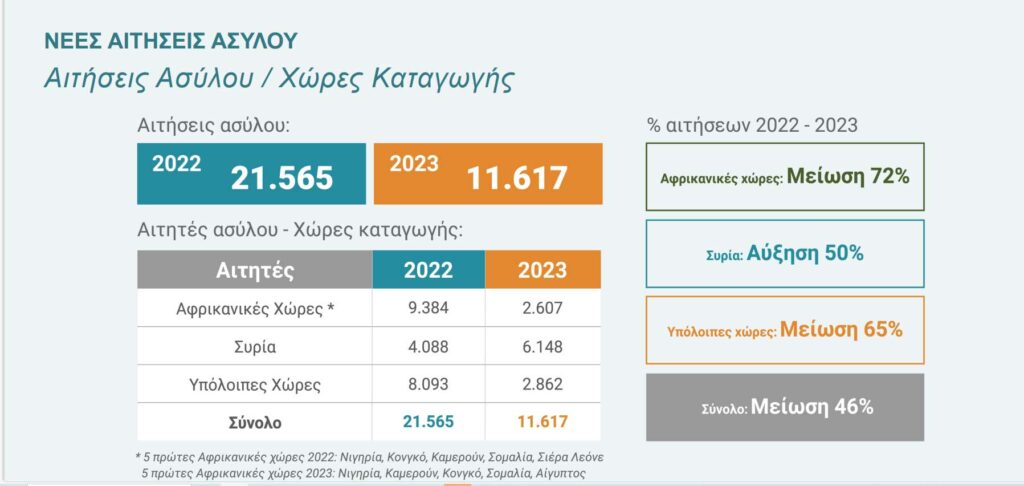
As the Minister explained, the result of the actions was, among other things, a 37% reduction in arrivals, while asylum applications also recorded a decrease of almost 50%.
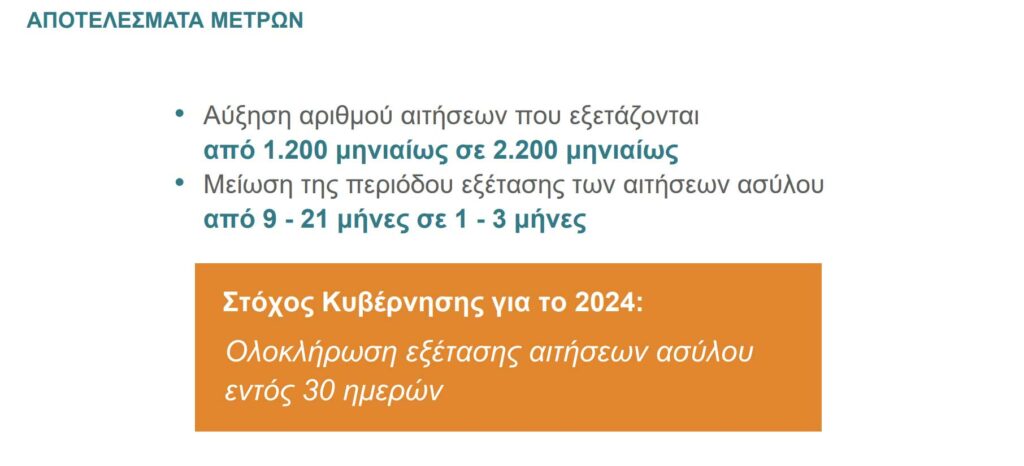
At the same time, thanks to the increase in examiners, it has been possible to reduce the period for examining asylum applications to a maximum of three months, with an average of 2,200 applications processed per month.
In total, as he pointed out, in 2023, 20,239 decisions were issued, with the Government's goal for 2024, as announced by the President of the Republic recently, being to further reduce this time and for decisions to be issued within 30 days.
In anticipation of tomorrow's debate in the Plenary of the Parliament and the possible vote in favour of the establishment of the Deputy Ministry of Migration, Konstantinos Ioannou called on all political forces to recognize the importance for the country of bringing together all migration and asylum services under one body, with this as the sole competence. "I am sure that in tomorrow's debate in plenary, this common finding will take shape," he concluded.
Below are the actions of the Ministry as presented by Konstantinos Ioannou:
Limiting migratory flows – Reducing arrivals
In particular, one of our findings concerned the mass arrivals of irregular migrants via the Green Line. These were mainly nationals of sub-Saharan African countries, who arrived via Istanbul Airport in the occupied territories with so-called student visas and then crossed into the free areas where they sought asylum.
What emerged was that the vast majority came to Cyprus for economic benefits and not because of the risk they ran in their country. Contributing to the uncontrolled migratory flows was the fact that smugglers, taking advantage of these people's need for a better life, created expectations among migrants, enticing them to believe that Cyprus is an "economic paradise", where they could have access to large amounts of benefits, as well as to the labour market until their asylum application was examined.
To address this parameter, we proceeded with a series of actions, aimed at reducing arrivals.
Specifically, among others, • We conducted an online information campaign in countries of origin, such as Nigeria, Cameroon and the Democratic Republic of Congo,
to inform potential migrants about the real conditions in Cyprus. This campaign was particularly successful, as the information page to which the promotion referred, garnered more than two million visits.
• We negotiated the Action Plan for the Eastern Mediterranean, in which we succeeded in including almost all the positions of the Republic, so that the Plan has added value for Cyprus, with measures limiting the uncontrolled arrival of migrants from Turkey, focusing on limiting the flows, mainly from Turkey.
• Indeed, especially in the actions concerning Turkey, we pressed the European Commission to take measures aimed at improving the degree of control of persons arriving in Cyprus through Istanbul Airport, with the help of Frontex and Europol.
• At the same time, we have taken measures to make Cyprus a less attractive destination, limiting the economic benefits. Specifically, through the interconnection of the systems of the Asylum Service and the Social Welfare Services, we ensured the immediate severance of benefits from all those whose application is finally rejected.
• At the same time, we increased the period of employment after asylum from one to nine months in order to limit access to financial resources, in addition to material reception conditions.
• In this context, we have intensified controls in sectors of industry to combat illegal employment, in cooperation with the Ministry of Labour and Social Insurance.
• In addition to the above, recognizing that migrant flows are the result of the actions of organized networks of smugglers, we focused on cracking down on the networks in cooperation with neighbouring countries of origin, enhancing the exchange of information.
• At the same time, we proceeded to the establishment of a special unit in the Aliens and Immigration Service of the Police, with the exclusive responsibility of identifying and dismantling smugglers' networks.
As a result of the above actions, arrivals decreased by 37%, while asylum applications also recorded a decrease of almost 50%. In contrast to Cyprus, where the number of new asylum seekers decreased significantly, in the rest of the European countries of the Eastern Mediterranean, there was an increase.
For example, in Greece the increase in new asylum seekers reached 72%, in Italy 61% and in Spain 38%. We had a sharp decrease of 72%, especially in the number of new asylum seekers from African countries. The data suggest that the problem of mass arrivals from Africa has largely been resolved. The optimistic thing for us is that, despite the increase in flows by sea, which are mostly Syrian nationals, overall there is a decrease.
Speeding up asylum procedures
A very important aspect of the problem was the fact that the examination of asylum applications was completed in an average of one year and in many cases, this period exceeded 21 months. On the one hand, this was due to the large number of arrivals which made it difficult to manage applications. On the other hand, it was a result of the lack of staff at the Asylum Service and the delays observed in the legal process.
To address this problem, we have gradually increased and eventually more than doubled the number of asylum examiners, and we are now at 85 from 35 in March last year. Thanks to the increase in examiners, it has been possible to reduce the period for examining asylum applications to a maximum of three months, as an average of 2 200 applications are processed per month. In total, 20,239 decisions were issued in 2023. The Government's goal for 2024, as announced by the President of the Republic recently, is for this time to be further reduced and for decisions to be issued within 30 days.
At the same time, and in combination with the reduced arrivals, it was possible to process many of the pending issues and the number has now been reduced to about 26,000. In combination with the cooperation we developed with the Administrative Court of International Protection for the implementation of measures, as well as with the placement of an Asylum Service Officer on a permanent basis in the Central Prisons, it was possible to conduct daily interviews and speed up the procedures for examining applications.
The shortening of the examination period is a very important pillar of our policy, as it now acts as a deterrent to anyone who would consider arriving in Cyprus, in order to abuse the system to ensure long-term residence and employment.
Infrastructure improvement
Equally important in the effective management of migration is the axis concerning the improvement of infrastructure, which, by extension, affects the entire operation of the reception and hospitality system.
During 2021 and especially in 2022, Cyprus was subjected to migratory pressures disproportionate to its capabilities. Typically, as I mentioned in my introduction, the residents of the "Pournara" First Reception Center exceeded three thousand in 2022, while the capacity of the Center is about 1,100. In view of the remaining gaps in the time taken to process applications, satisfactory living conditions could not be ensured. The reception and accommodation system has started to be relieved by reducing arrivals and speeding up the examination of new applications. Today, the Center hosts approximately 700 people, a number that changes depending on arrivals and releases from the Center.
In addition, the Center has completed the improvement works for the transport of medical equipment, as well as other logistical equipment, which allows the operation of the Center under better conditions and provides the opportunity for better living conditions.
At the same time, the construction works for its conversion into a closed structure have been largely completed, thus limiting the exit and movement of migrants and increasing control and surveillance, in order to enhance the sense of security of residents in neighbouring communities. Construction works continue to upgrade the Centre and are expected to be completed later this year.
In addition, works are underway to upgrade and expand the Reception and Accommodation Center for Applicants for International Protection in Kofinou, with the aim of increasing the available housing units by 100, as well as creating a new medical center, entertainment areas and other infrastructure. The first phase of the project has been completed and completion is estimated within the first half of 2024, and the Center will have a capacity of 800 beds. Kofinou mainly hosts families with children or single men and women.
Finally, works have begun for the construction of a new Accommodation Center for Applicants for International Protection with a capacity of 1,000 people in the Limnes area as well as a Pre-removal Center in Mennogeia, with the capacity to accommodate approximately 800 people. The project is co-funded by the European Commission with €67.6 million. I have repeatedly said that the lack of a pre-removal centre, where people whose applications have been finally rejected and are under deportation could be detained in large numbers, is an obstacle to the completion of our plans. The fact that we do not now have this infrastructure acts as a brake on the effort to increase returns, since there is no space for the detention of rejected and illegal immigrants, until the completion of the necessary procedures for their departure. Therefore, at this point in time, the creation of such an area will make a very important contribution to achieving the objective of strengthening the field of expulsions.
Strengthening the return sector
Bearing in mind the lack of a pre-removal center for mandatory deportations, the Ministry of Interior has adopted targeted measures that have led to an increase in departures, whether they concern voluntary returns, deportations, or relocations. In particular, we have strengthened our cooperation with Frontex, while at the same time we are trying to secure more places in existing police detention centres, so that the police can carry out larger-scale operations to arrest illegals. In particular, it was decided to target operations on the basis of Frontex's scheduled return flights, both in terms of timing, available seats and countries of origin concerned by the Agency's flights.
In addition, we placed great emphasis on the voluntary return program with a financial incentive, which ranges from €1,000 to €1,500, depending on the country of origin. In addition, together with our partners in the European Union, we have made the most of the relocation scheme to other Member States, which has also contributed to the Union's project to reunite migrant families.
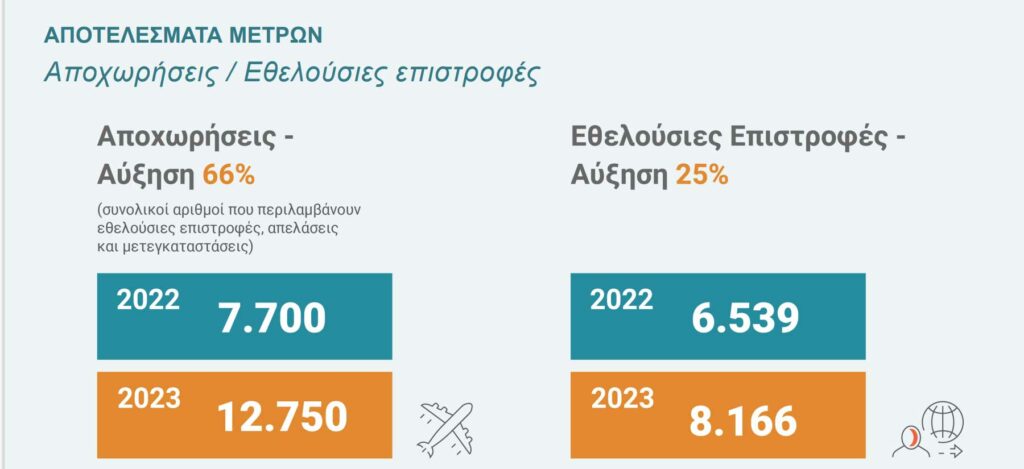
As a result of the above measures, we managed to greatly increase withdrawals from Cyprus. Indicatively, for the whole of 2023 we had an increase in the total number of departures by 66% compared to 2022, despite volatile exogenous factors affecting migration data. The same positive sign was recorded in January this year, following the encouraging results of 2023. More specifically, last month, 782 persons arrived in Cyprus, while the number of those who left our country reached 1,081, with the percentage of departures over arrivals reaching 138%. This positive balance between departures and arrivals has been stable over the last quarter and the corresponding rate for February looks set to be equally high.
In contrast to the rest of the Member States in the European Union, which record single-digit departures-arrivals rates, Cyprus, having implemented targeted measures, ranks first in the Union in terms of the rate of departures over arrivals and in fourth place in absolute numbers of returns and expulsions. Very important for us was the moment when, from Nicosia, the Commissioner for Home Affairs praised our country, urging other states to follow Cyprus' example. Equally commendable are the comments we receive from other European Ministers and officials responsible for migration, such as the EUAA and UNHCR.
Social inclusion and inclusion
Intercultural integration and the social inclusion and integration of migrants are among the main parameters of our migration policy. For this reason, we have proceeded with the elaboration of an integrated policy, which includes 50 actions divided into five sectors, aiming to create conditions for the smooth integration into the Cypriot society and economy of third-country nationals legally residing in the Republic of Cyprus. The issue of the integration of migrants is very high on the priorities of the European Union and UNHCR and constitutes a commitment of the Republic of Cyprus to its European and international obligations.
Specifically, the five areas concern housing, employment, skills improvement, education and health. We are in the final stage of completing the consultations with all the competent Services and other Ministries involved, and it is expected that the final text will be submitted to the Council of Ministers for approval in the next few weeks, within March, so that the implementation of the actions can begin as soon as possible.
At the same time, in cooperation with the European Asylum Agency, we are developing the National Strategy for Reception, which establishes guidelines for procedures from reception to accommodation. Finally, in cooperation with EUAA and the Deputy Ministry of Social Welfare, a manual is being developed for guidance for guardians who undertake the supervision of unaccompanied minors, in order to strengthen their protection and support framework.
Eastern Mediterranean Action Plan
As a frontline member state and having largely resolved the problem of increased flows of Africans, Cyprus focuses on addressing the disproportionate pressures it faces from nationals of neighbouring Syria, who often use countries such as Lebanon as a transit point.
Through our contacts with officials from the Commission, Europol and Frontex, we have promoted initiatives to strengthen cooperation with countries of origin and transit, with a focus on enhancing effective border management along the Eastern Mediterranean route. In addition, we are looking for ways to create the conditions that will allow illegal immigration to be replaced with legal immigration, for the benefit of our economy and the labour market.
In addition, through our various actions, we have been able to strengthen improved asylum procedures and intensify returns, intensifying our cooperation with countries of origin and transit.
Reassessment of Syria's status
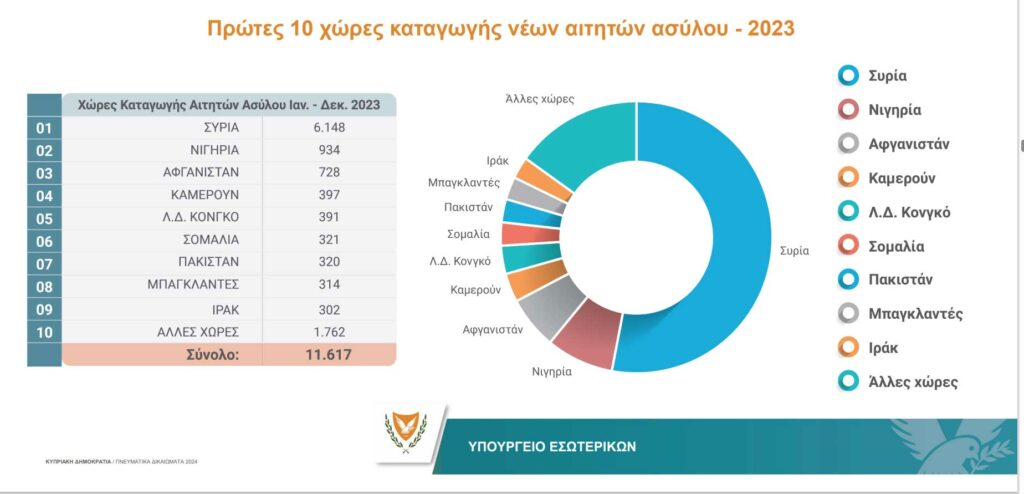
The large number of arrivals of Syrian nationals arriving in our country via sea routes from Syria or Lebanon is a cause for concern. Typically, in 2023 this number increased by 50% compared to 2022. What can be seen from the data collected is the admission that these individuals are promoted and exploited by organised migrant smuggling networks.
This fact calls for stepping up our action to combat this form of crime. We raised the issue urgently with the competent bodies of the European Union, calling on them to take more active action to strengthen the operational capacity of countries, with the involvement of Europol, in the framework of the Action Plan for the Eastern Mediterranean. During Commissioner Johansson's last visit, we managed to obtain her commitment to seek the creation of a coordination team under the umbrella of Europol, with the participation of the prosecuting authorities of Cyprus and Lebanon, in order to strengthen the effort made to coordinate the actions of the two services through the expertise of the Agency.
Finally, the Government of Cyprus has been promoting an initiative since last summer, in order to discuss and reassess the status of Syria, on the basis of the actual data prevailing in the country at that time and following the assessment made by the European Asylum Agency, according to which areas of Syria are considered safe. A new evaluation by the Agency is expected in April. A possible outcome at European level in designating specific areas in the country as safe will allow the return of Syrian nationals to them to be promoted, under strict conditions that will ensure their safety, significantly reducing the exploitation currently observed.
I will raise this issue again and urgently at the forthcoming Home Affairs Council to be held in Brussels on Monday. Already in our bilateral contacts with our counterparts, we see the interest in discussing the issue, and we expect that this will of the countries will be heard and we will be led to a political decision at European Union level.
