
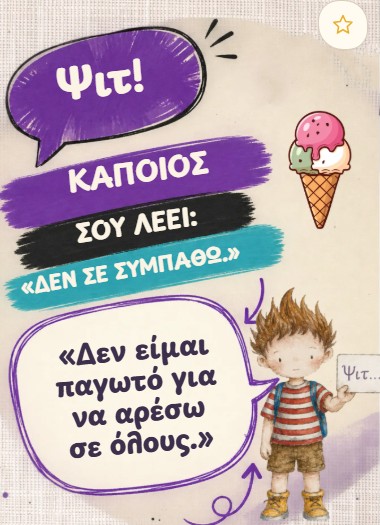
"Someone touched me in a way I didn't want to." "I'm not ice cream for everyone to like." "Your value doesn't diminish because someone didn't get to see it." "I don't feel safe now." In front of these and so many other scenarios and situations, is the visitor of "Pst! You have it!". An illustrated, experiential world of empowerment aimed at children from the age of six, which sprang from the imagination of a 13-year-old, from a small paper hero and an award-winning short film.
"Pst! You've got it!", it's an extremely creative, innovative and fresh tool. A digital state with beautiful designs and colours, where the more children go through it, the more they cultivate skills to face small or big challenges in life. They learn how to set boundaries, think positively, and get to know themselves in an interactive and playful way.
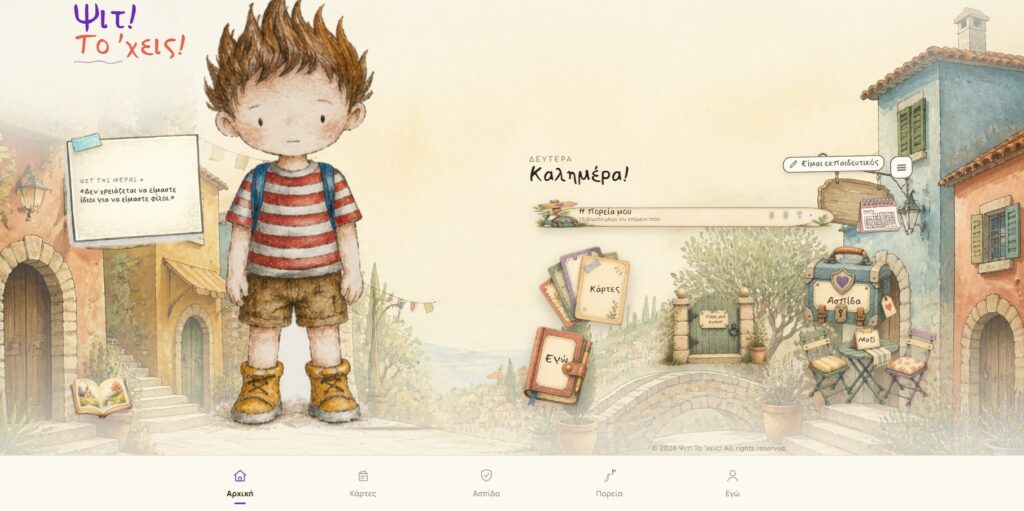
At the same time, however, they also have a shield in front of them, which is made up of telephone lines to ask for help, a button to notify someone close to them or even to communicate their problem with an adult they trust.
The initiative of "Pst! You have it!", supports "Hope For Children", which will present the tool on the occasion of International Children's Day, on November 20.
"Shield" when the danger is tangible
Where more than a line is needed, the "Shield" and the button: "SOS – Now what do I do?" are offered by Pst.
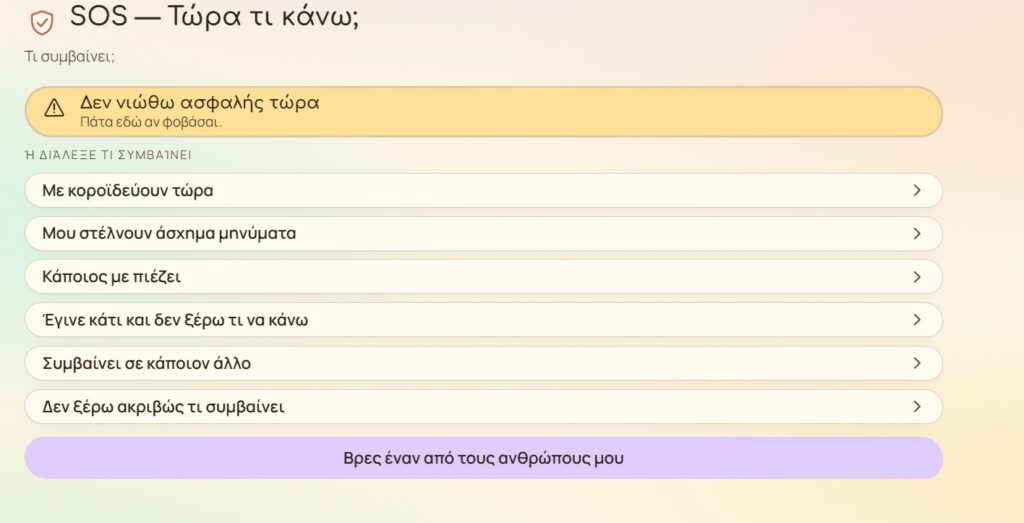
In this topic there is the option "I don't feel safe now", which leads the child to specific steps:
A) I need help with you now. Where helplines are gathered.
• 116 111: Support line for children and adolescents.
• 1466: National Helpline of the Hope For Children CRC Policy Center in collaboration with the "VOICE" Council.
• 112: Single pan-European emergency number (e.g. Police, Fire Brigade).
B) This needs a safe major. This message is addressed to an adult who will choose the child. It reads:
"You need to take this seriously."
"The priority now is the safety of the child. Listen without questioning. The child does not need to prove anything. Don't let the child handle it alone. Remove the child from anything that puts him in danger, if possible. Don't promise silence about something dangerous. Ask for immediate help from the competent services: 116111, 1466 or 112".
C) Find a safe adult. Find a safe adult and tell him what's going on. If you're having trouble saying, you can show him this screen.
• He doesn't have to be the person who is with you now.
• If the first grown-up doesn't listen to you or help you, you can tell someone else. Keep going until someone helps you.
D) What is happening? Choose what fits. Here are incidents described and a first support is included:Someone touched me in a way I didn't want to. Answer: "This is not your fault. Your body is yours. Even if you froze, didn't say "no," or didn't know what to do, you can say it now. You don't have to decide if it was 'serious enough'."
Other incidents:Someone hit me or tried to hit me.Someone forced or pressured me to do something I don't want to.Someone threatens me.I'm afraid that someone might hurt me.
When you respond to mockery with humour
One of the most characteristic sections of the platform is titled "Do you want to answer and don't know what to say?".
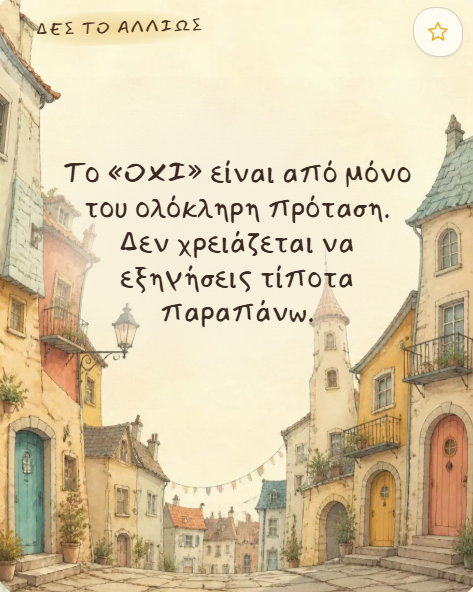
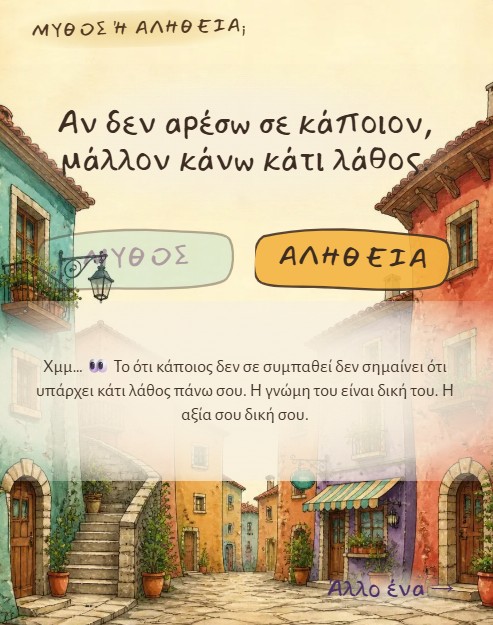
In it, the child finds inventive answers for difficult social moments, without having to resort to aggression or confrontation. "You have a few words in your pocket. A little humour, no drama at all. Choose the ones that suit you."Someone tells you that there's nothing you can do: "Penguins can't fly either, but they're still cool."Someone keeps making fun of you for something you're doing: "Watermelon doesn't care about broccoli opinion at all."Someone tells you that not everyone likes you: "Even pizza is not to everyone's liking!" or "I'm not ice cream for everyone to like."
Someone tells you you're curious: "'Different' suits me better."Someone says to you "Slow down, we were kidding!": "The joke probably didn't work!".Someone asks you "Are you wearing the same clothes again?": "Yes, fortunately they suit me and they suit me a lot!".
Practical tools for difficult times
In the "Management Tools" section, "Pst" offers practical techniques for situations that may cause anger, embarrassment, frustration, or insecurity.
These are interactive tools, which children can pin to have at hand or accompany with personal notes.One of them is "I don't bite", which urges the child to remain calm and move away when someone tries to provoke him."3-2-1" Before answering while you are angry: 3 seconds stop, 2 deep breaths, 1 thought. "What do I want to do now?".Bad message or comment? Don't erase it yet. Screenshot first and show it to someone great.
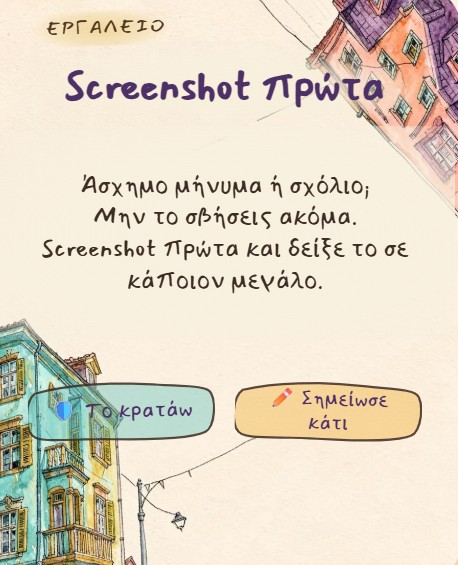
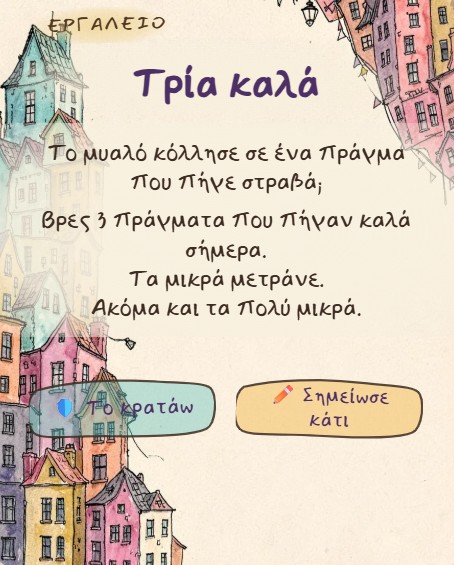
Don't know what to say? Don't you like where you are? Say "I have to go and go."Did you make a mistake and blame yourself? Ask: "If I had made it my friend, what would I have said to him?" Say the same to yourself. Did the mind get stuck on one thing that went wrong? Find 3 things that went well today. The little ones count. Even the very small ones.
"Look at it differently": Twenty small reminders
A different approach is offered by the "Look at it differently" section, which includes 20 short tips.
Among them are phrases like "A bad day is just a bad day," "Your value doesn't diminish because someone didn't get to see it," and "You don't have to know everything to get started. You learn some on the street." "Asking for help does not mean 'I can't'. It means 'I don't have to do it myself.'" "The fact that the others moved faster does not mean that you were late. You don't run the same race." "Sometimes the bravest thing you can say is, 'I don't know.'"
How to learn to say "no" and "stop"
Of particular importance is the "Find a way to say" section, which focuses on phrases and needs that children often find difficult to express.
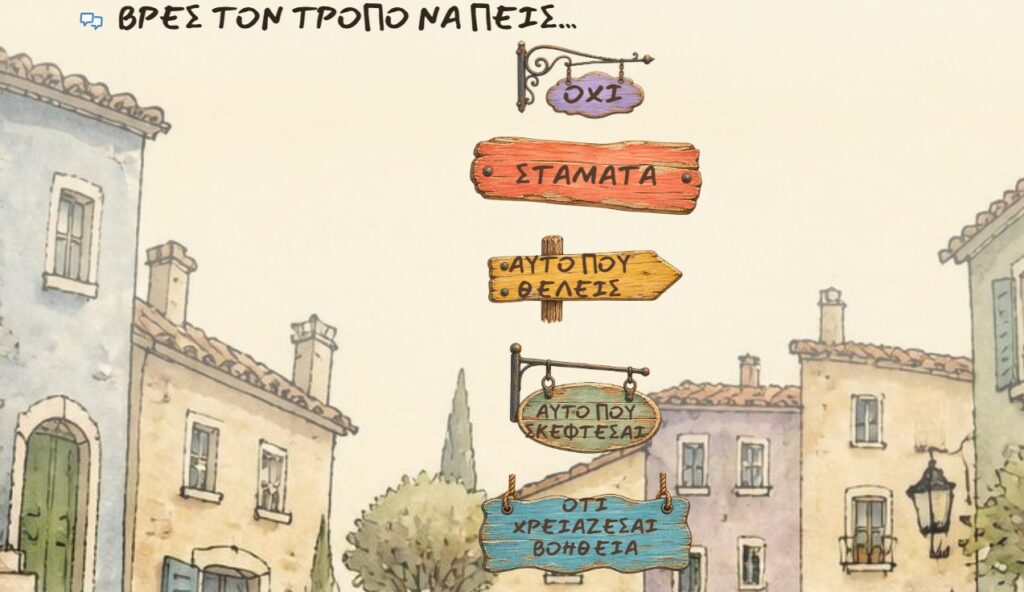
The tool helps them find their own way to say "no", "stop", say "what you want", "what you need", "ask for help".
For example, in order for a child to set a limit, different options are offered, depending on the way he feels most comfortable expressing himself.
Find a way to say stop
Clearly: "I don't like it, stop"
Calmly: "Don't do that, please"
Constantly: "Stop, he told you I don't want to"
A map with 260 empowerment steps
Another creative aspect of "Pst! You've got it!" is the interactive map of personal development.
Through it, children can track their daily progress and wander through different thematic areas, linked to their personal empowerment.
Among them are the "City of Self-Confidence," the "City of Positive Focus," and the "City of Choices."
The map includes a total of 9 points and 260 steps.
13-year-old Anna and the paper hero
It all started with Anna, a 13-year-old girl and a little paper hero, the protagonist of the animation film "Upstander".
The film in question, created by Anna Mavrommati, is made from hundreds of photographs and deals with the story of the moment when a child decides not to remain a mere spectator in the face of something that is not right.
"Upstander" won the First Prize at the Cyprus Film Days Children & Youth 2026, in the Secondary School category. But, he ended with a question. "How can we help a child find his voice not only in a difficult time, but in his daily life?"
Anna decided to try it and her idea became the starting point for the creation of an original online platform, a tool for daily mental and socio-emotional empowerment.
