
The Rialto is definitively returning to the city that kept it alive. The historic theater of Heroes' Square passes to the Municipality of Limassol, after a long journey that began long before the current settlement of its ownership status, in which the people of the city claimed their theater that was founded in the 30s and is still an integral part of the cultural heritage of Limassol.
But to remember how different the picture could be today, one has to go back to the early 90s. When its fate was hanging by a thread, with the possibility of its demolition and conversion into a parking lot. A group of citizens was the one who was activated, managing through a spontaneous, selfless self-organization to highlight it as a key issue of the city and, ultimately, to contribute decisively to its rescue.
It all started in September 1990, when Evis Michaelides, a jewelry designer, activist and known for his involvement in the Limassol community, was informed by the architect Maximos Pantelides that plans had been requested to demolish the Rialto and create a parking lot in its place. The information came as a shock. "We had to immediately inform, mobilize the people about these plans, looking forward to the possibility of organizing and claiming," he recalls speaking to "F".
"Initiative to save the Rialto"
The first gathering took place at the social hangout "Chrysallida", a self-managed social space housed at 13 Christodoulou Sozou Street in Limassol and was a central point of reference for the alternative space in the 1980s. Many more meetings and discussions followed, with the participation of people from different fields, organizations, groups and citizens who felt that along with the old theater, a part of the city's memory was in danger of being lost.
"With its demolition, all those beautiful memories that everyone lived from the '50s were also demolished," says Mr. Michailidis. This is how the "Rialto Rescue Initiative" was created, an independent group with no hierarchical structures. The assemblies were open and the turnout was great. "More than 150-200 people must have passed through these open assemblies," he adds.
After each assembly, they made new leaflets and continued to inform the public. Among the interventions of the Initiative was the effort to highlight the architectural value of the theater and to keep the issue alive until a solution is found.
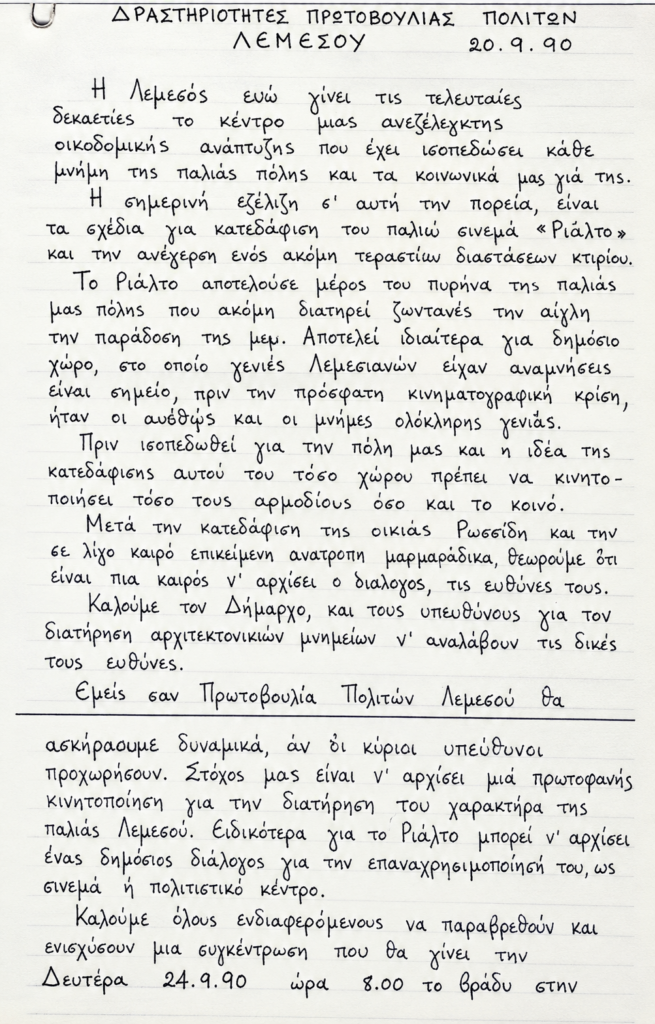
The initial core of the Initiative included, among others, the architect Sevina Floridou, the sociologist Andreas Panayiotou and many other Limassolians from the fields of culture, architecture, journalism, civil society and politics.
Andreas Panayiotou recalls that Limassol already had a strong alternative movement since the 90s. They were people returning from studies abroad, but also a wider climate that had already begun to take shape in the 80s. The protection of public spaces, after all, had its roots even further back, in the 70s, when there were mobilizations for the beaches.
"In the 90s, two issues arose. The area, as it was being formed, began to make interventions for the preservation of historical buildings of Limassol, with an initial focus on the preservation of the Castle area. Until suddenly the issue of the Rialto arose, which they wanted to flatten. Then the mobilization began. There were some rallies just below the Square, in "Chrysalida", and through these mobilizations the issue of saving the Rialto as a historical site was raised."
He also remembers the rally on Athinon Street, where people from different places began to gather. "As soon as the event became public, people began to mobilize. The mobilization expanded. We met, we drafted the texts, we sent them, we put out announcements and leaflets, all written collectively."
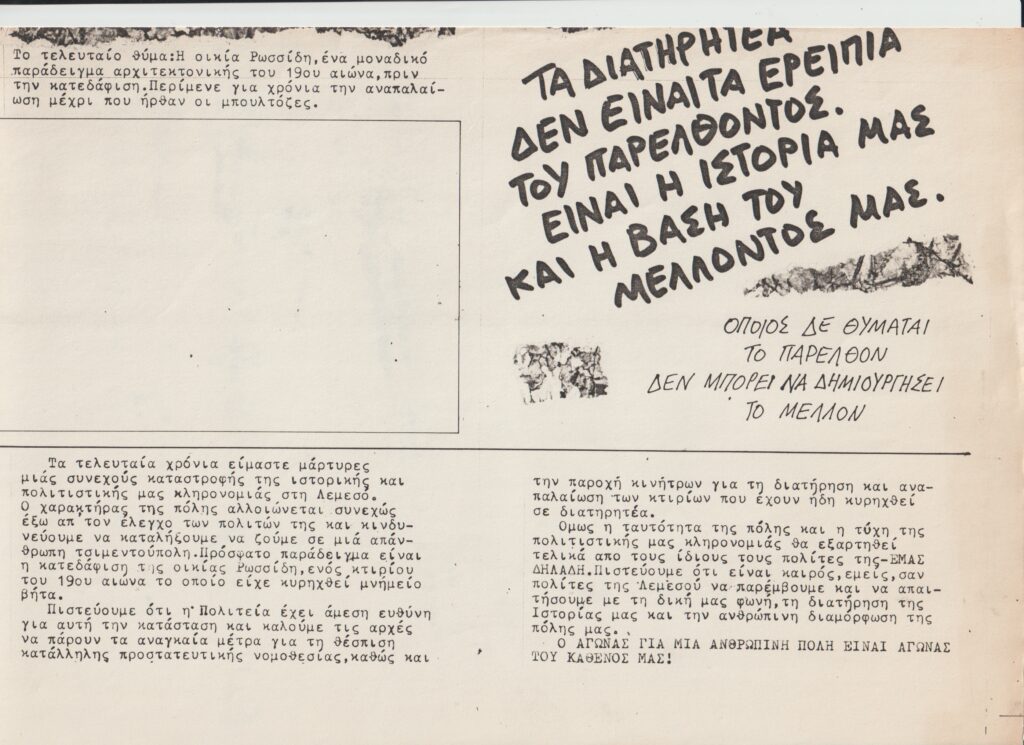
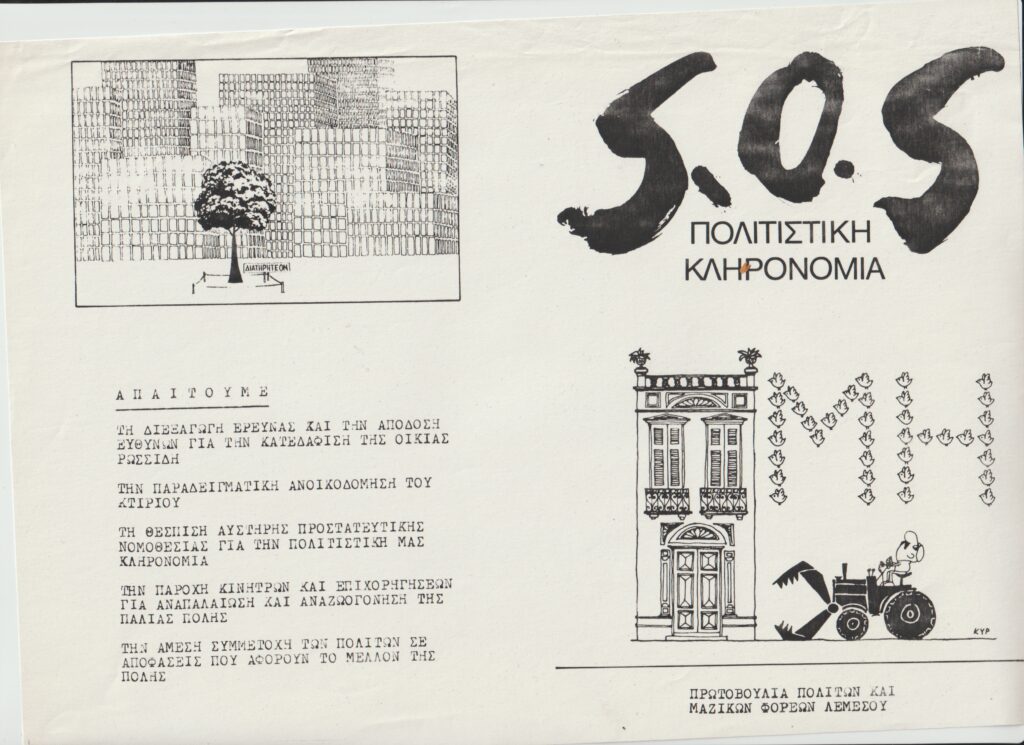 From the archive of the sociologist Andreas Panagiotou, which testifies to the social turmoil of the time.
"It was our 'Cinema Paradiso'"
The architect, Sevina Floridou, an active member of the initiative, spoke to us about her own personal relationship with Limassol at that time, which was then beginning to change rapidly. "I had just moved to the city and rented offices in one of the lanes of the area, thinking that I had come to a historic city. And suddenly I realize that around me at that time there were plans for a rapid change – a change in its physiognomy, based on an American philosophy, with a car culture.
Among the plans were to widen roads, demolish buildings, make a bunch of changes. Part of all these modifications of the city was the Rialto, whose plans were to convert it into a supermarket or a parking lot. In any case, however, it was destined to be demolished and converted into something else, completely different."
The value of the Rialto, according to the architect, goes beyond its architectural substance. It is a building that was associated with the collective memory and identity of the city, as from the first moment of its presence in Limassol it acquired a special social role.
"The essence of the building is intertwined with the common emotionality, with the identity of the city. In addition to the architectural aesthetics and social status of the building, it touched everyone and was important to society from the moment it appeared. It was perhaps one of the first public buildings where the people of the city could attend joint events."
The architect also dwells on the relationship between the building and the urban landscape of the time. The Rialto, with its modern architecture, stood out both in volume and form, in an area that, as he explains, was then degraded. "It had an Ottoman bath run by a Kefoglou, while in the beginning it was an open space where donkeys parked. When the English came, the city was more structured to the west, towards the port. The part of the city to the east was shallower, so no building stood out. It was a very degraded, as we all know, corner of the city."
The appearance of the Rialto changed this image, not only because of its presence in the urban space but also because of the new way of social life it brought with it. As Ms. Floridou says, "as soon as the volume of this building and its role in society appeared, it began to attract people who put on their best clothes to go, in a ritual way, to have a good time, to listen to music."
The Rialto was, at the same time, a place where important personalities were hosted and important events of the city's cultural life took place. "It was the place where Solon Michailidis played pieces for the first time. Great personalities have passed through the Rialto," he notes.
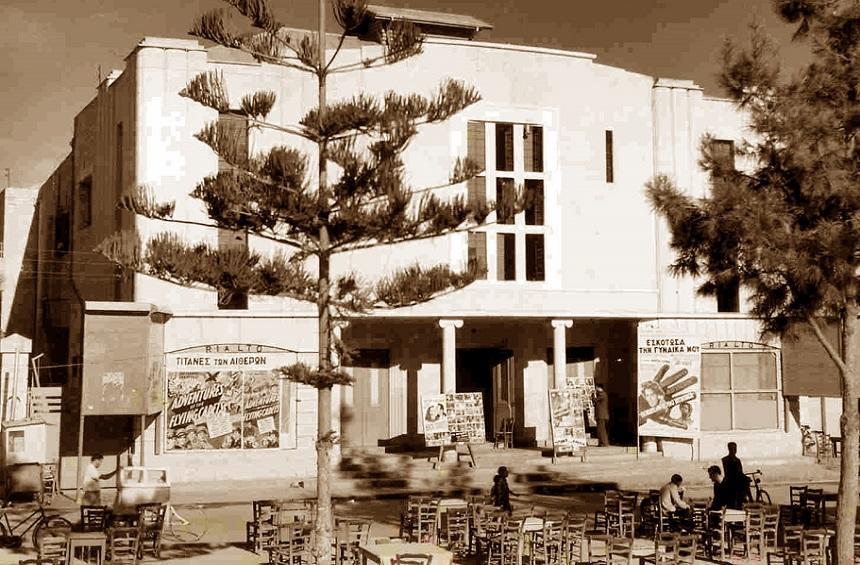 From the archive of the Cyprus University of Technology (CUT)
He also attaches particular importance to the social role of the theatre as a meeting place for Greek Cypriots and Turkish Cypriots. "It was also important that it was accessible to Greek Cypriots and Turkish Cypriots. The world was not divided then." He cites, in fact, as an example the event for the reopening of the Rialto, where Nicos Anastasiades and Mustafa Akinci referred to their own childhood memories of the theater. "They remembered that when they were kids, they used to go to the cinema there."
This relationship with the personal and collective memory of the city is perhaps what, according to Sevina Floridou, makes the Rialto so special. "There is no Limassol who does not touch the memory of this building, because it was a place of intense socialization." And he even connects this relationship with the city's cinematic tradition: "It is no coincidence that we have so many Limassol directors who grew up there and who all have a relationship with it since their childhood. It was our 'Cinema Paradiso'."
The solution of the Limassol Cooperative Savings Bank
In the 2019 article about the 20th anniversary of the reopening of the theater, Andreas Christou remembered that period and described his own anguish. "After a meeting of the Committee where it became clear that our efforts were leading to a dead end, I told Hambis Genethliou characteristically that "the RIALTO is gone, we are losing it. It will be sold and demolished and with it the memories of the people of Limassol will be demolished."
And then something decisive happened. The solution came from the Limassol Cooperative Savings Bank. As recorded by Andreas Christou in 2019, Hambis Genethliou acted as a bridge between the Initiative Committee and the Cooperative Savings Bank Committee and put forward the idea of Rialto buying the STL and keeping it for Limassol. Evis Michailidis attributes the decisive suggestion to Melios Georgiou, to the Committee of the Cooperative. The proposal was adopted and in February 1991 the Cooperative Savings Bank bought the abandoned theater.
The purchase was the beginning of a much larger effort, with the expansion of the stage and auxiliary spaces through land acquired behind the Rialto, while the Cooperative Savings Bank also allocated money for the improvement of Heroes' Square. An architectural competition followed in 1994, the project was announced in 1996 and work began in 1997.
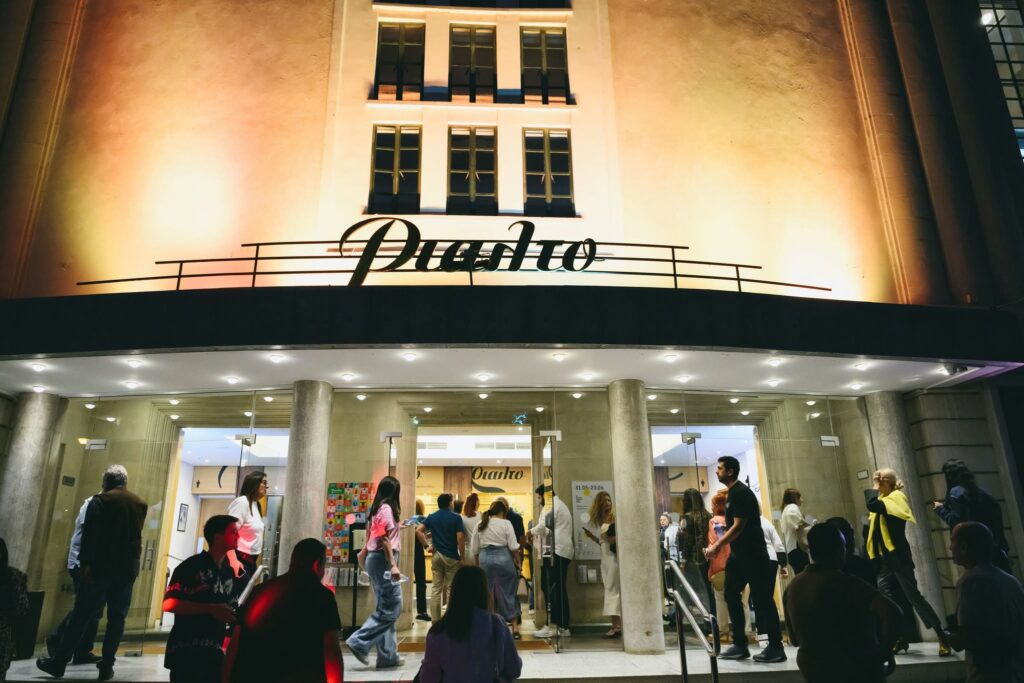
Architect Themis Themistocleous undertook the design of the new Rialto. The old cinema was restored and converted into a modern theater, retaining important elements of its historical identity, reopening its doors on May 15, 1999. Its reopening marked a wider effort to revitalize Heroes' Square and old Limassol.
According to Ms. Floridou, "The façade was kept intact, as was the request. The room had some beautiful elements and some peculiarities. The balconies with the galleries on the side were more stylized, not so linear and modern, because we were at a crossroads between classical and modern architecture. The more industrial features inside the building had not yet been clarified. He had a stylization that was kept."
From "Chrysalis to Today
Thirty-six years after the then "Rialto Rescue Initiative", history seems to be coming full circle. The people of Limassol found themselves once again activating around the historic theater and claiming it for their city.
From the "Chrysallis" of the early 90s to today's mobilization, through dozens of public statements by people in the city, from the artistic and not only field, the Rialto has become an example of how the power for change can start from below, from people who meet, organize and decide that they will not let a decision pass in their absence. And when this collective demand gains enough momentum, it can reach the institutions and change the very course of a city.
For Evis Michailidis, the importance of history lies in the struggle itself. "On how the inhabitants of a city themselves, as active citizens, can self-organize, mobilize, claim and, ultimately, bring about change."
Andreas Panagiotou explains that the central point of the action was the participation of citizens in the city and the claim of the right to have a say in decisions concerning the place in which they live. "There are buildings for which we fought whole struggles to save them, but in the end they were razed to the ground. Some others, however, were saved." And, at the same time, as Mr. Panagiotou adds, Heroes' Square was the place where a cultural change was taking place. "An area frequented by Vassilis Michailidis. It was and is part of our history."
And perhaps Rialto's relationship with the city can be summed up in the words of Sevina Floridou: "Heroes' Square exists because it is the Rialto. And the Rialto is part of the Square and the whole of Limassol."
