
THE YOUNG PEOPLE OF THE REGION HAVE A VOICE AND IT IS HEARD - HOW THEIR IDEAS AND PROPOSALS CAN BE TURNED INTO EFFECTIVE LOCAL INITIATIVES - Filenews 25/10 by Marios Demetriou
The voice of young people from rural, semi-urban and peripheral areas of free Cyprus, asking for their meaningful participation – through dialogue – in the processes that concern them in the local communities where they live, was heard at the conference entitled "Youth Voices Into Action", which the non-governmental organization for Social Policy and Action (SPAO) organized in the framework of the GivEUvoice project co-financed by the European Union.
The conference took place on Saturday, October 17, 2026 at Eleftherias Square (lower tier) in Nicosia, as part of the all-day festival "Erasmus+ Festival Nicosia 2026" organized by the Municipality of Nicosia and the Foundation for the Management of European Programmes (CPERI) Lifelong Learning, as part of the 10th anniversary edition of the Erasmus Days 2026.
The Organization for Social Policy and Action participated in the festival as a beneficiary of the Erasmus Program, among other bodies that implement it in Cyprus, such as public and private secondary schools, academic research centers and other organizations, which operated kiosks and interactive stations in the festival area, promoting to visitors the Erasmus+ Program for education, training, youth and sport.
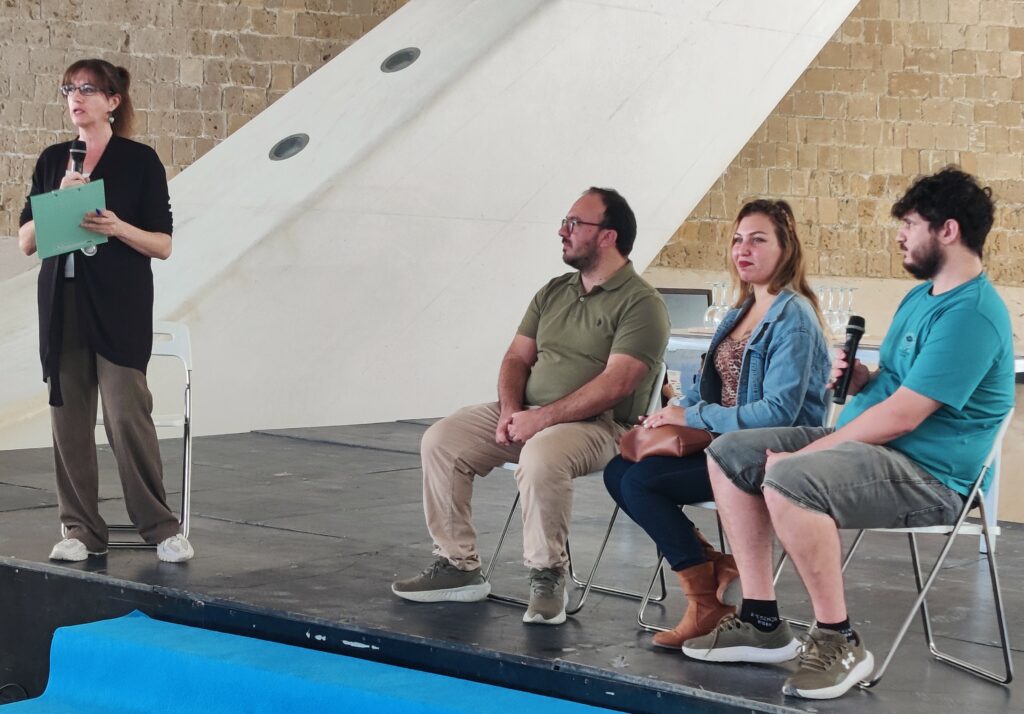
The event included creative and interactive activities for young and old, music, dance and various presentations, with a special focus on digital, green and basic skills across Europe. Of particular interest was the discussion moderated by the executive and scientific director of SPAO, Ifigenia Katsi, with 26-year-old Natalie Mannouri, 27-year-old Andreas Meletier and 37-year-old Antonis Adamou, who participate in GivEUvoice.
Ms. Katsis told "F" that "through the conference, the results of GivEUvoice were presented and the views of the young people themselves were heard and how their ideas and proposals can be turned into effective local initiatives". Mrs. Katsis told us that the action of SPAO at the local level includes meetings with representatives of the communities of western Nicosia, where its headquarters are located, such as Kokkinotrimithia, Agioi Trimithias, Denia, Mammari and Paliometocho.
A European experience in Oroklini
"Through these projects, many young children who face a variety of challenges have been empowered," the director of SPAO told us and referred to the real cases of three young people who participated in the organization's programs. He first spoke to us about 21-year-old Andreas, stating that "he is on the autism spectrum and actively participates in the actions of the YouthSocialAct and GivEUVoice projects.
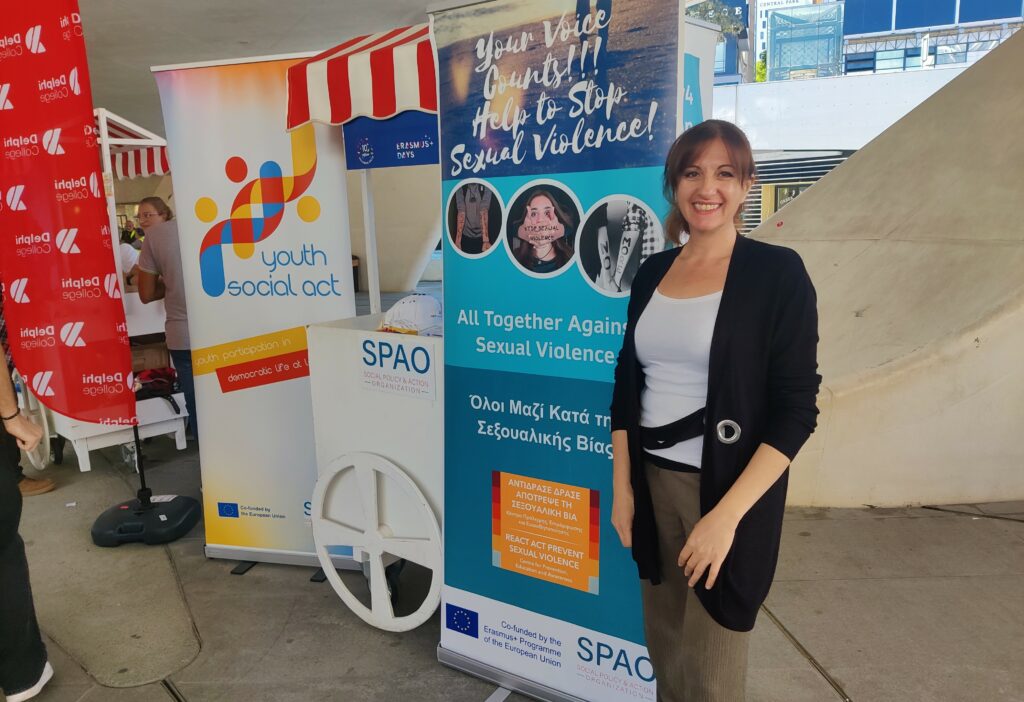
His first contact with the SPAO – he added – was in a transnational educational program of YouthSocialAct, which was organized in Oroklini. At first he was cautious, not sure if he would like the experience and for reasons of safety and comfort, he chose not to stay at the hotel. Every day he travelled to and from Nicosia. His participation in the program proved decisive.
The contact with young people from six different EU countries, the interactive exchange of views and ideas, the discussion around the priorities of the project, but also the multicultural exchange of knowledge about cultures and traditions, combined with the equal acceptance he received, created a deeply positive experience that pushed him to open up more: to socialize with other young people outside the program, to bring a guitar and Cypriot traditional dishes, to go out with them in the evening and share elements of their own culture.
His European experience at Oroklini was a turning point, as it encouraged him to register for other trainings abroad, in the context of GivEUVoice. Today Andreas is trained by our organization as a Youth Leader and Youth Worker, with the aim of contributing to the attraction and participation of more young people in Erasmus+ mobility, as well as their involvement in local actions of the YouthSocialAct, through the Youth Ambassadors programs. He is very interested in issues of sustainable development and mobility."
From a "weak student", a young and good leader
The second case concerns 20-year-old Stefanos who, as Ifigenia Katsi told us, "has been diagnosed with ADHD from an early age and is a typical example of a child who was targeted by his school environment. He found it difficult to stay focused on the lesson, spoke frequently in class, easily lost interest and was accused of creating trouble and problems.
At the same time, he was considered a "weak student" and was included in an afternoon remedial teaching program. Through his mother's voluntary participation in the organization's activities, we met Stefanos. From the first moment he showed a willingness to help and actively participated in the organization of specific activities. Because he met the age criteria of the Chance2Travel4Youth project, we encouraged him to participate in the project's last trip, to two European cities.
The trip involved five young people and two escorts, with all expenses covered, and Stefanos participated in all the preparation meetings, acted as an assistant escort, activated the children in the group, took care of the protection and safety of everyone – even one of the chaperones – and demonstrated increased leadership, critical thinking and empathy skills. Upon his return to Cyprus, he expressed the desire to participate in other mobilities abroad. We supported him to take part in a youth exchange in Spain, together with his sister, as they met the criteria for participation.
Stefanos surprised us again: he actively participated in all the activities of the program, formed friendships with other children and demonstrated significant critical thinking and empathy skills, especially through his direct contact with young people with physical disabilities. Today Stefanos is trained by the organization as a Youth Leader and Youth Worker, in order to support Erasmus+ actions and act as a multiplier, transferring to other young people the benefits of participating in such activities."
The "reconnection", after her first trip
The third case concerns 21-year-old Maria who, as the director of SPAO told us, "came into contact with the organization through her mother, who was very worried about her daughter. Maria was facing a severe form of workplace bullying, which had led her to social withdrawal, isolation and distancing herself from activities she previously enjoyed.
Her mother was looking for ways to support her, as her daughter's behaviour had changed significantly. After discussion and encouragement, we had a meeting with Maria, explained to her how we support each young person on a personal level and she decided to participate in a training workshop in Spain, together with two other girls. It was the first time she travelled abroad alone, without her parents or friends – an important step towards autonomy and personal empowerment. The friendships she created helped her "unlock" and reconnect with her social environment. After her return to Cyprus, Maria began to participate in actions at the local level and gradually become more actively involved, offering her own knowledge, experiences and skills.
Her participation in European and local activities was a decisive factor for her personal recovery, the strengthening of her self-confidence and her return to an active, socially connected daily life.
At the same time, during her participation in various actions, we were given the opportunity to discuss with her practical and useful tips for dealing with bullying behaviours in the workplace. Through this process, she was further empowered, gained greater self-awareness and developed skills in managing difficult situations, which contributed substantially to improving her daily life and bringing her back to a safe and supportive environment."
Mobility opportunities and volunteering
"I never thought that I would participate in the cleaning of a beach in a fishing village in Portugal, that we would have a flash mob in Madrid, or that in less than ten days, I would make friends for the rest of my life and even from different countries," Antonis Adamou told "F".
He added: "Beyond travelling, participating in actions and the skills one can develop, Erasmus+ opens up new horizons for you, as you have the opportunity to share concerns and exchange views with people from all over Europe and beyond, to feel truly a European citizen and to have your voice heard, both at local and European level.
Even today, at 37 years old, I continue to look for mobility opportunities, as they are not just for pupils and students. This year, with my participation in the youth exchange in Thessaloniki in the framework of the GivEUvoice project with the Cyprus team chosen by SPAO, I had the opportunity to meet young people from rural and remote areas from 7 other countries and talk about the problems we face, civic participation and the future we want to build.
The importance of volunteering in the community is great, because without expecting anything in return, financial or otherwise, you participate with your soul to contribute to your community or society in general. It can be a beach cleanup, a tree planting, participation in the organization of festivals, even a visit to a nursing home. You can do it in your own community, or in another one that needs it. And in fact, through the European Solidarity Corps you can do it in other European countries as well. Volunteering is important because it brings the community together around a goal, contributes to the environment and society and has an economic benefit for the area, since visitors will prefer it for their excursions."
Why do we find it difficult to hear?
Natalie Manouri observed that "young people's ideas about equality, mental health, rights, the environment or new ways of working, question the way older people grew up. In addition, the new generation is growing up in a digital, rapidly changing world and its challenges and stimuli are completely different from those of previous generations. So when young people propose new ways of thinking, the first reaction of older people is often defense or rejection ("you're still young", "you don't know how the world works").
Life experience is often confused with the exclusivity of truth, but experience points to the past, while the imagination and fresh look of young people point to the future. Being open-minded towards young people is not a passive attitude, but a conscious choice. We listen to young people, not to correct them or prove them wrong, but to understand their perspective.
Even if an idea seems foreign, strange or exaggerated to us, we need to recognize the emotional and logical basis it has for the young person who expresses it. When we "give the microphone" to the new generation, we do not "do a favour" to young people, we are giving a gift to society itself, because young people bring the momentum, the absence of prejudices and the need for development. If the older generation manages to combine its own wisdom with the courage of young people – instead of trying to silence them – then the conditions for real progress are created."
Natalie Manouri concluded with a reference to the Erasmus programs, stressing that her trips as part of her participation are "one of the most decisive experiences" for her. He added, among other things: "Through these trips I am constantly learning new things and seeing up close the differences with Cyprus, but also the common problems faced by young people in other countries. I thus realize that many of our anxieties and challenges are not only a Cypriot phenomenon, but concern the youth everywhere.
But the most important thing is the communication itself, since by coming into contact with people from different countries and cultures, I exchange ideas and concerns, which honestly would never cross my mind if I remained limited only to the data of Cyprus. These conversations open up new horizons for me, change the way I see things and give me the strength to think more freely and creatively."
Different points of view and commonalities
"I started participating in the GiveEUVoice program without knowing much about it," Andreas Meletier told us. "Through this – he added – I had the opportunity to talk to many young people from all over Europe, I met people with very different views, but also with some common points. We have all seen that society is becoming more and more isolated, that young people find it difficult to make their voices heard and that we have all tried – with varying degrees of success – to remedy this situation.
In addition, on a more personal level, these trips turned out to be quite demanding for me. I find travel very stressful – sharing accommodation with strangers was very uncomfortable, and participating in workshops that required public speaking was almost impossible for me. However, through my participation in these events, at least my public speaking has improved considerably.
I believe it is important for young people to participate in such events whenever they have the opportunity. This can really broaden your perspective on the issues that concern youth around the world. You can see how things are done in a different way, such as a public transport system that does not serve all people, or an education system in which your grades do not depend on just one exam..."
