
For the first time, the existence of a monumental fortification enclosure in ancient Palaepaphos is documented – The findings of the excavation of the University of Athens in Kouklia shed light on the successive reinforcement of the fortification.
An important fortification system of the Late Bronze Age, which was strengthened and expanded in successive building phases, was brought to light by the excavation of the National and Kapodistrian University of Athens (NKUA) at the site of Marcello, in Kouklia, in the area of ancient Palaepaphos.
The new findings document, for the first time, the existence of a monumental fortification enclosure at Palaepaphos during the Late Bronze Age.
The central find of the 2026 excavation season is a rectangular bastion, which was later enlarged with the addition of a new structure, forming an almost square tower measuring about 7.4 by 7.3 meters. The successive building interventions, as well as the subsequent strengthening of its sides, show that the fortification was upgraded repeatedly, from the Late Bronze Age to the Cypro-Classical period.
The excavation was carried out during the months of August and September 2026 by the Department of History and Archaeology of the University of Athens, under the direction of Professor Konstantinos Kopanias.
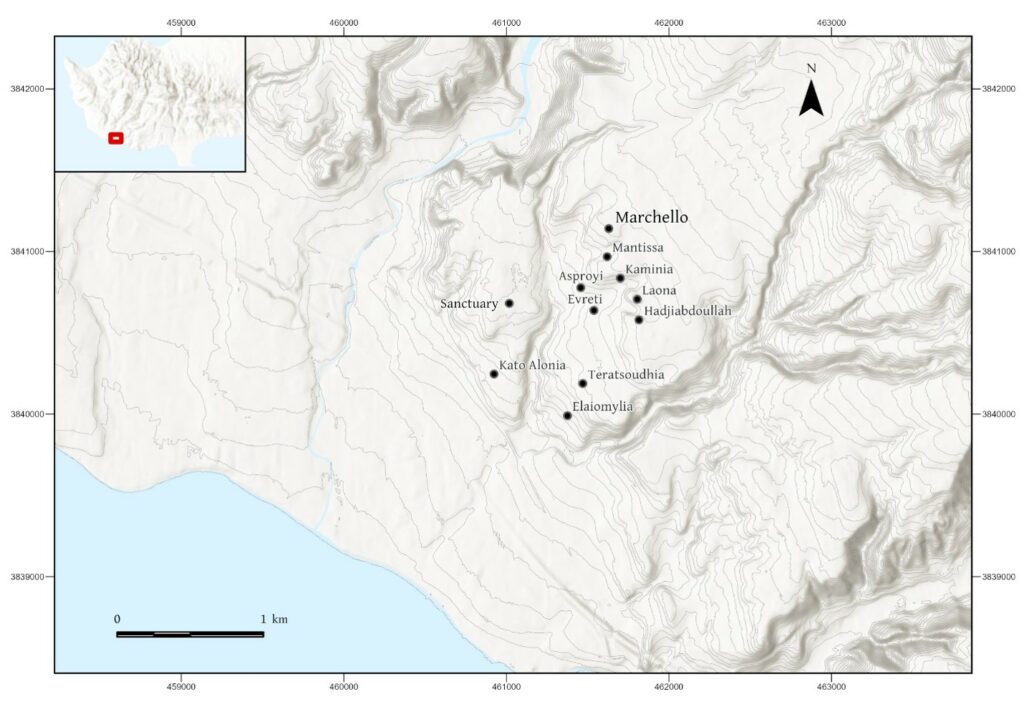 The site of Marcello and other important archaeological sites in the area of Palaepaphos. Source: NKUA.
From the bastion to the tower
The rectangular bastion dates back to the Late Cypriot III period, towards the end of the Late Bronze Age. In a later construction phase, a Π-shaped structure was added to it, resulting in the formation of an almost square building, in the center of which a chamber of about nine square meters was formed.
The almost square floor plan, the large thickness of the walls and the existence of the inner chamber support its interpretation as a fortification tower. Only the foundations of the building are preserved today, with the result that its original height remains unknown.
The fortification seems to have been reinforced again already during the Late Cypriot III period, with the addition of a wall about 2.7 meters thick on the northwest side of the tower.
Another important intervention took place much later, in the 4th century BC, during the late Cyproclassical period. Then a new wall was added to reinforce the northeast and southeast sides of the tower. The dating is based on the pottery found in its foundation trench. Probably during the same period there was a significant widening of the wall.
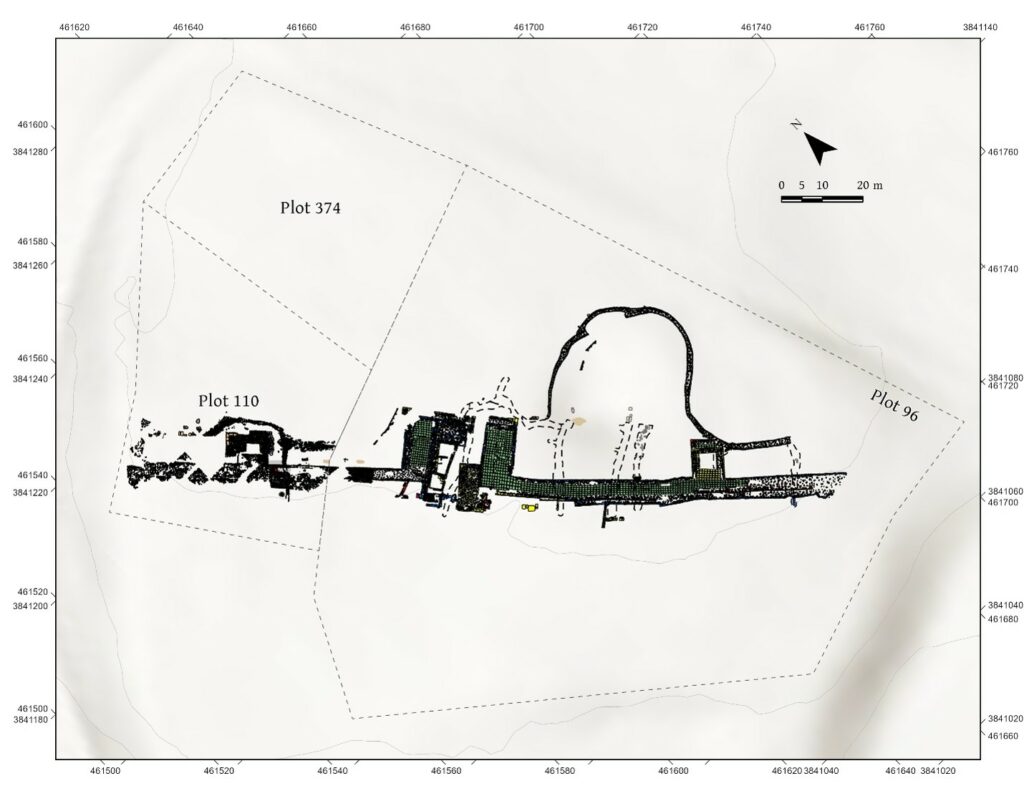 General plan of the excavations at the site of Marcello, where the wall and the monumental gate can be seen in blocks 96 and 110. Source: NKUA.
Evidence of wall dating
The findings of this year's excavation reinforce the dating of the initial phase of the wall to the Late Cypriot II-III period, at the end of the Late Bronze Age.
An important piece of evidence is an undisturbed archaeological layer, which was discovered this year in connection with the wall and contained pottery from the same period. A concentration of marl was found on its surface, a material that was probably used during the construction of the wall. The marl was spread over the stone foundations, creating a flat base for the construction of the superstructure from mud blocks.
The site of Marcello is located less than a kilometer northeast of the sanctuary of Aphrodite. Previous excavations by a British and German-Swiss mission, as well as by the University of Cyprus, had revealed an elongated wall, a monumental gate and other important remains.
PALA1) the bastion, 2a) the addition by which the bastion was enlarged into a tower, 2b) the reinforcement of the northwest side of the tower, probably during the Late Cypriot III period, 2c) the strengthening of its northeastern and southeastern sides in the 4th century BC, 3) the concentration of marl next to the wall. Source: NKUA.
However, questions about their dating and interpretation remained unanswered. Since 2021, NKUA has been conducting systematic excavation research with the aim of investigating the history of the site.
In the area investigated by the University of Athens, no building phases of the Cyprogeometric or Cypro-Archaic periods have been identified so far. Therefore, the question remains open whether the fortification was in continuous use in the period between the Late Bronze Age and the Cyproclassical period.
The continuation of the research and the further study of the findings is expected to contribute to a better understanding of the evolution of the monumental fortification work and its place in the history of Palaepaphos.
After the completion of the works, the architectural remains were covered with a ground cover cloth to protect them.
