
New information on the activities and organization of one of the important chalcolithic settlements of Cyprus was brought to light by the second excavation period in Erimi Pamboula.
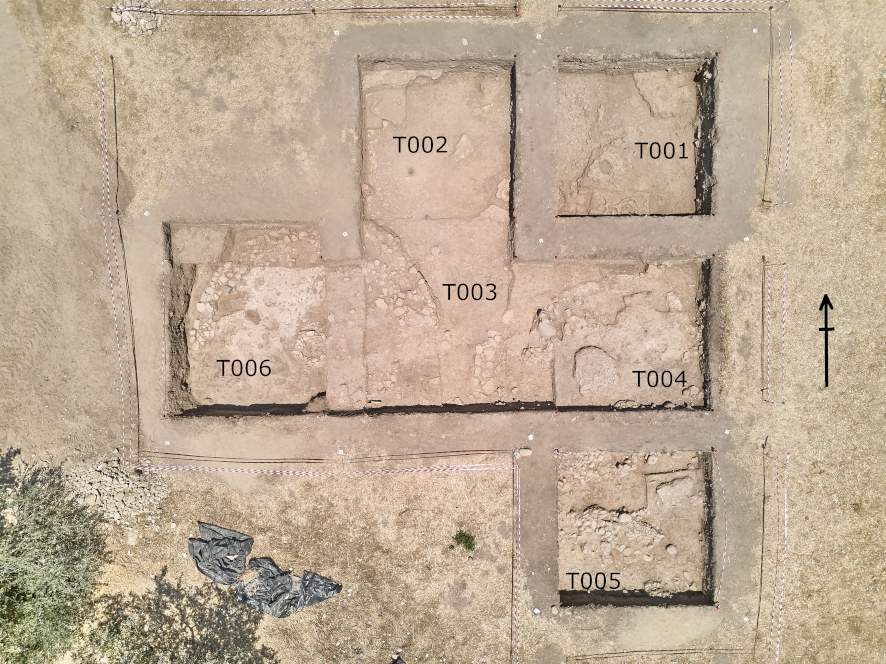
The research of the National and Kapodistrian University of Athens (NKUA) revealed a wide outdoor space with traces of flooring, hearth, stone indigium, garbage pit, concentrations of pottery and bones, as well as traces of ocher processing.
This year's excavation also allowed the floor plan of a circular building, which had been excavated in parts in the past by the Department of Antiquities of Cyprus, to be almost completed. At the same time, it was found that a rectangular wall or structure, which had been identified in 2025, belongs to a neighbouring circular building.
The findings contribute to the investigation of daily life and activities in the settlement, which dates from the Middle to the beginning of the Late Chalcolithic period, between 3500 and 2900/2800 BC.
Pottery, tools and animal bones
The movable finds of the excavation include a large number of pottery sherds, mainly of the "Red on Open" category, as well as a variety of tools made of polished and carved stone. Objects made of picrolite were also found, such as pebbles, semi-works and beads, clay masses, sea shells and animal bones, mainly from deer.
Of particular interest are the traces of ocher processing, which add another element to the study of the activities carried out in the settlement. The Notice does not, however, specify the use of ochre nor does it allow for firm inferences as to the purpose of its treatment.
The excavation took place from June 25 to July 24, 2026, under the direction of Professor George Vavouranakis, with the participation of researchers and students from universities in Cyprus and abroad.
The research project was attended by, among others, Associate Professors Evi Margariti and Efthymia Nikita and postdoctoral researcher Angelos Hadjikoumis from the Cyprus Institute, who studied the archaeobotanical, human and animal remains respectively. Gaia Moustone, a postdoctoral student at the University of Siena, studied the carved stone tools, while Dr. Dimitris Kloukinas examined the architectural remains of clay.
This year's research continued near the site of the older excavations of P. Dikaios. The pottery studied so far confirms the dating of the settlement from the Middle to the beginning of the Late Chalcolithic period, offering new data on the evolution of human settlement in the area.
