
In the year 2025, taxpayers spent €9.5 million. for the feeding of the National Guardsmen, but 69% of them stated that they sometimes or daily resort to KAPM products, 41% choose to be fed with food outside the camp, while 74% prefer not to consume the meal in the Unit before leaving the camp.
It is noted that only 8% of the soldiers of the National Guard state that their food needs are largely covered, while almost 7 out of 10 (67%) consider that the coverage of their nutritional needs is mediocre or not satisfactory.
The above findings are recorded in a Report of the Audit Office, which examined "whether the feeding of the soldiers is adequate and safe and the rational management of public resources is achieved". However, as indicated, if some canned food and other materials that systematically end up in the bin were not included in the feeding, about €10,000 would be saved per week, i.e. €520,000 per year.

The Auditor General also notes that in some cases quantities of food up to 42% greater than the actual needs were ordered, while hot food was systematically received at temperatures below the permissible limits.
Between 5-25% (average 15%) of ready-made portions of food, 2-30% (average 12%) of ready-made frozen portions of food and 0-15% (average 7%) of food from the kitchens of the National Guard end up in the baskets.
As for the degree of satisfaction of the soldiers, per meal, 34% characterize their degree of satisfaction with the food provided to them as moderate, 35% as sufficient or high and 31% as low.
Between 5-25% (average 15%) of ready-made portions of food, 2-30% (average 12%) of ready-made frozen portions of food and 0-15% (average 7%) of food from the kitchens of the National Guard end up in the baskets.
As for the degree of satisfaction of the soldiers, per meal, 34% characterize their degree of satisfaction with the food provided to them as moderate, 35% as sufficient or high and 31% as low.
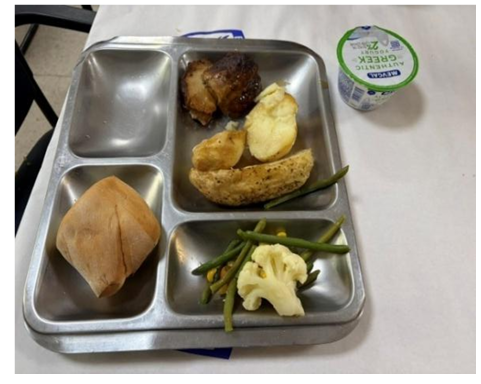
According to Mr. Papakonstantinou, the general picture suggests that the feeding works adequately, since 69% of the soldiers characterize their degree of satisfaction as moderate and above, however the fact that a significant percentage of 31% expresses a low degree of satisfaction shows that there is significant room for improvement.
As stated in the preface of the Auditor General, the degree of satisfaction of soldiers with food ranges between 44.5% and 61%, i.e. it is characterized as moderate, while only about 20% among soldiers who follow a special diet (e.g. vegetarians) consider that their nutritional needs are adequately or fully covered.
Worthy of further investigation, according to the Auditor General, is the fact that the lowest scores are recorded in beverage (44.5%) and breakfast (48.9%).
Also of the three feeding methods (pre-prepared, frozen and Unit kitchens), the camp Unit kitchens received a slightly higher score compared to ready-made food. As indicatively, in the provision of meals, the general satisfaction was 59.6% (from kitchens), 50.5% (from ready-made portions) and 52.5% (from frozen).
As stated in the Report, the supply and distribution of ready-made portions of food covers 44% of eligible soldiers (i.e. those who are in service at the time of its delivery). 10% of remote camps are covered with ready-made frozen food, while 46% of soldiers eat from the food, which is prepared in National Guard units.
Noteworthy for the positive performance of the camp kitchens is the fact that 4 out of 17 active kitchens operate without a professional cook. There are 21 professional cooks serving in the National Guard.
The choice of food is somewhat clumsy, if it is taken into account that a review of the officials of the Audit Office found that neither the daily energy needs of the soldiers (based on the daily military requirements) nor the corresponding total daily energy in calories, provided through the consumption of a complete soup kitchen, have been determined. Also, no analysis of the nutrient content of meals (carbohydrates/fat/proteins) has been performed.

From the audit he investigated, the following emerges:-25% of the soldiers stated that their needs are met little or not at all and only 30% reported a high or very high degree of coverage, while almost one in two (45%) considered that their nutritional needs are met to a moderate degree. 22% state that the coverage of their needs is largely satisfactory. Only 8% say their needs are largely met
-Almost 7 out of 10 participants (67%) consider that the coverage of their nutritional needs is mediocre or not satisfactory. The main reasons for dissatisfaction relate to the quality of meals and nutritional imbalance, especially regarding the increased presence of carbohydrates and fats, which are recorded as the main concerns in all feeding methods.
– The daily cost of food for each soldier fed with ready-made portions of food was estimated at €7.52, plus VAT. Based on a study carried out by the National Guard General Staff in 2017, the daily cost of food per soldier (from the kitchens of the National Guard, was estimated at €7.05, although the data varied upwards.
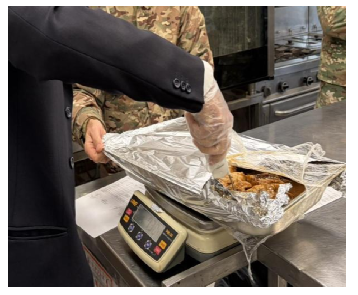
During the sudden on-site inspection at the "V. Kapotas" Camp, on 8.8.2025, the procedures followed during the delivery – receipt of ready-made portions of food/products to gastronomes were evaluated, the results of which showed the following weaknesses:
-At the reception of the food, only two conscripted soldiers were present, instead of at least one of the members of the receiving committee.
-The thermometer presented by the representative of the contractor company for conducting thermometric control of the delivered portions of food, on the one hand it did not agree with the code indicated on the delivery-receipt note and on the other hand it was not properly certified by an independent certification body.
-The electronic scale for carrying out weighing control on the delivered portions of food/products was not properly checked, as the last control of its operation, by the competent Service of Weights and Measures, was carried out on 13.4.2022. Following the recommendation of the Audit Office, the scale in question was checked and it turned out that it was not suitable for the specific audit.
From thermometric checks carried out in the camp's restaurants, as well as in outposts, before the start of serving the meal to the soldiers, the following were found:
-The results of the hot food measurements showed a negative deviation ranging between 15 and 25 degrees Celsius from the minimum permissible temperature of 60 degrees Celsius.
-During the inspection, the Service team tasted the food of the soup kitchen, which was judged to be satisfactory.
-Out of a total of 30 turkey sandwiches with cheese, ordered and received for breakfast of that day, only 13 were consumed by the soldiers (i.e. 57% remained unsold).
-Of the total of 30 pieces of Lebanese pie with tuna, ordered and received for the breakfast of the previous day (21.1.2026), only 20 were consumed by the soldiers (i.e. 33% remained unsold).
-An unjustified amount of unsold individually packaged products included in the morning drink (coffee, sugar, evaporated milk, jam) was found in the restaurant. Also, both in the restaurant of the Unit and in Fylakio, a number of unsold canned tuna, significantly disproportionate to the strength fed, was found, which are offered as an accompaniment to portions of food (legumes) twice a week.
-The individual portions of food ordered and delivered to the BARSAK Outpost and Observatory were 100% and 57% more, respectively, than their current strength in soldiers. Orders exceeded by 42% and 40%, respectively, the daily entitled feeding power.
During the sudden on-site inspection at the headquarters of the Outpost "206" of a specific unit, it was found that 50% of the portions ordered were consumed.
Finally, it is mentioned that the aspect of recycling, of individual packaging, also suffers, since it is essentially not implemented.
