 |
| European Council President Antonio Costa and European Commission President Ursula von der Leyen, and Turkish President Recep Tayyip Erdogan |
European Council President Antonio Costa and European Commission President Ursula von der Leyen on Thursday called on Turkish President Recep Tayyip Erdogan to “seize the renewed momentum” to bring about a solution to the Cyprus problem, after the trio met on the sidelines of Wednesday’s Nato summit in Ankara.
Both European leaders published identical social media posts following the meeting, declaring that the European Union and Turkey are “strategic partners”, and that they are “committed to strengthening our relationship”.
“In a more challenging world, our partnership matters more than ever. Turkey has been an important partner in addressing the crises in the Middle East and supporting efforts for a just and lasting peace in Ukraine,” they said.
On Cyprus, they said that “we must also seize the renewed momentum to advance a settlement of the Cyprus issue through the UN-led process”, with the United Nations having undertaken a “new initiative” in recent weeks and months with the aim of bringing about a resumption of negotiations in earnest to resolve the Cyprus problem.
Erdogan also held a bilateral meeting with British Prime Minister Sir Keir Starmer on the sidelines of the Nato summit, with the pair signing a “security and defence partnership document”.
Turkey’s presidential communications directorate after of the meeting between the leaders of two of Cyprus’ guarantor powers that Erdogan had “stated that cooperation and close dialogue between Turkey and the United Kingdom are important, and that the two countries would continue to advance their relations”.
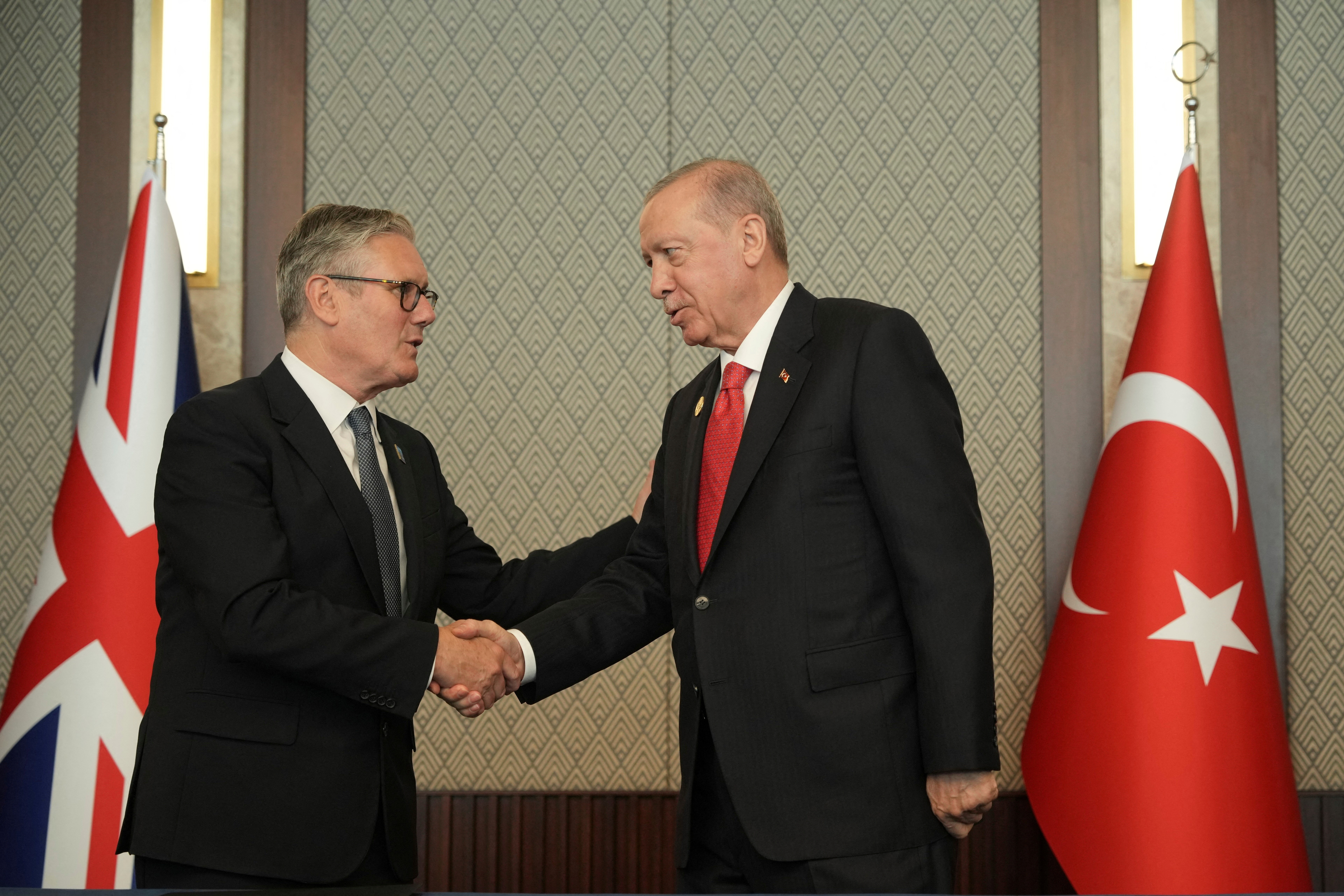 British Prime Minister Sir Keir Starmer with Turkish President Recep Tayyip Erdogan in Ankara on Wednesday
Kyriakos Mitsotakis, the prime minister of Cyprus’ other guarantor power, Greece, was also at the Ankara summit, though he was less warm in his dealings with Erdogan on the day.
“An alliance needs to be based on the fundamental principle of good neighbourly relations, and at a time when my country is still faced with an open threat of war by Turkey, should we exercise our legal right to expand our territorial waters, I think we need to be cognizant of the fact that the sensitivities of all Nato allies need to be taken into consideration,” he said.
He added that “after all, we are a defensive alliance”, and that “I am sure that these outstanding issues can be resolved in the spirit of good neighbourly relations and in the spirit of cooperation”.
The “open threat of war” to which Mitsotakis was referring is a Turkish parliamentary resolution signed in 1995 regarding both country’s claims in the Aegean sea.
At the time, the Turkish parliament had declared that any unilateral action by Greece beyond 12 nautical miles from the country’s coast in the Aegean sea would constitute a “casus belli” – a reason to go to war.
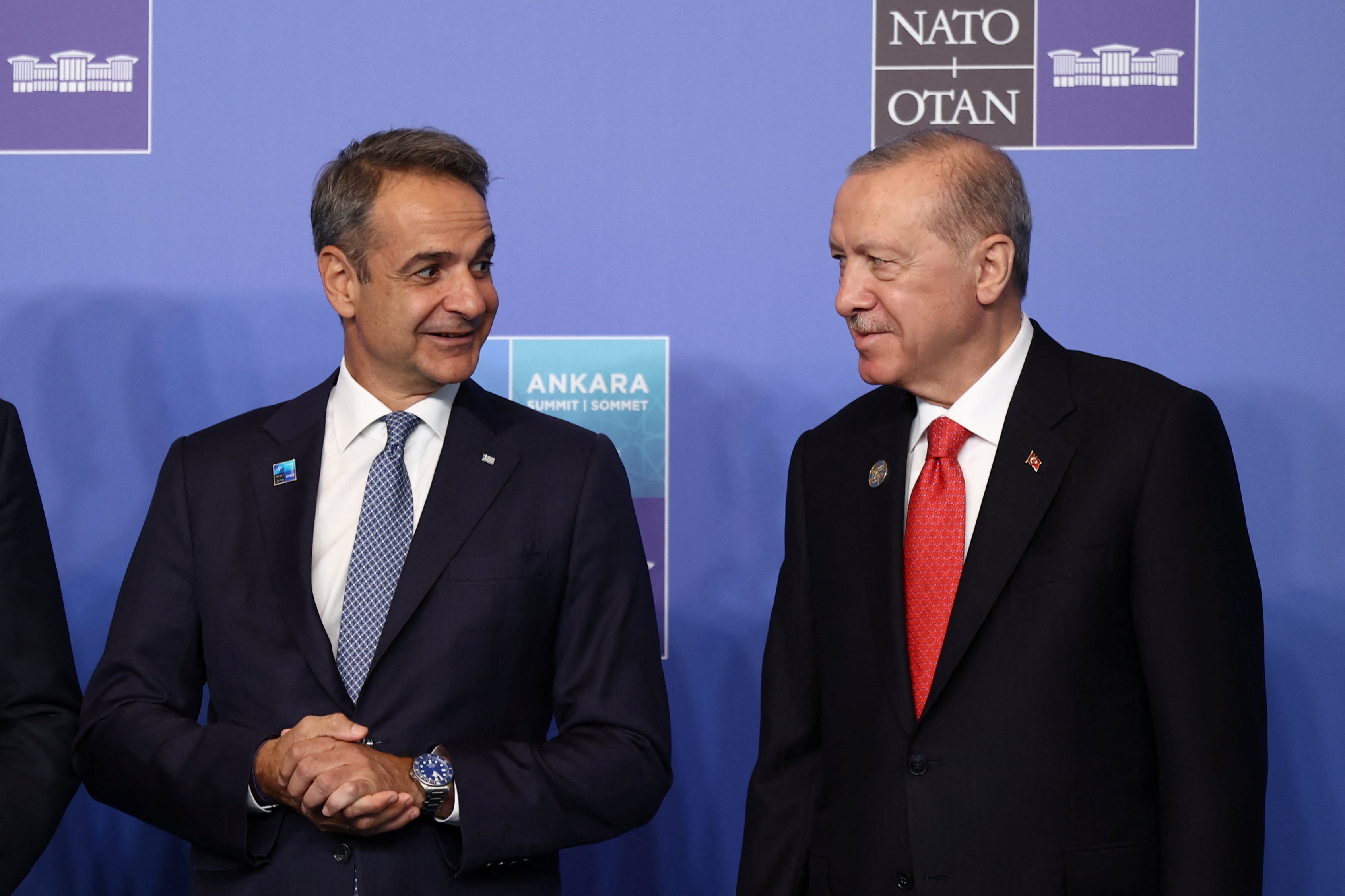 Greek Prime Minister Kyriakos Mitsotakis and Turkish President Recep Tayyip Erdogan in Ankara on Wednesday
Later, Mitsotakis did describe the summit as “magnificent”, and say that “I always appreciate Turkish hospitality”, while promising to “continue to cooperate with President Erdogan in a constructive relationship”.
Erdogan later said of the Aegean dispute that “I fully share Mitsotakis’ view” that the matter needs to be resolved, and expressed hope that the two countries’ foreign ministers, Turkey’s Hakan Fidan and Greece’s Giorgos Gerapetritis, would soon hold talks on the matter, and that he personally would negotiate with Mitsotakis “if necessary”.
Neither Mitsotakis, nor Starmer, nor Erdogan made reference to Cyprus during their public statements in Ankara, and likewise, the joint declaration issued at the end of the summit named only four countries – Canada, Russia, Turkey, and Ukraine – by name.
Nonetheless, Nato continues to form part of the ongoing discussions regarding security guarantees in a post-solution Cyprus, with it having been suggested that those guarantees may come in the form of the new Cypriot republic’s accession to Nato, alongside the presence of Nato troops from Turkey, Greece, France, the UK, and the United States on the island.
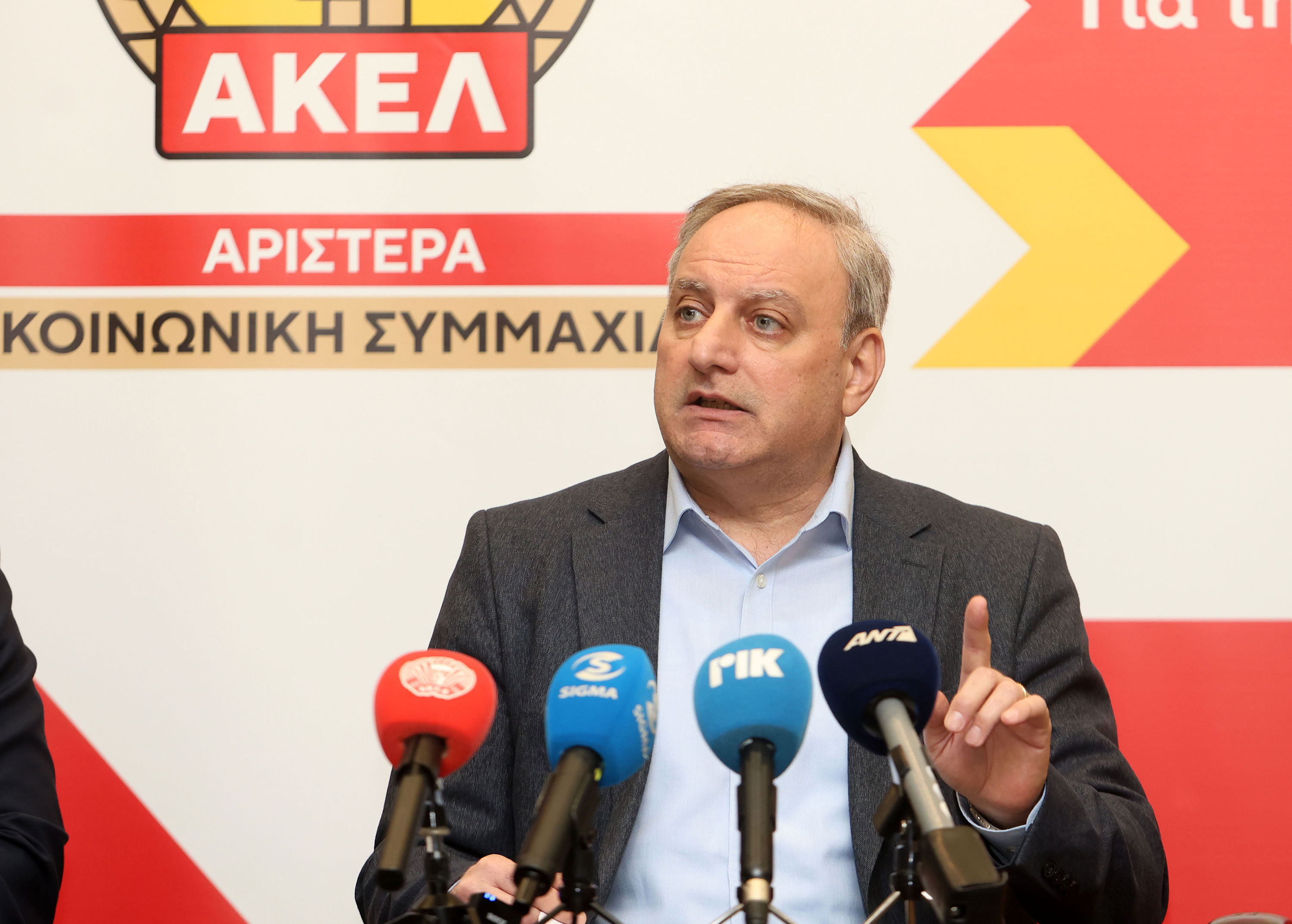 Akel leader Stefanos Stefanou
However, this idea has already received vehement pushback from Akel leader Stefanos Stefanou, who told diplomats on Wednesday that “those who think about Nato involvement in [a solution to] the Cyprus problem should do their calculations without Akel”.
“Those who know the situation in Cyprus well can easily understand that a solution without Akel’s support cannot be supported by the people,” he said.
This assertion is not without precedent, too, given that the party had withdrawn its support for the Annan plan to reunify Cyprus prior to the 2004 referendum, officially because the UN security council did not provide adequate guarantees regarding post-reunification security.
At the time, the party had said it was “saying ‘no’ now to cement the next ‘yes’”. This hypothesis has not yet been tested at a public vote.
Nonetheless, efforts on the island and elsewhere continue with the aim of bringing about a resumption of talks in earnest on the Cyprus problem, with UN envoy for the Cyprus problem Maria Angela Holguin set to meet Antonio Costa on Monday.
She is then expected to return to Cyprus with a view to holding more meetings with both Turkish Cypriot leader Tufan Erhurman and President Nikos Christodoulides with a view to convening an enlarged meeting on the Cyprus problem.
That meeting will involve the island’s two sides, its three guarantor powers, Greece, Turkey, and the UK, and the UN, and will likely take place next month.
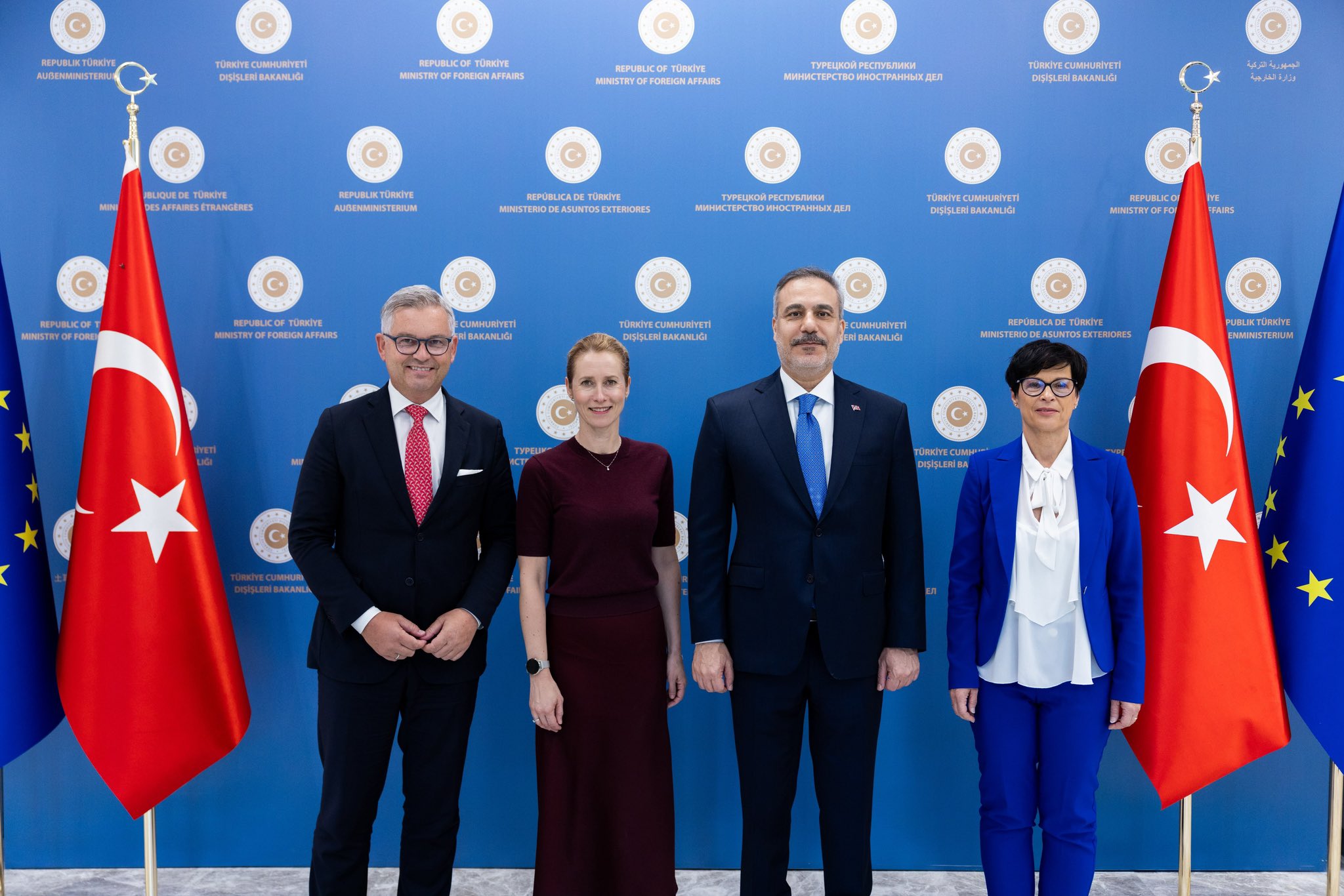 [L-R] European Internal Affairs Commissioner Magnus Brunner, EU foreign policy chief Kaja Kallas, Turkish Foreign Minister Hakan Fidan, and European Enlargement Commissioner Marta Kos
In advance of that, the EU’s foreign policy chief Kaja Kallas, Enlargement Commissioner Marta Kos, and Internal Affairs Commissioner Magnus Brunner all visited Turkey and signed a joint declaration with Hakan Fidan offering their support for UN Secretary-General Antonio Guterres’ efforts in Cyprus.
Likewise, Erhurman last week said that “we have stated that we support Guterres’ efforts”, and that “we continue to support them”, while also calling for “results” to be achieved at the next enlarged meeting, while Christodoulides having said that its outcome must entail “the resumption of talks”.
Holguin herself went further, calling on Cypriots to “seize this historic opportunity to negotiate a lasting solution” and saying that Guterres is “evaluating which could be the next phases that will convince both parties to take concrete steps towards a final solution”.
