
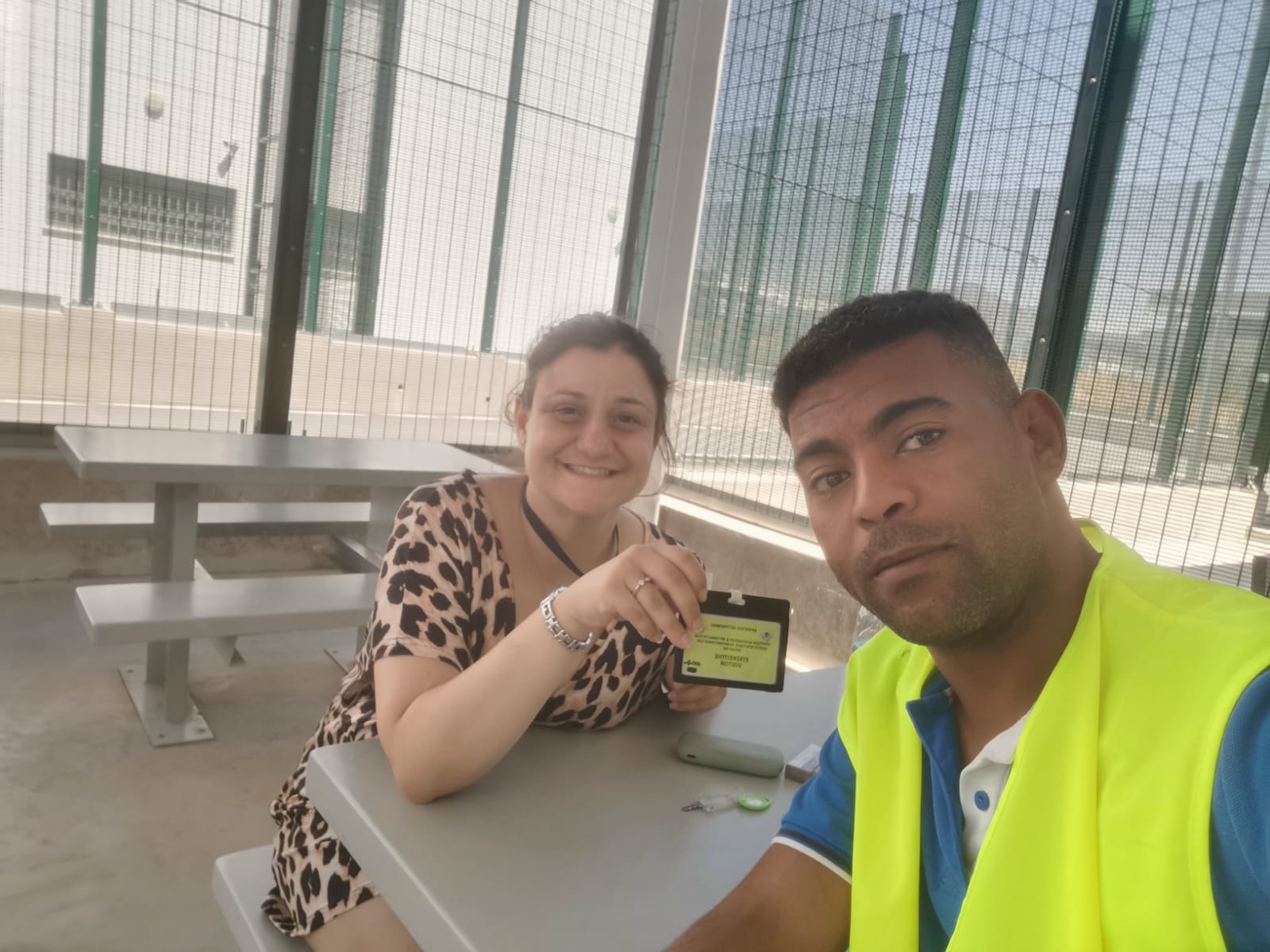
Romani Youssef sits in a detention centre, waiting to be deported back to Egypt after being arrested as a ‘prohibited immigrant’ two months ago.
Meanwhile, his Cypriot fiancée Anthi Giatrou sits in a small flat without any job or support system (or even air-conditioning), six months pregnant with their child.
“I’m not asking to be special in Cyprus,” Youssef told the Cyprus Mail. “All I ask is a chance to fix my life.”
That said, the details of his case mean he has to be ‘special’ – in that an exception must be made, for humanitarian reasons.
Youssef came to Cyprus in 2015, and applied for asylum. Nine years later, in November 2024, he was definitively told – having exhausted the appeals process – that his application had been rejected.
“At the end, I stayed illegally,” he admits. “Because I cannot go back.”
The case is both simple and surprisingly complicated. On the one hand, Youssef can have no complaint with the legal process, even if he thinks the court came to a wrong decision. Having been turned down for asylum he can legally be deported, though it’s unclear when the order will be enforced.
Equally, though, every case is judged on its own merits and the authorities may – at their discretion – allow Youssef to stay, as the soon-to-be father of a Cypriot child.
The case for doing so is obvious. A child shouldn’t be deprived of its father. The mother confirms that it’s his child, and that their relationship is genuine. “It was our decision” to get engaged, she told the Cyprus Mail. “We both wanted it – and the baby, too.”
In fact, even keeping Youssef detained while his fiancée is pregnant is needlessly cruel. Giatrou, who had dizziness and vaginal bleeding earlier in the pregnancy, is constantly tired and needs support. Youssef was actually arrested when he went to pay her mobile-phone bill, because she was unable to do it herself.
There’s an added complication, in the ongoing issue of stateless kids.
At the moment, due to a gap in the law, if one parent is residing in the country illegally when a child is born – even if the other parent is fully Cypriot – the child doesn’t get citizenship, and remains (scandalously) stateless.
This creates a kind of Catch-22 situation. Youssef is seeking an exemption as the father of a Cypriot child. If he’s registered as the father, however, the child won’t be officially Cypriot!
One possible solution is for Youssef to agree to the deportation order and go back to Egypt. Once there, and once the child is born, Giatrou can visit him and they can get married.
He could then apply to be removed from the stop list (the order prohibits his re-entry to Cyprus for five years) and come back legally, with a DNA test, as her husband and the child’s father – and, since he wouldn’t have appeared as the father at birth, the child would have citizenship.
It’s a possibility – but the risks are too great.
Not just the risk that it wouldn’t work, leaving the couple permanently separated. There’s also the risk of what would happen to Youssef in Egypt – which is why he preferred to stay here illegally, rather than return, in the first place.
“He was a journalist there,” says Giatrou, and quite vocal on what he calls “Christian rights”, making him a target for militant Muslims.
“From what he told me, they attacked his family too, and tried to kill him many times. He has the scars on his body.”
The Cyprus Mail saw an Egyptian medical report (a key piece of evidence in Youssef’s asylum application) noting his extensive injuries – mainly stab wounds – after an altercation, which he says was religiously motivated.
Even so, that was in 2011, when he was 21. It’s unclear if he’d still be in danger now, all these years later.
Then again, is it right to send him back, and force him to take the risk – especially when it also risks a Cypriot woman losing her fiancé, and a Cypriot child losing its father?
In the end, the simplest – and most humane – course of action may just be to let him stay, for the child’s sake.
