
In March 2023 European Central Bank (ECB) chief Christine Lagarde fell for a prank call where she unwittingly revealed that Europe’s central bank digital currency, the digital euro, will have a “limited amount of control”. Though anecdotal, it was one more cog in the general direction of travel where physical cash gets pushed aside by digital means of payment that’s both issued and controlled by a central authority. Whatever the motive, benign or not, the issue comes down to control.
In the video prank posted online, a prankster impersonating Ukraine President Volodymyr Zelenskiy had a conversation with Lagarde.
“We are considering whether for very small amounts, anything that is around €300 [or] €400, we could have a mechanism where there is zero control, but that could be dangerous,” said Lagarde, recalling a previous terrorist attack in France believed to be financed by rechargeable and anonymous credit cards.
Last week the Cyprus Mail published an article by Cyprus-based lawyer Andreas Shialaros on how, as of July 1, cash can no longer be used to pay rent – supposedly to crack down on tax evasion. He argued that this can’t be seen in isolation, citing for example Greece where an omnibus bill before parliament requires every transaction of €500 or above to be settled electronically – and where the total value of the transaction matters rather than the individual receipts, to prevent splitting bills into small cash chunks to stay off the radar.
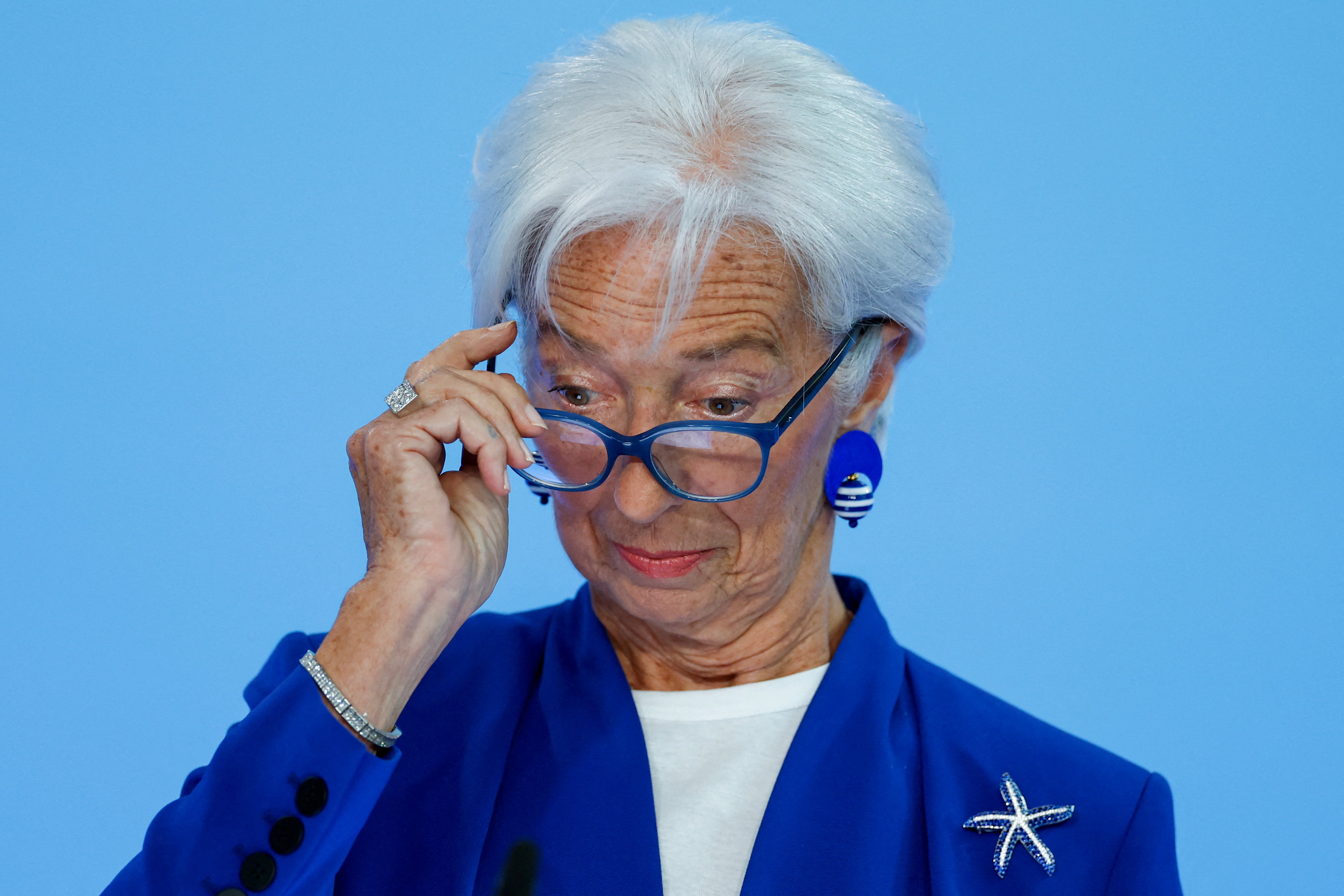 European Central Bank (ECB) President Christine Lagarde
And at the EU level, the new Anti-Money-Laundering Regulation already foists a €10,000 cap on cash business transactions across the bloc from July 10, 2027, expressly permitting member states to set lower national limits. The European Digital Identity Wallet, meanwhile, is moving from large-scale pilots into deployment.
In follow-up commentary, Shialaros explained what the digital euro is, what it isn’t, and what it means for the average person.
The ECB meantime, cognizant of concerns about individual liberty and anonymity, insists the digital euro will not supplant, but complement cash.
“The ECB and the Eurosystem would not be able to identify who you are or what you are buying from the payment data we get,” their website says.
They aim to be ready for a potential first issuance of the digital euro during 2029, assuming the necessary EU legislation is adopted in 2026.
As for the Central Bank of Cyprus, it has this to say: “We are examining how to make our currency digital. The way people prefer to pay is changing and it is important for our currency to evolve in parallel. It would complement – not replace – cash.”
Shialaros goes back to basics, asking what kind of money is the digital euro, in law.
“The euros in a bank account are not central bank money,” he explained.
They’re a private liability of the commercial bank, redeemable on demand into central bank money in the form of cash. When a customer pays with a debit card, the bank’s promise is transferred from one private intermediary to another, with the card network and the payment processor in between, and the central bank sees the interbank settlement, not the individual retail transaction. The state can compel disclosure of those records by court order, but the architecture is decentralised across many private actors, none of whom has a complete view.
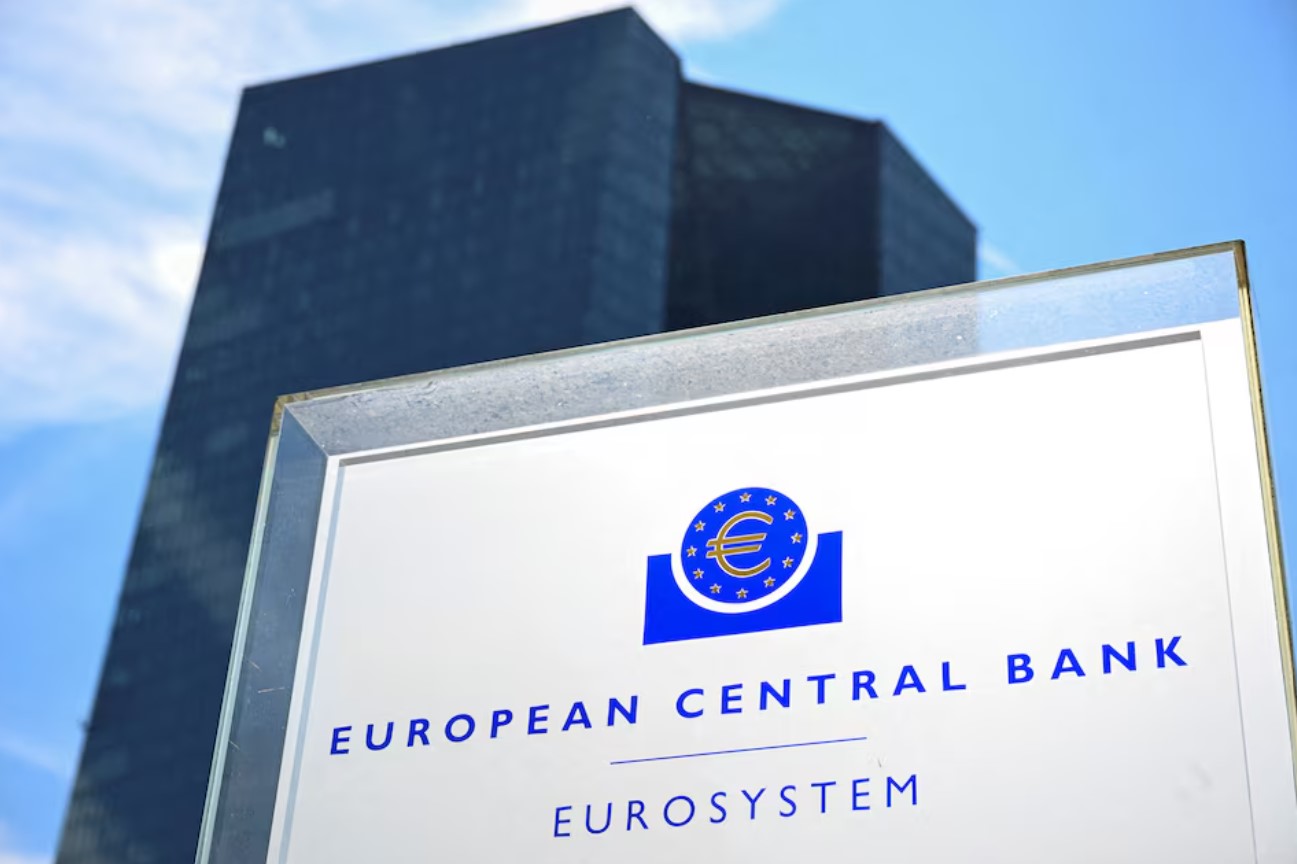 A view of European Central Bank headquarters in Frankfurt, Germany
“The digital euro is something quite different. It is, like cash, a direct liability of the ECB – public money, not a bank’s promise. Unlike cash, it lives on infrastructure operated by the Eurosystem itself, with supervised payment service providers sitting between the user and the Eurosystem.
“The shift is that the issuer of the currency would, for the first time, be the operator of the rails on which retail payments run.”
Cash, in the form of euro banknotes, is what lawyers call a bearer instrument: whoever holds it owns it, and using it requires the consent of no third party. Under Article 128(1) of the Treaty on the Functioning of the European Union, euro banknotes are the only notes with the status of legal tender within the Union.
The proposed digital euro, though also a direct liability of the central bank, departs from cash in three respects that matter in law. It is an account, or a record on a settlement platform operated by the Eurosystem and accessed through supervised payment service providers.
Online, every transfer requires the cooperation of the system. Offline – meaning device-to-device – the transactions are designed to mimic cash, but only within identity-bound wallets and only up to capped amounts the holder does not choose.
The ECB has openly tested hypothetical holding caps of up to €3,000 per person, to prevent customers moving their balances out of commercial banks in a crisis.
“Cash,” stressed the lawyer, “has no holding cap, no identity-bound wallet, and no third party standing between the holder and the next transaction. A bearer instrument with a holding cap is, by definition, no longer a bearer instrument.”
The question is: how exactly will the digital euro be legally equivalent to cash, and in what respects will it not?
“‘Complement, not replace’ is a slogan suitable for a press release. It’s not an answer suitable for primary legislation,” Shialaros told us.
The proposed Digital Euro Regulation provides for a limited form of offline functionality intended to mimic the anonymity of cash, up to low transactional thresholds yet to be finalised.
Above those thresholds, every transaction will be tied to a verified identity through anti-money-laundering rules and, in due course, through the European Digital Identity Wallet.
“The right to make a small, lawful, anonymous payment is not a criminal concession. It’s a feature of any free society,” said the attorney.
“A democracy in which every coffee, every donation to a political party, every contribution to a church or a mosque, every payment to a lawyer in a sensitive matter is identified at the point of payment is a different kind of democracy from the one we have today.
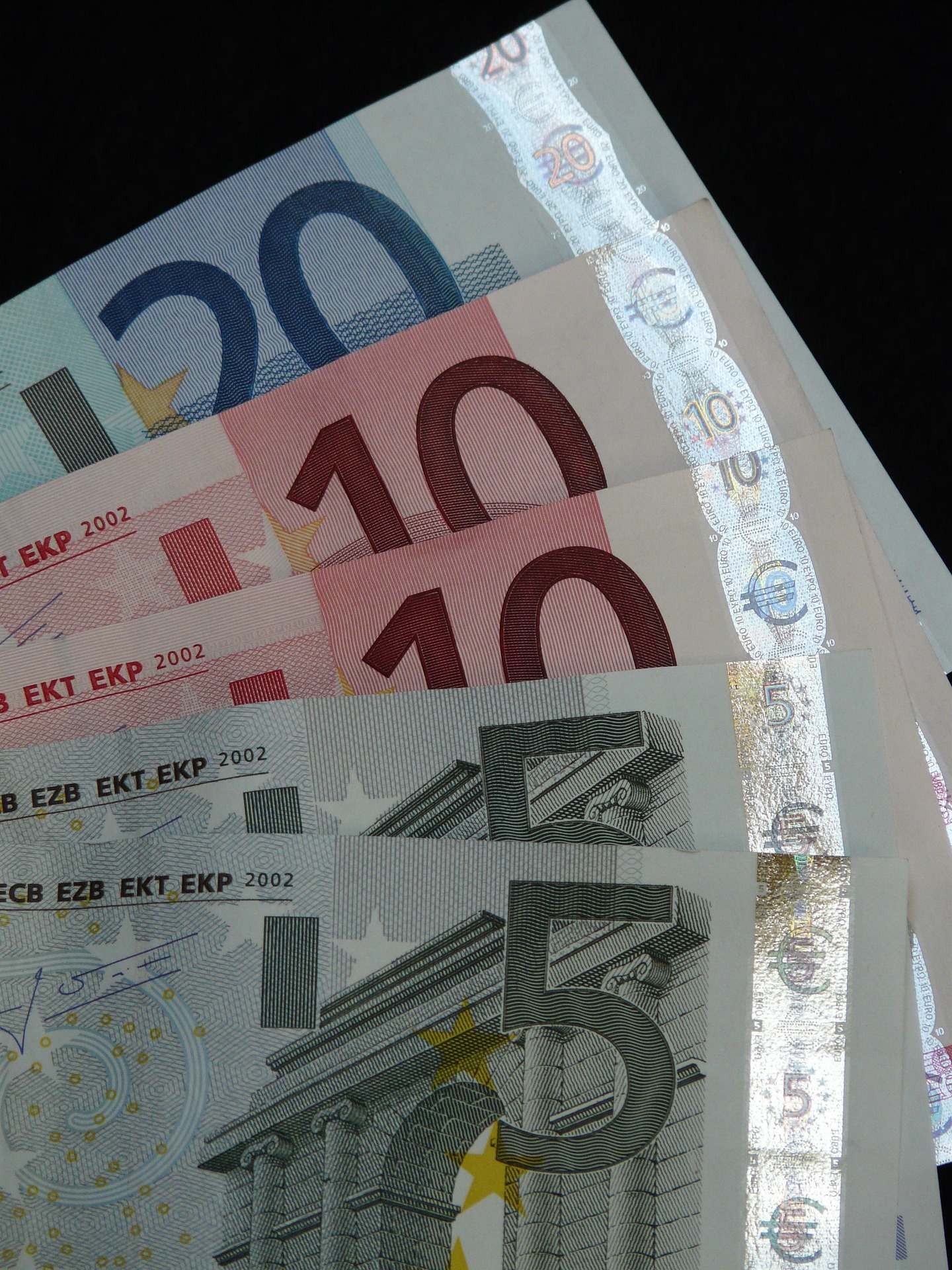
It gets dicier: a digital currency that’s programmable wrests more control away from the individual.
Officials are careful to insist that the digital euro will not be programmable. They mean the holder will be free to spend it on whatever they wish.
“That’s a narrower assurance than it sounds, and it relies on the listener not noticing the difference between ‘is not’ and ‘cannot be’,” Shialaros pointed out.
“A programmable infrastructure that is not programmed today can be programmed tomorrow by amending the rulebook, and the ECB has openly confirmed that such a rulebook is under active development.”
The ECB has been careful to distinguish ‘programmable money,’ which it disclaims, from ‘conditional payments,’ which it does not. The current draft of the Digital Euro Regulation reflects that distinction: programmable money, in the sense of money whose use is limited by the issuer to specific goods, services, time periods or geographical areas, is to be prohibited; conditional payments, that is, automated payments instructed by the user when pre-defined conditions are met, are to be permitted.
So far, so reassuring, the lawyer remarked. But the protection is only as good as the final text agreed. The Commission’s proposal of June 2023 has not been enacted, and the boundary it draws between ‘programmable’ and ‘conditional’ is technical, narrow, and amendable.
Second, the rulebook sitting beneath the regulation is being drafted by the ECB-coordinated Rulebook Development Group.
Third, the hypothetical holding caps of up to €3,000 per person that the ECB has been asked to test are themselves a feature that cash does not have, and that the ECB has openly defended on financial-stability grounds.
The question isn’t whether officials currently intend the digital euro to behave like a programmable instrument. It is what, in binding legal form, prevents it from ever doing so, and what democratic process would be required to remove that protection.
Here, one need only recall China’s social credit system.
“Capabilities, once built into national infrastructure, do not stay unused merely because their builders said they would,” Shialaros observed.
He doesn’t contest that the trajectory toward digital and centralised money has a “respectable” public-policy rationale: tax compliance, fighting the shadow economy, modernisation.
“What I dispute is the picture presented to the public, in which the digital euro is a discrete, neutral, sovereignty-enhancing technical project. It is nothing of the kind. It is the keystone of an architecture whose other stones are already being laid: identity in the wallet, payment in the system, cash progressively restricted by category and by amount.
“When that architecture is complete, the question of whether the digital euro is ‘voluntary’ will answer itself. It will be voluntary in the same sense that having a bank account is voluntary today: you may decline, and you may keep your savings under the mattress, provided your landlord, your employer, your utility company and the tax authority are willing to work around your eccentricity. They will not be.”
Shialaros said he doesn’t oppose the digital euro outright. His take is that Cyprus, a small member state that has historically been a price-taker on EU financial regulation, should approach the closing stages of this legislative process “with its eyes open and its conditions clear”.
Cyprus should insist on a number of points.
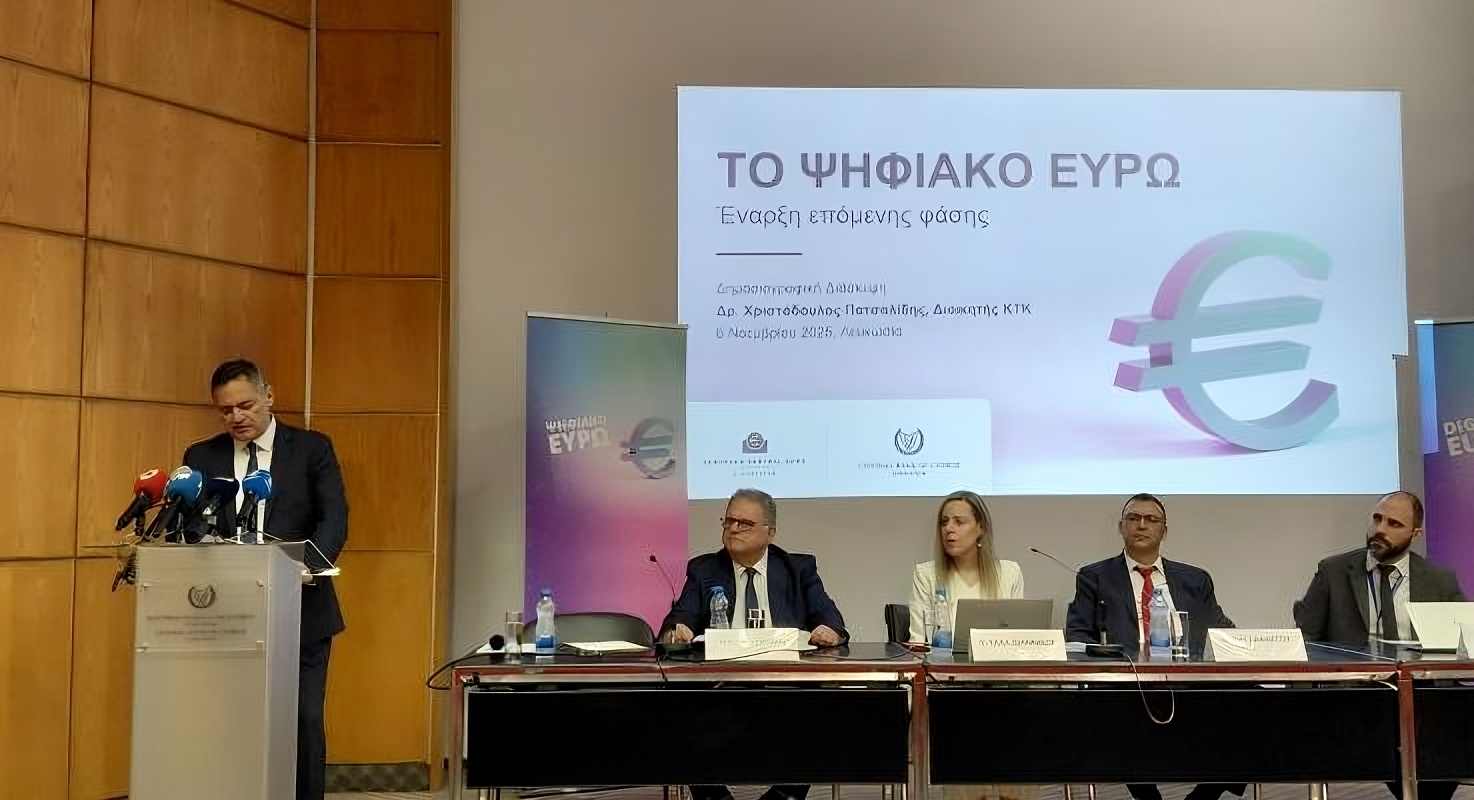 Central Bank of Cyprus governor Christodoulos Patsalides during a presentation for the digital euro
First, an unambiguous statutory guarantee that euro banknotes and coins will retain their status as legal tender, with mandatory acceptance by payees subject only to limited and proportional exceptions.
Second, a meaningful threshold for offline, identity-free use of the digital euro, set high enough to preserve the everyday function that cash performs today, and entrenched in the Regulation itself rather than left to a Commission implementing act.
Third, a binding prohibition on programmable features, expiry, geofencing, conditional release, negative interest on retail balances, removable only by an explicit act of the European Parliament.
Fourth, clarity from the Central Bank of Cyprus, in advance of the Governing Council’s eventual design decisions, on the position the Governor will take on holding limits, on the offline anonymity threshold, and on the privacy architecture, all of which the Regulation will partly delegate to the ECB and partly to the Commission.
Fifth, a public national review of how the pieces of this architecture interact in the life of an ordinary Cypriot household.
