
A reported new power-sharing plan to bring about a solution to the Cyprus problem is “neither necessary nor appropriate”, former Turkish Cypriot chief negotiator for the Cyprus problem Ozdil Nami has said.
“The two sides have already negotiated and agreed upon the essential elements of governance through a Cypriot-owned, Cypriot-led process. Even on the issue of the rotating presidency, the divergence was never about the principle itself but rather the method of election,” he said.
He added that “likewise, the competences of the federal government have already been comprehensively agreed, while the question of sovereignty was effectively addressed” in a joint declaration published in 2014 by the leaders of the day, Nicos Anastasiades and Dervish Eroglu.
“At a time when both current leaders have publicly expressed their readiness to respect past convergences, the role of the United Nations should be to safeguard and build upon what has already been achieved, not to reopen settled matters or redesign arrangements painstakingly negotiated by the parties themselves,” he said.
He added that “the UN’s efforts would be better directed toward helping the sides bridge the remaining gaps rather than revisiting issues that have already been resolved”.
Regarding the idea of a “transitional period” for an agreement to be implemented, as was suggested in media reports over the weekend, he warned that previous attempts at similar step-by-step implementations of agreements “have failed for a variety of reasons”.
These reasons, he said, included “concerns about implied recognition, the loss of negotiating leverage, and domestic political sensitivities on both sides”.
“Those realities have not disappeared. Consequently, it is difficult to see why further time and energy should be invested in approaches that have consistently proven unworkable,” he said.
On this front, he said that finding mutually acceptable interim agreements on parts of a solution would end up being “more difficult than resolving the remaining core issues” from the most recent round of negotiations in earnest to solve the Cyprus problem at the Swiss ski resort of Crans-Montana in 2017.
He also warned against suggestions that territorial exchanges should take place before the implementation of a comprehensive solution, saying that “to assume that Greek Cypriot support for a final agreement would increase if territorial concessions were delivered in advance of agreement on power-sharing and political equality is, at best, an optimistic proposition”.
Additionally, he said, if the Turkish Cypriots agree to cede territory to the Greek Cypriots in advance of a solution, and a final solution agreement is then rejected by the Greek Cypriot side, the Turkish Cypriots will be left in a weakened position.
“Would Turkish Cypriots then be expected to make further territorial concessions and accept a diminished interpretation of political equality in pursuit of two affirmative votes? Where would such a process end? At what point would it be acknowledged that the obstacle lies elsewhere?” he asked.
To this end, he said that he has “repeatedly argued to international interlocutors”, including UN envoy Maria Angela Holguin, who is reportedly behind the plan, that “the principal challenge today is not the substance of a settlement but the structure of the negotiating process itself”.
“What prevents the parties from crossing the finish line is not a lack of confidence between the two communities. Rather, it is the absence of a clearly defined timeframe, the lack of effective arbitration mechanisms, and the absence of meaningful consequences for rejecting an agreement at the final stage,” he said.
As such, he said that it is “time for the United Nations to move beyond approaches that merely accommodate those lacking the political will to reach a settlement”.
Instead, he said, the focus should rest “on designing a process that encourages genuine engagement, accountability, and decision-making by all parties”.
“Only then can there be a realistic prospect of achieving the comprehensive settlement that has eluded Cyprus for far too long,” he said.
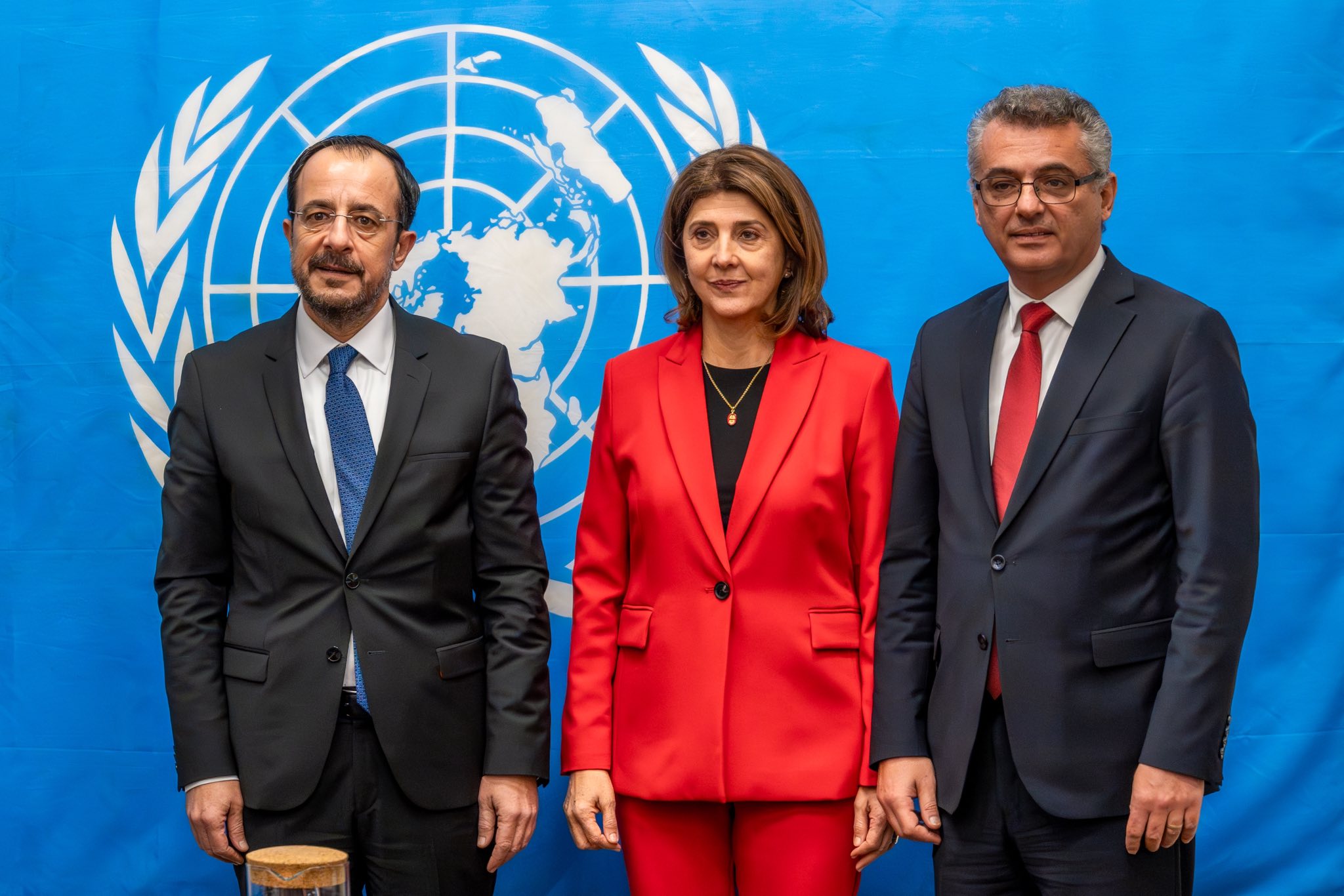 Nikos Christodoulides, Maria Angela Holguin and Tufan Erhurman
Reports which first surfaced in newspaper Politis over the weekend had suggested that Holguin has presented a “looser” solution to the Cyprus problem, with two constituent states in a structure wherein the island’s central government “would retain only absolutely necessary competences so that the new state can function internationally, within the European Union, and institutionally”.
Additionally, the reports suggested that the central government would be led by a “presidential council” led by the two communities’ leaders, with a cabinet consisting of only five or six ministers, dealing with foreign affairs, defence, internal affairs, finance, and European affairs.
Most, if not all other competencies, would be left to the constituent states.
The reports also suggested that guarantees would be offered in the form of the new Cypriot republic’s accession to Nato, alongside the presence of Nato troops from Turkey, Greece, France, the United Kingdom, and the United States on the island.
On the matter of the transitional phase, the reports suggested that the solution would be implemented over a period of two or three years, with territory being ceded by the Turkish Cypriots during that period, in return for the Turkish Cypriot side being allowed direct trade, direct contact, and direct flights to Ercan (Tymbou) airport.
