
Energy security and water security are fast becoming inseparable
For decades, Cyprus has treated energy policy and water policy as largely separate issues. Energy planning focused on electricity generation, fuel imports and infrastructure development, while water planning focused on reservoirs, groundwater resources and desalination. This separation is becoming increasingly difficult to maintain.
Climate change, increasing and prolonged droughts, rising electricity demand and increasing reliance on desalination are creating a new reality in which energy security and water security are becoming inseparable. The future availability and affordability of water increasingly depend on the future availability and affordability of energy.
That is why Cyprus needs not only a long-term energy strategy, but also an integrated energy-water strategy extending to 2040 and beyond.
The need for such an approach is becoming increasingly urgent
Cyprus is one of the countries facing the greatest water shortages in Europe. Due to climate change, rainfall patterns have become more variable, average temperatures continue to rise and droughts are becoming more frequent and prolonged. Inflows to dams have become less reliable.
As a result, desalination has evolved from an emergency measure to an essential element of national water security.
Today, a significant proportion of Cyprus’ drinking water comes from desalination plants. In the future, this dependence is likely to increase further. Even if rainfall conditions temporarily improve, long-term climate projections suggest that desalination will remain a permanent feature of the country’s water system.
However, while desalination improves water security, it also creates a new vulnerability.
Desalination requires large amounts of electricity. In Cyprus, most of this electricity is still generated with imported petroleum products. This means that the cost and security of water supply are increasingly linked to the cost and security of energy supply.
The challenge facing Cyprus is not simply how to produce more water. It is how to secure water supply in a way that is economically viable, environmentally responsible and resilient to future shocks.
The current approach remains largely reactive
In Cyprus, historically, major water initiatives have often been triggered by drought crises. When dams fall to critical levels, emergency measures are taken, additional desalination capacity is considered, and temporary solutions are developed. These responses may be necessary in the short-term, but they are not a long-term strategy. They will become increasingly costly and ineffective.
A long-term energy-water strategy should begin with the recognition that water security is now a strategic national objective, comparable in importance to energy security.
First priority: reducing water production’s dependence on imported fossil fuels
Future desalination capacity should increasingly be powered by renewables, reducing both operating costs and exposure to fuel price volatility.
However, desalination with RES requires more than just solar panels. The intermittent nature of RES means that storage solutions must become part of the overall system. Batteries can help smooth-out short-term fluctuations, while water storage infrastructure can provide long-term flexibility.
This introduces one of the most important but often overlooked opportunities available in Cyprus. Water storage can effectively act as a form of energy storage.
Desalination plants do not necessarily need to operate at a constant output throughout the day. During periods of abundant solar production and low electricity demand, desalination plants can increase production and store water in tanks or other storage systems. During periods of lower renewable production, production can be reduced while the stored water continues to meet demand.
In fact, the water sector can become a flexible consumer of electricity, helping to absorb renewable energy that might otherwise be curtailed.
This is particularly important because Cyprus is already facing increasing RES cuts. Significant amounts of solar electricity are wasted because the electricity system lacks sufficient storage and flexibility. Using desalination plants as flexible loads could help reduce these losses, while enhancing water security.
Second priority: diversification of water resources
Desalination alone cannot provide complete water safety. A resilient water system requires multiple sources of supply.
Treated wastewater reuse should become a central pillar of water policy, particularly for agricultural applications. Every cubic metre of recycled water used for irrigation reduces pressure on freshwater resources and desalination facilities.
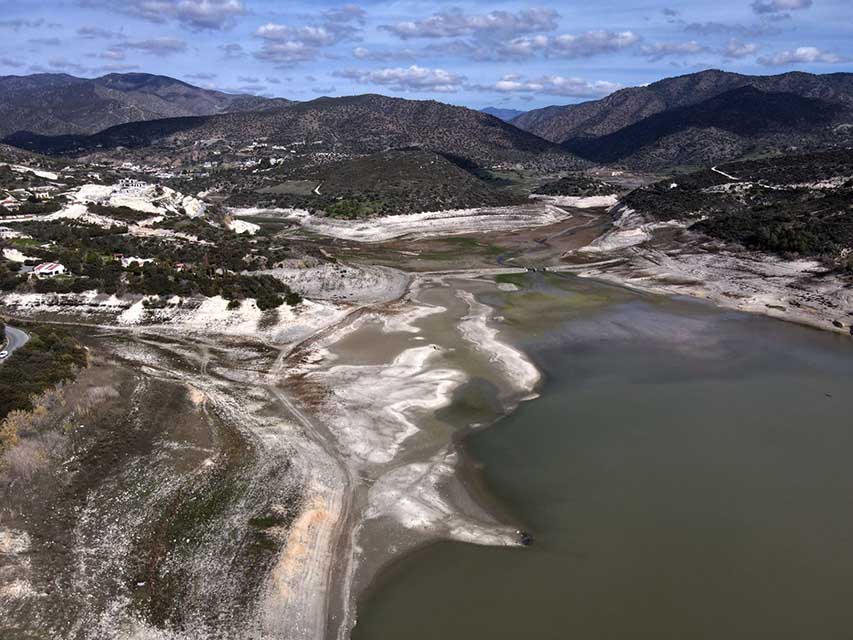
When reservoirs fall to critical levels, emergency measures are taken, additional desalination capacity is considered, and temporary solutions are developed
Managed aquifer recharge should also be expanded where feasible. During wetter years, excess water can be stored underground for use during drought periods. This provides a strategic reserve while helping protect groundwater systems.
Third priority: strategic resilience
Just as Cyprus maintains strategic oil reserves, it should increasingly think in terms of strategic water reserves. Infrastructure should be designed to withstand prolonged drought scenarios rather than moderate conditions.
This requires planning for extremes. What will happen if Cyprus experiences three or four consecutive years of severe drought? What happens if a large desalination plant goes out of business? What happens if the electricity supply is curtailed during a period of high water demand?
A long-term strategy should explicitly address such scenarios and ensure that there is sufficient redundancy within the system.
Fourth priority: governance
The Auditor General’s criticism of state inefficiency is particularly relevant to both the energy and water sectors.
An integrated energy-water strategy would require closer coordination between ministries, regulators, utilities and infrastructure operators. Investment decisions affecting one sector should be evaluated for their impact on the other.
Most importantly, planning horizons must extend beyond immediate political cycles.
What could success look like by 2040?
Cyprus could have a water system in which the majority of desalinated water is produced using renewable energy. Desalination plants would operate flexibly to absorb excess solar output. Battery systems and water storage infrastructure would work together to enhance resilience. Wastewater reuse would cover a much larger share of agricultural demand. Strategic water reserves would protect against prolonged droughts. Energy and water infrastructure would be designed as elements of a single national resilience framework. Such a vision is ambitious but achievable.
The broader lesson is clear. Water security can no longer be seen solely as a water issue, just as energy security can no longer be seen solely as an energy issue. Climate change, desalination, renewable energy and resource resilience are increasingly interconnected.
The IMF has highlighted the vulnerabilities created by Cyprus’ energy dependence. The Auditor General has quantified the costs of delay and inefficiency. Together, they point to a broader conclusion: long-term resilience requires integrated planning.
Cyprus’ future security will depend not only on how it generates electricity, but also on how it manages water. A successful national strategy must therefore combine the two. The era of separate energy and water planning is over. The future belongs to an integrated approach capable of providing affordable energy, secure water supplies and greater resilience in an increasingly uncertain world.
