
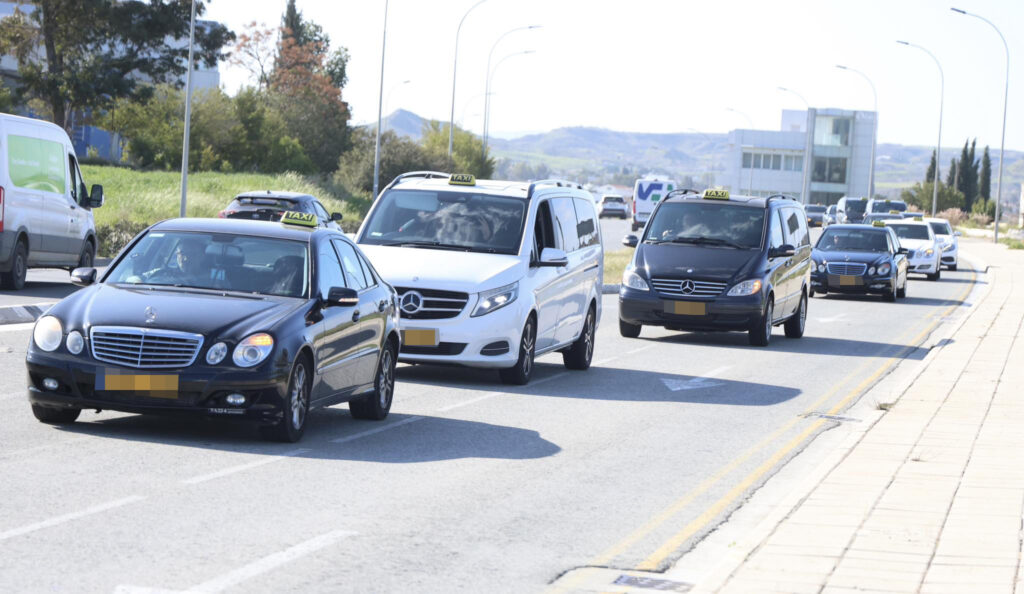
An extensive and deep reform of the operating framework of the taxi service in the Republic of Cyprus is brought by the proposed bill to amend the "Regulation of the Traffic Transport Law". This is the first substantial revision of the system in more than 20 years, as the market has remained frozen without the issuance of new licenses since 2002. Today, there are 1,588 active licenses for city taxis, while there are also licenses for 212 rural taxis. The estimate is that their number after the changes will exceed 3,200 permits in the coming years and will reach up to 5,600.
The reform, which is being promoted by the Licensing Authority, attempts to respond to the burning issues that have dominated the public sphere for the past three years. At the center of the news were the intense mobilizations of professional drivers, culminating in the strike of March 2026 against the unbearable operating costs and the annual rent of licenses. At the same time, public opinion was strongly concerned by the sharp outbreak of piracy, the repeated complaints of tourists about overcharges at Larnaca and Paphos airports, the low availability of vehicles at peak hours, as well as the discussion about the legal operation of digital booking platforms.
The report attempts three things:
>> First, it records in detail the most important changes introduced by the bill compared to the existing legislation.
>> Secondly, it examines whether these changes really upgrade the profession of taxi driver and the service received by the citizen.
>> Third, it assesses the correspondence of the bill with the findings and recommendations of the scientific study prepared by Frederick University on behalf of the Licensing Authority in 2025, as well as with the complaints and requests that have been publicly expressed over the past three years.
Therefore, the new bill is largely based on the findings of the Frederick University study and promises a double upgrade:
• For the professional driver, the radical crackdown on piracy is ensured with crippling administrative fines and court measures, a fair mathematical formula is introduced for the issuance of new licenses, a "brake" is put on the speculative rental/transfer of licenses as investment assets, the "special lease vehicle" (van/Vito type) is legalized and the Register of Intermediaries is established that transfers the responsibility of compliance to the digital platforms themselves.
• For the citizen and the tourist, the availability of taxis in urban centers where huge shortages are currently recorded is significantly increased, the fleet is renewed with mandatory new vehicles of Euro VI anti-pollution technology or fully electric, controlled and safe travel away from illegal drivers is ensured, price transparency is enhanced through mandatory pre-rental receipts and the use of modern booking applications is legalized under strict state regulations rules.
The five pillars of upgrading the profession
Evaluating the bill from the point of view of the professional himself, five key points are identified that shield the industry:
>> War on Piracy: Illegal passenger transport is described by drivers as "the cancer of the industry". The data are shocking: Piracy cases skyrocketed from 108 in 2024 to 306 in 2025, with fines imposed exceeding €540,000. The bill strengthens administrative fines (€750 to the driver, €1,500 to the owner and €1,500 to each intermediary) and gives the Courts the power to impose a temporary ban on the movement of the vehicle or even the suspension of the operation of illegal premises.
>> An end to the freezing of licenses: With the new article 9, a transparent mathematical formula is introduced that links the number of licenses per seat to the permanent population and the number of tourist nights. The process will be re-evaluated every three years, putting an end to arbitrariness. In addition, a social quota of 10% is established for large families, families with three children and parents with disabilities.
>> Licenses return to the state: Until now, taxi licenses had been turned into golden private assets, with their resale value on the open market even reaching €100,000, while 48.6% of them were rented out irrationally. The new licenses will not be transferred "while alive or due to death". The new licenses will now belong to the state, protecting the driver from unbearable rents.
>> Legalization of 7-9 seater vehicles: The institution of the "special lease vehicle" (Vito/van) is introduced to serve tourist groups and hotels. Transport will be allowed exclusively through a prior written or telephone reservation, while it is expressly forbidden to approach customers on the street or in the squares, eliminating unfair competition.
>> Responsibility on platforms: A special register is created at the Department of Road Transport (TOM) for Bolt-type electronic platforms. Each mediator is required to appoint a compliance officer and only work with legally licensed taxis. Failure to appoint an officer will result in hefty administrative fines of up to €50,000.
Changes in the service to the citizen
The reform promises to radically change the experience of the passenger public from the point of view of the citizen-passenger and the tourist. In detail, the five points that substantially upgrade the service:
• An end to waiting in big cities: The Frederick University study showed a huge geographical imbalance. Nicosia has only 472 taxis for 330,000 inhabitants (ratio 1:700 inhabitants) and Limassol 487 for 258,000 inhabitants (1:530), with 71% of students stating that they cannot find a taxi at night. The Licensing Authority estimates that the new formula will lead to the issuance of 3,200 to 5,600 additional licenses by 2030, solving the availability problem.
• Green and modern vehicles: All vehicles registered as taxis for the first time should be new, Euro VI class or fully electric (BEV), upgrading the comfort and safety of passengers. Gradual renewal and will upgrade the experience especially for tourists using taxis to/from airports and hotels.
• Safety for the passenger: The fight against illegal transport directly protects the citizen. The pirates acted without professional security, without a criminal record check and without a vehicle suitability check. The new platform, the electronic registration of pre-booking and the responsibility of the intermediary will offer the citizen the certainty that the vehicle he is riding in is legal, insured and checked.
• Blocking overcharges at airports: For the pick-up of passengers from airports, ports or roadblocks, it becomes mandatory to have a pre-booking receipt with the details of the passengers, the flight and the pre-agreed cost. The measure responds to the long-standing complaints of tourists about profiteering.
• Controlled applications: The Register of Intermediaries legalizes and obliges transparency of Bolt-type applications, by registering in the register, appointing a compliance officer, listing vehicles with a legal license, indicating a registration number in advertisements. The citizen can now call a taxi from an application with greater certainty that the provider obeys rules and can be controlled.
Gap in accessibility for the disabled and the elderly
Despite the given positive direction, the analysis of the bill and its comparison with the main recommendations of the Frederick University Study highlight significant shortcomings in the aspect of user service.
In particular, there is no provision for any special category of taxi licenses for wheelchair-accessible vehicles, nor any relevant training of drivers in the service of the disabled. The Study identifies this as a gap and recommends the establishment of a Wheelchair-Accessible Vehicle category with relevant incentives/obligations.
At the same time, the bill is paradoxically silent about the mandatory acceptance of electronic payments and the issuance of digital receipts, a long-standing request of consumers and tourists. According to tourist reports, not having a mandatory card is a major negative element of the experience.
Although the study recommended mandatory retraining of drivers every 3-5 years in matters of road safety, tourism ethics and first aid, the bill does not institutionalize such a mechanism.
The taxi is treated as an 'island' rather than a link in the transport system and is not part of the 'Mobility as a Service' (MaaS) framework for combined tickets with buses or other means.
The purchase of electric vehicles is mandatory, but it is not accompanied by government subsidies, tax exemptions or the creation of fast charging infrastructure at the ranks and airports.
