
"Trafficking in human beings is not... far away, it's happening next to us", is the message of the first event of the women's organization AGORA Club 2 Nicosia held on May 7, 2026 at the EAC main building in Nicosia, "highlighting a critical issue that affects both the Cypriot and international society" as highlighted by the president of the Club Elena Theodorou Koza.
"AGORA Club 2 Nicosia, a member of the international network AGORA Club International, will continue its action with initiatives that enhance information and the active participation of society on key social issues," Ms. Koza told "F". He added that "Agora Cyprus is part of the international network of the Agora Club and has been actively active in Cyprus for 6 years with the aim of promoting social contribution, women's empowerment and solidarity".
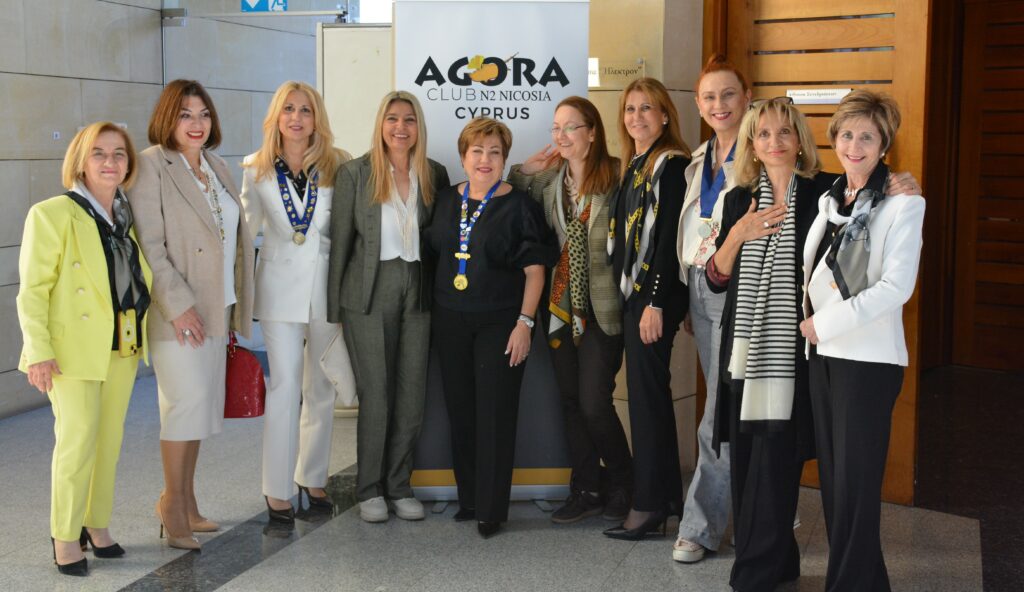 The executives of AGORA CLUB CYPRUS at the event of May 7th.
The event was organized in collaboration with the anti-trafficking organization Step Up Stop Slavery, on behalf of which the founder and CEO of the organization and financial compliance consultant in Nicosia, Katerina Stefanou, and Irene Che, leader of survivors of human trafficking, president of the Advisory Council of Step Up Stop Slavery, made statements. From the Anti-Human Trafficking Office of the Police (GEP), police officer Maria Georgiou addressed a greeting.
Building public-private partnerships
"At Step Up Stop Slavery our work is based on the belief that tackling human trafficking requires a coordinated, social response," Katerina Stefanou emphasized in her speech and added: "Our strategy is based on three interrelated pillars – multi-stakeholder collaboration, youth participation and survivor leadership – to create resilient, systemic change.
Central to our approach is the belief that no single actor or sector can fight trafficking in human beings alone. We bring together professionals from all sectors – including the private sector – to train side by side, fostering the shared understanding that effective action requires.
Our training programs are based on the National Referral Mechanism (NRM) manual of the OSCE Office for Democratic Institutions and Human Rights (OSCE – ODIHR), equipping participants with the practical tools for proactively identifying victims and referring them to trauma-based support.
By building public-private partnerships and ensuring that all stakeholders speak a common language, we strengthen the entire response chain – from early recognition to long-term recovery."
Ms. Stefanou stressed that "the damage caused by human trafficking is deep and lasting. Survivors face severe physical injuries, post-traumatic stress disorder, depression, an addictive emotional attachment to the abuser, social isolation, loss of education, financial ruin, and constant fear of the authorities. Recovery requires comprehensive support, including access to justice, psychological care, financial avenues, and lasting security."
Youth Active Participation and Survivor Leadership
"Our second pillar – said Katerina Stefanou – recognizes that constant change must start from the next generation. Through Step Up Youth we work directly with young people, equipping them not only with the knowledge to stay safe online and in their daily lives, but also with the creative skills to become their own advocates.
Our young members have already created three films about online safety, raising awareness about the tactics used by predators and groomers targeting young people. Ultimately, we believe that by working with young people now, we can change mindsets and build a culture that refuses to tolerate human trafficking and actively works to eliminate the demand that drives it."
Referring to the third pillar of the organization's strategy, Ms. Stefanou stressed that "at the heart of everything we do, is the leadership of the survivors. Step Up Stop Slavery has recommended the Step Up Survivors Advisory Council, ensuring that those with lived experience, are genuine architects of our project. Survivors' recommendations are directly integrated into policy, and their voices connect with stakeholders in every sector – from finance to hospitality – so that people who understand human trafficking in depth are the ones shaping how it is addressed."
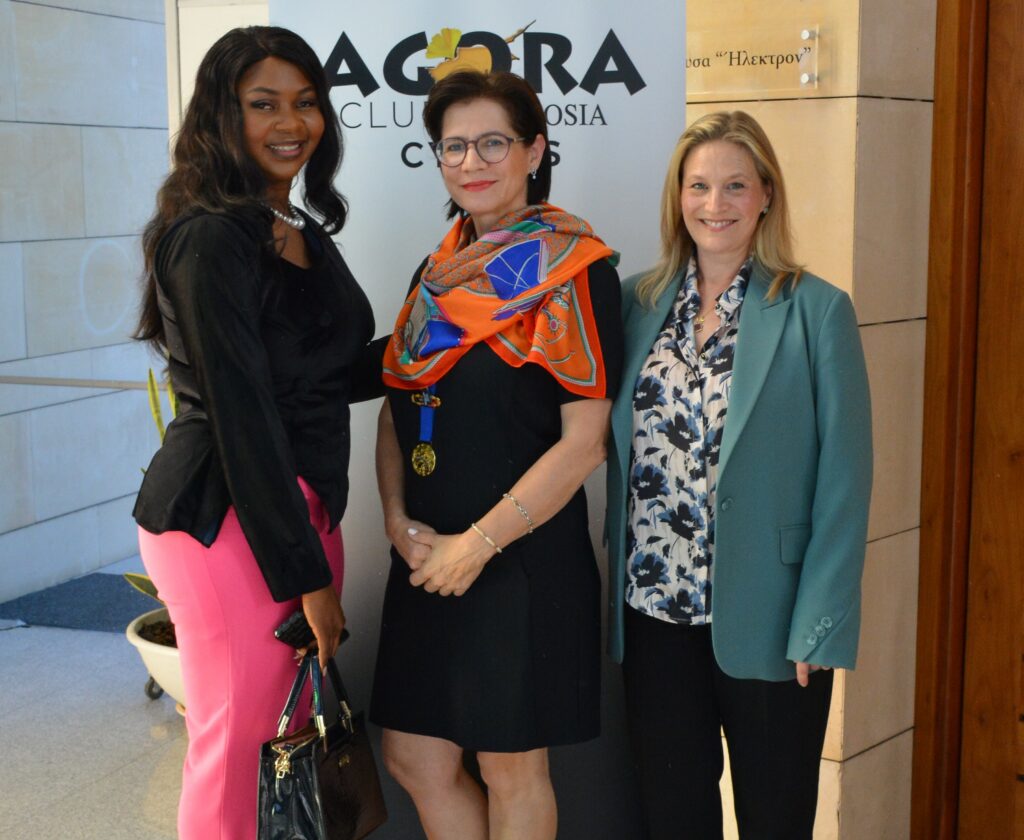 From left to right, Irene Che, Anna Charikli and Katerina Stefanou.
Labour exploitation and domestic slavery
The event put labour exploitation at the center of discussions, since according to the United Nations Office on Drugs and Crime (UNODC) World Report for 2024 concerning human trafficking, the most common forms of exploitation today are forced labour, sexual exploitation and forced crime.
According to Katerina Stefanou, "the scale of the crisis is rising rapidly, since in the period 2019 – 2022 the global number of victims of forced labour increased by 47%. The 2024 Report identified almost 75 thousand victims of human trafficking for 2022, of which 42% were trafficked for the purpose of forced labour – and experts warn that this represents only the tip of the iceberg, as the hidden and coercive nature of labour exploitation does not allow the vast majority of cases to be identified.
As UNODC Executive Director Ghada Waly noted, criminals are trafficking more and more people into forced labour, including sophisticated online scams – a stark reminder that modern slavery takes many forms and that awareness, cross-sectoral collaboration and proactive identification of victims, has never been more critical."
The CEO of Step Up Stop Slavery made special reference to domestic slavery, pointing out that it is "a hidden crime and one of the least visible forms of human trafficking. Many people - he added - do not recognize that they are victims of trafficking, believing that they have simply been hit by a "bad employer".
The components of domestic slavery include working 12-18 hours a day without a day off, confiscation of passports, living in a kitchen or basement, isolation from the family and without access to a telephone, linking their visa to their employer and withholding "owed" money for travel expenses."
Ms. Stefanou underlined that many victims of domestic slavery do not report the exploitation they suffer due to the visa connection with the specific employer, due to the retention of passports/documents by the employer, the fear of deportation in case of a report of abuse, the lack of knowledge of legal rights, the lack of support routes or safe housing, the financial need to send money to the family and the risk of forced irregularity in case of abandonment of the abusive employer".
He concluded by stating that the Council of Europe's Group of Experts on Action against Trafficking in Human Beings (GRETA) has recommended that the Republic of Cyprus take urgent measures on domestic slavery and ratify International Labour Organization Convention No. 189 on Decent Work of Domestic Workers.
Why Survivors' Voices Matter
Irene Che, leader of survivors of trafficking in human beings, chair of the Advisory Council of Step Up Stop Slavery emphasized in her intervention that "the voices of survivors are important because they strengthen prevention efforts.
Survivors – he added – offer experiential experience and real knowledge, help build trust with vulnerable populations, improve awareness campaigns, can identify gaps in existing systems and help create more effective policies and solutions.
Survivors – he continued – are not just victims, they are experts. Their lived experience supports awareness-raising campaigns in reality, builds trust with vulnerable communities, identifies gaps in existing systems and promotes better, more human-centred policies. Placing survivors at the center of the work against human trafficking is not only a moral necessity, but a very effective prevention and combat action.
Trafficking in human beings involves recruiting, transporting, or sheltering individuals through deception for exploitation – whether sexual, labour, or for forced begging, organ harvesting, criminal activity, or forced marriage. This crime disproportionately affects women and girls and is fuelled by poverty, inequality, discrimination and conflict.
Victims include children and young people without family support, migrants with irregular status, people with physical or mental health problems, or people with a history of gender-based abuse or discrimination. Traffickers often present themselves as friends, partners, or employers. They lure victims with false promises of work, romantic relationships, or a better life. Confiscation of documents, threats and violence, are means of maintaining control over the victim. They are increasingly using social media and digital platforms to recruit and exploit victims."
"As a society we have the responsibility not to pass by"...
"Trafficking in human beings is not just a criminal offense, it is a blatant violation of human rights that affects the dignity, freedom and safety of victims," said GEP spokesperson, police officer Maria Georgiou, from the podium of the event. He added: "Despite the fact that it often remains invisible, it unfolds next to us and affects human lives in the most cruel way. Trafficking in human beings is not a phrase of exaggeration, it is a reality that we often choose not to see. This is where the biggest challenge lies, because it does not always "shout" its presence, but hides behind normality, behind stories that seem "ordinary" and behind silences. The victims are "invisible" not because they do not exist, but because we do not recognize them. They are men, women and children who are trapped in situations of exploitation, with no way out. They are people who live under the control of others, but are afraid to speak up. They are women who are sexually abused, but are ashamed to speak out. As a society we have the responsibility not to pass by, not to ignore, to observe. Because a suspicion, an observation, a report can be an occasion for saving a person. At the same time, for those of us who serve in positions of responsibility, this responsibility is even greater. Our role requires vigilance, training and, above all, humanity. Because the recognition and handling of a victim is not just a process, but a duty and ability to see the person behind the situation. Dealing with the phenomenon is not only a matter for the authorities, it is a matter for all of us. Every citizen who chooses to be informed, not to be indifferent and to act, becomes an integral part of the solution."
The GEP identified 30 victims in 2025
According to the most recent data on human trafficking in Cyprus sent to us as part of the report by Senior Lieutenant Eleni Michael, head of the Anti-Human Trafficking Office of the Anti-Crime Department at the Police Headquarters, in 2025 there were 5 convictions of traffickers compared to 7 in 2024, 5 in 2023, 4 in 2022 and 4 in 2021. In 2025, 30 victims were identified by the GEP, of which 16 are women and 14 are men. 18 of these people are victims of labour exploitation, 9 victims of sexual exploitation and 3 victims of other forms of exploitation. 24 of these 30 victims are foreigners and 6 are Cypriots. In the same year 2025, 21 people (14 men and 7 women) were arrested on suspicion of human trafficking, of which 12 were Cypriots and 9 foreigners. A total of 315 reports of trafficking in human beings were received in 2025, compared to 336 in 2024, 512 in 2023, 265 in 2022 and 169 in 2021. It is noted that internationally 49.6 million people live in conditions of modern slavery, including 12 million children. Criminal profits from forced labour reach $236 billion a year, making human trafficking the second most profitable criminal enterprise in the world, behind only drug trafficking. In the European Union alone, almost 10,000 victims were registered in 2024, 63% of whom are women and girls.
