
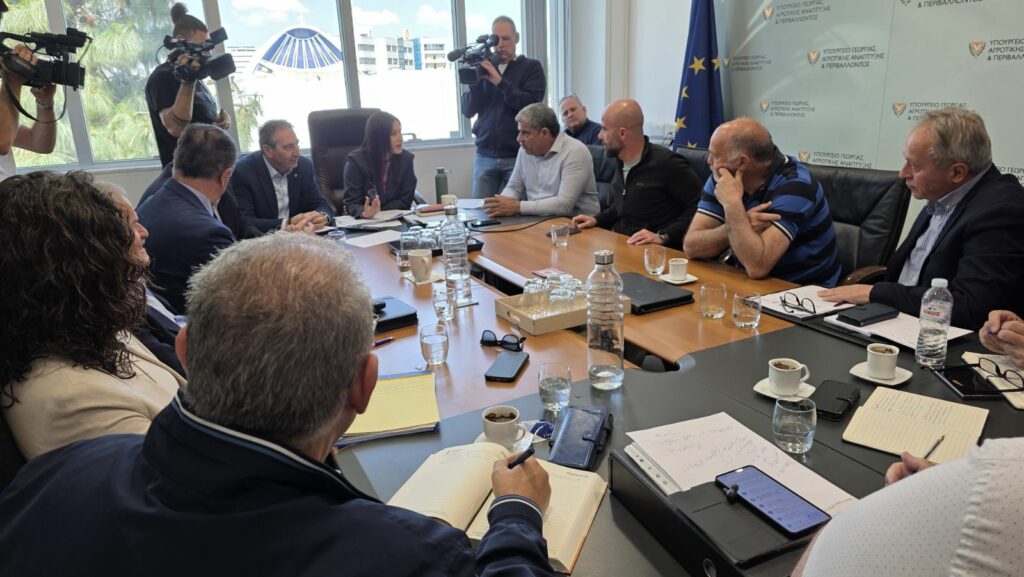
The amounts of compensation to livestock farmers in relation to foot-and-mouth disease were announced a while ago by the Minister of Agriculture, the total amount of which amounts to €35.6 million. These amounts were agreed by the Ministry and the agricultural organizations at a meeting of the Special Advisory Committee as support for livestock farmers.
The new compensation prices are substantially increased:
• For sheep and goats, from €43 – €178, the compensation increases to €47 – €420 for animals of high genetic value.
• For cattle, from €150–€1,500, it increases up to €2,500, depending on the category and productivity.
The European reference values are much lower (€1,000 for cattle and €140 for sheep and goats). The Republic of Cyprus consciously chooses to support livestock farmers with compensations up to 150%–200% higher than European levels, assuming significant additional costs to ensure the next day of Cypriot livestock farming.
The Minister's full statement:
Foot-and-mouth disease – a highly contagious zoonosis – is managed by the Veterinary Services based on European regulations and biosafety protocols. However, beyond the veterinary dimension, we must not forget that this crisis affects livestock farmers first. It is tragic to lose in an instant the livestock that is the labour of a lifetime.
From the first moment, our priority was the substantial support of our livestock farmers. As early as the end of March, advances for loss of income have been paid, as well as payments for milk and feed. With the new proposal to the Council of Ministers, the advance payment will now be given to all those affected, regardless of the number of animals, which will speed up payments.
In addition, and on the basis of the intensive dialogue that we have been having for weeks with the agricultural organizations and the representatives of the livestock farmers participating in the Special Advisory Committee, but also having as our common basic principle to give a real incentive for reactivation to our livestock breeders, the government decided: Immediate payment of compensation for the livestock killed to all those affected.
I note that the initial prices of the three-member committee of the KYs were judged to be low in relation to the market data and the needs of the units. That is why, following data provided by livestock breeders and agricultural organizations, a significant revision of the methodology and the amount of compensation was made. The new compensation prices are substantially increased:
• For sheep and goats, from €43–€178, the compensation increases to €47–€420 for animals of high genetic value.
• For cattle, from €150–€1,500, it increases up to €2,500, depending on the category and productivity.
It is worth noting that the European reference prices are much lower (€1,000 for cattle and €140 for sheep and goats). The Republic of Cyprus consciously chooses to support livestock farmers with compensations up to 150%–200% higher than European levels, assuming significant additional costs to ensure the next day of Cypriot livestock farming.
The first payments start as early as next week.
2. Those livestock farmers who choose to reactivate will receive income loss support for at least twelve months, until their units fully return to production. The loss of income will take into account labour, fixed costs, social insurance, financial obligations, etc. so that it is fair and based on the real needs of livestock farmers.
3. Reconstitution of livestock with animals of high genetic value on the basis of a State Aid Plan. The criteria and financial parameters of the Plan to ensure genetically improved livestock will be based on the findings of the Special Scientific Committee under Mr. Malas. The financial support will be determined based on the genetic value, productivity, age, etc. of the animal and a maximum value (amount) will be set per category of animal. In cases where this amount exceeds the amount of compensation that the breeders will have received for the slaughters, the state will subsidize the difference.
4. Coverage of the cost of feeding the animals that will be acquired with the Reconstruction Plan, for the period when the animals will not contribute to the farmer's income.
5. For each livestock farmer, a state official will be appointed to support and guide the reconstruction of his unit, so that the next day can be built with proper, sustainable planning and safety.
With the revisions that have been decided and the additional support and reactivation measures that are being promoted, the total amount to support our livestock farmers is estimated to exceed €35.6 million.
As you know, in addition to the above, the Government is also considering additional measures concerning the protection of PDO halloumi and ensuring the unhindered continuation of exports.
It is a fact that foot-and-mouth disease has significantly affected the quantities of milk available, creating pressures throughout the production chain. We recognize that this situation negatively affects all stakeholders and producers and, therefore, we are in constant consultation with all stakeholders.
In this context, additional temporary measures are being studied to safeguard the PDO and exports on which the income of all livestock farmers depends, and for which there will be further announcements in the coming days.
The measures we announced are the product of close and substantial cooperation with agricultural organizations and livestock farmers' representatives. They are their own suggestions, documented, targeted and reflect the real needs of the industry. That is why they were adopted. I would like to thank all the members of the Advisory Committee for their serious and constructive stance, which proves that dialogue is the only way to effective crisis management.
I owe special thanks to Mr. Malas for his scientific guidance and contribution to the formulation of a reconstruction plan with animals of high genetic value — a prerequisite for safeguarding our halloumi.
I also thank the officials of the Department of Agriculture and the Veterinary Services for their continued support of the work of the Commission.
But the biggest thank you belongs to the breeders themselves. To those livestock farmers who, despite the difficulties, comply with biosecurity measures, cooperate and fight every day for a more modern, more resilient and more competitive Cypriot livestock farming. The state will continue to stand by them, with firm and practical support.
Michalis Lytras: Livestock farmers should not proceed with any unnecessary mobilizations,
I have the honor today to be nominated by the colleagues and all the company we had the session to make the statement on behalf of everyone, said the Honorary President of the Panagrotiki Union of Cyprus, Michalis Lytras. Today we had a substantial productive meeting chaired by the Minister and we were informed of the decisions regarding what our affected livestock farmers will get from foot-and-mouth disease.
The decision that has been taken and is ready to be approved by the Council of Ministers reaches the limits that we, as an agricultural movement, had set in terms of the compensation of livestock capital. That is why we have been satisfied with this request but also for the lost income, which was our request. Also, the Minister of Agriculture has agreed with what we have asked for now regarding the numbers. Therefore, we, as an agricultural movement, have been satisfied with the decisions that will be approved by the Council of Ministers.
That is why we call on the livestock farmers, dealing with their problem properly, to agree not to proceed with any unnecessary mobilizations, on the one hand so that they do not suffer, on the other hand not to transmit the virus from the polluted areas to the unpolluted areas and to move forward prudently, seriously to deal with this problem not only of compensation but also of the recovery of our livestock farming, which we consider an essential primary sector of production. Let's not forget that we must not lose either our livestock farming, or our halloumi, which is one of the most serious incomes that Cyprus has from livestock farming.
If I have spoken for a long time, it is because we feel that we must all responsibly, without deviating, seriously deal with this problem in order to have live livestock farming forever in Cyprus.
