
DELAYED PATIENT ACCESS TO NEW MEDICINES - ONLY 66 OUT OF THE 168 APPROVED NEW MEDICINES ARE AVAILABLE IN CYPRUS - MORE THAN A YEAR AND A HALF OF WAITING - Filenews 28/5 by Marilena Panayi
Cyprus continues to record low performance in terms of patient access to new treatments, remaining below the European average, according to new data from EFPIA's W.A.I.T. (Waiting to Access Innovative Therapies) Indicator, which assesses the availability and timing of access to new medicines in European countries.
The results of the survey, which were published on May 19, 2026 by the European Federation of Pharmaceutical Industries and Associations (EFPIA), concern new medicines approved in the period 2021-2024 and record significant differences between the countries of the European Union and the European Economic Area. The data were released by the Cyprus Association of Pharmaceutical Companies Research and Development.
Cyprus ranks 21st among 36 European countries, which, according to KEFEA, reflects the long-standing difficulties that still exist in the processes of evaluation, approval and reimbursement of new treatments
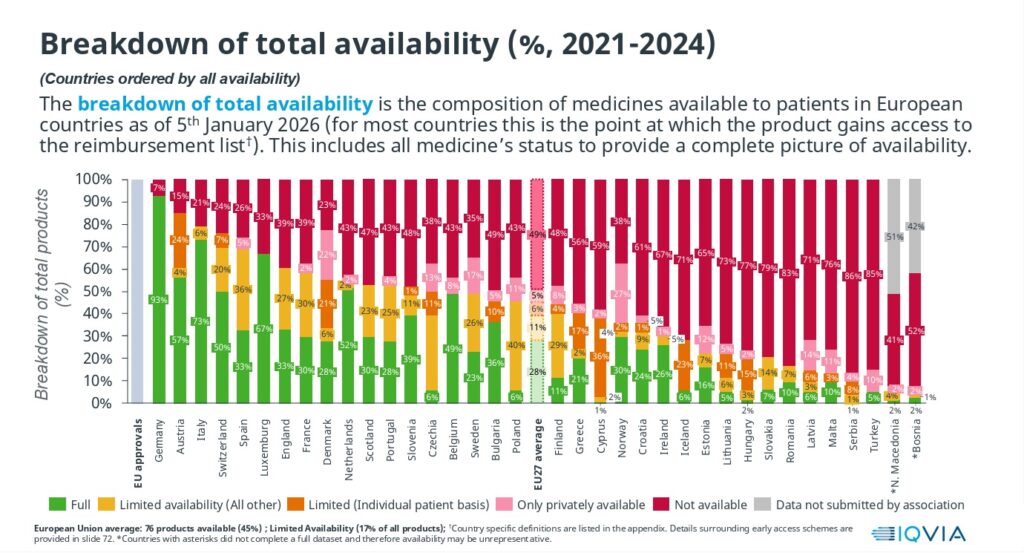
Based on the study data, the time it takes for patients to access innovative medicines varies widely across Europe.
Germany continues to be the country with the fastest access, with new treatments becoming available on average in 158 days from European approval. On the opposite side is Romania, where the corresponding time reaches 1,110 days.
The average in the 36 countries that participated in the survey is 597 days, while in Cyprus the time until the availability of innovative treatments is estimated at 528 days.
Despite the fact that Cyprus appears slightly better than the European average in terms of time delay, overall patient access remains limited, reports KEFEA.
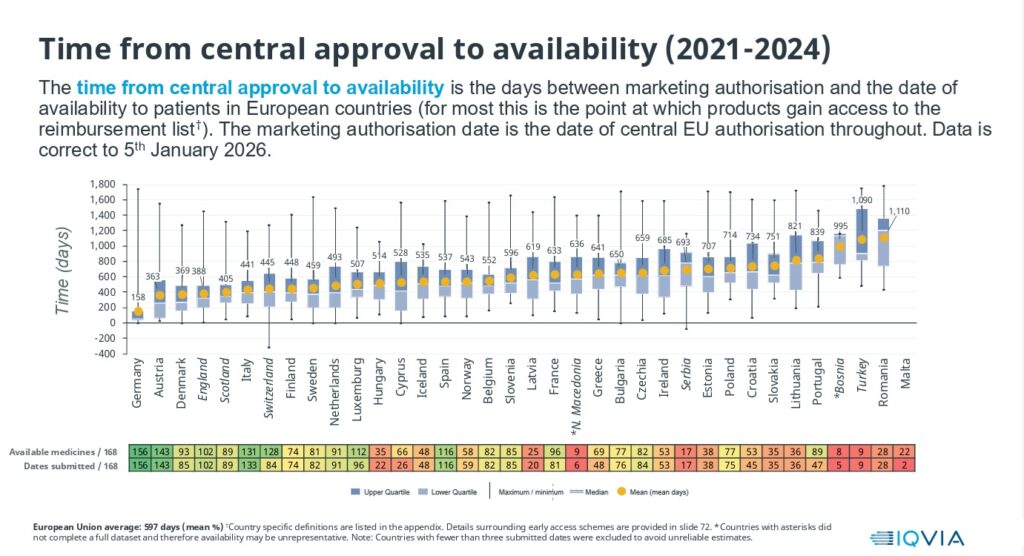
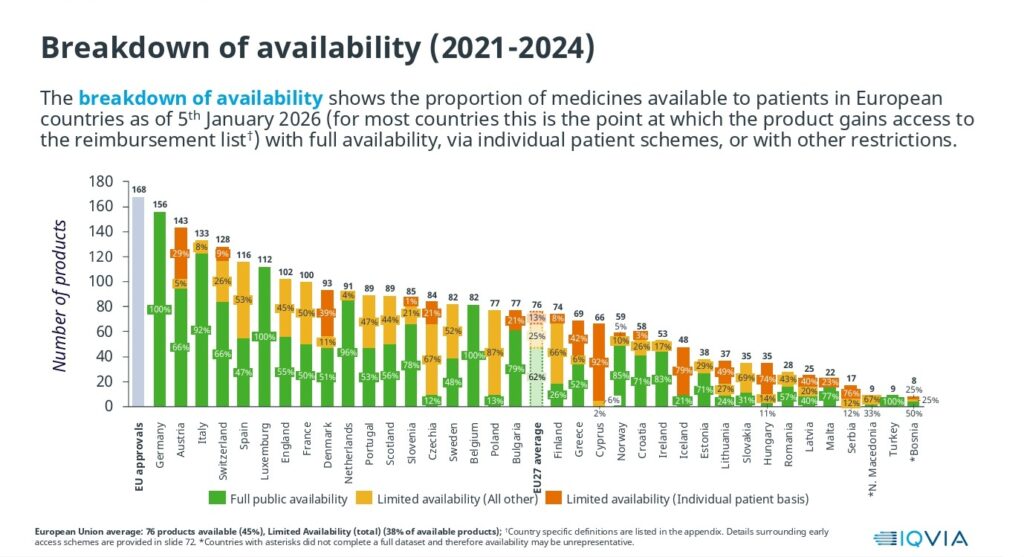
Specifically, out of the 168 innovative medicines that have received European approval, only 66 are available in the Cypriot market, which corresponds to 39%. The average in the 36 European countries reaches 45%, i.e. about 76 innovative medicines available per country. Germany also retains the top spot in this index, as it provides access to 156 of the 168 approved medicines.
KEFEA highlights the fact that out of the 66 innovative medicines available in Cyprus, only 2% are administered without restrictions or additional procedures. For the vast majority of treatments, and specifically for 92%, special approvals are required or restrictions on patient access are applied. In Germany, on the other hand, access to new medicines is granted without restrictions in 100% of cases.
KEFEA attributes the delays and access problems mainly to the slowness of regulatory processes, the different evaluation requirements and the limited health budgets, arguing that closer cooperation of all stakeholders is needed to address the obstacles.
As pointed out, in the case of Cyprus, changes in procedures are needed so that patients can gain access to new medicines immediately after their European approval, even before the national evaluation and reimbursement procedures are completed.
The president of KEFEA, Kyriakos Mikellis, stated that, despite the improvement recorded in recent years in the availability of new treatments, delays continue to be a serious problem for patients in Cyprus.
As he mentioned, the evaluation of new drugs still in several cases requires two or even three years, while he underlined the need to speed up procedures, meet schedules and increase investments in medicines by both the Health Insurance Organization and the Ministry of Health.
He also noted that, although new health technologies often have a higher cost, the benefits they offer to patients, the health system and society as a whole outweigh the economic price.
It is reported that based on the study, Cyprus is in a very good position in terms of access to anti-cancer drugs. According to the report, 32 of the 56 new anti-cancer drugs included in the study were available in Cyprus during the period under review, a percentage of 57%.
