
Pact sets framework for French troop presence on island
A Status of Forces Agreement (SOFA) constitutes another landmark in the long-evolving defence and security ties between Cyprus and France. It comes amid shifting geopolitical sands in the volatile region of the eastern Mediterranean and the Levant, as the island looks to leverage its geographical location as well as its status as an EU member.
On April 26, President Nikos Christodoulides confirmed that negotiations with Paris have entered a formal phase, with the SOFA agreement to be concluded at ministerial level.
He said the arrangement “will provide for the presence of French forces on Cypriot territory for humanitarian purposes”, framing it as part of a broader strategic alignment between the two states.
The agreement establishes the legal and operational framework governing the presence, movement and activities of French military personnel in Cyprus.
It defines jurisdiction, taxation, customs procedures and conditions of deployment, while ensuring reciprocity for Cypriot personnel operating in France.
Christodoulides said the agreement was expected to be concluded in June.
The Cyprus Mail understands the June timeline is anything but random. Defence ministry sources told us it coincides with the informal meeting of EU defence ministers, scheduled to take place in Nicosia on 7 and 8 June.
The idea is to have the SOFA finalised by then, so that it’s signed and sealed at the informal summit.
The sources could not give more details – such as whether French forces would be permanently stationed in Cyprus.
The SOFA might have been announced earlier, at the informal meeting of defence ministers initially scheduled for 11 March. However, the Cyprus presidency of the EU Council postponed the gathering due to regional security developments impacting travel.
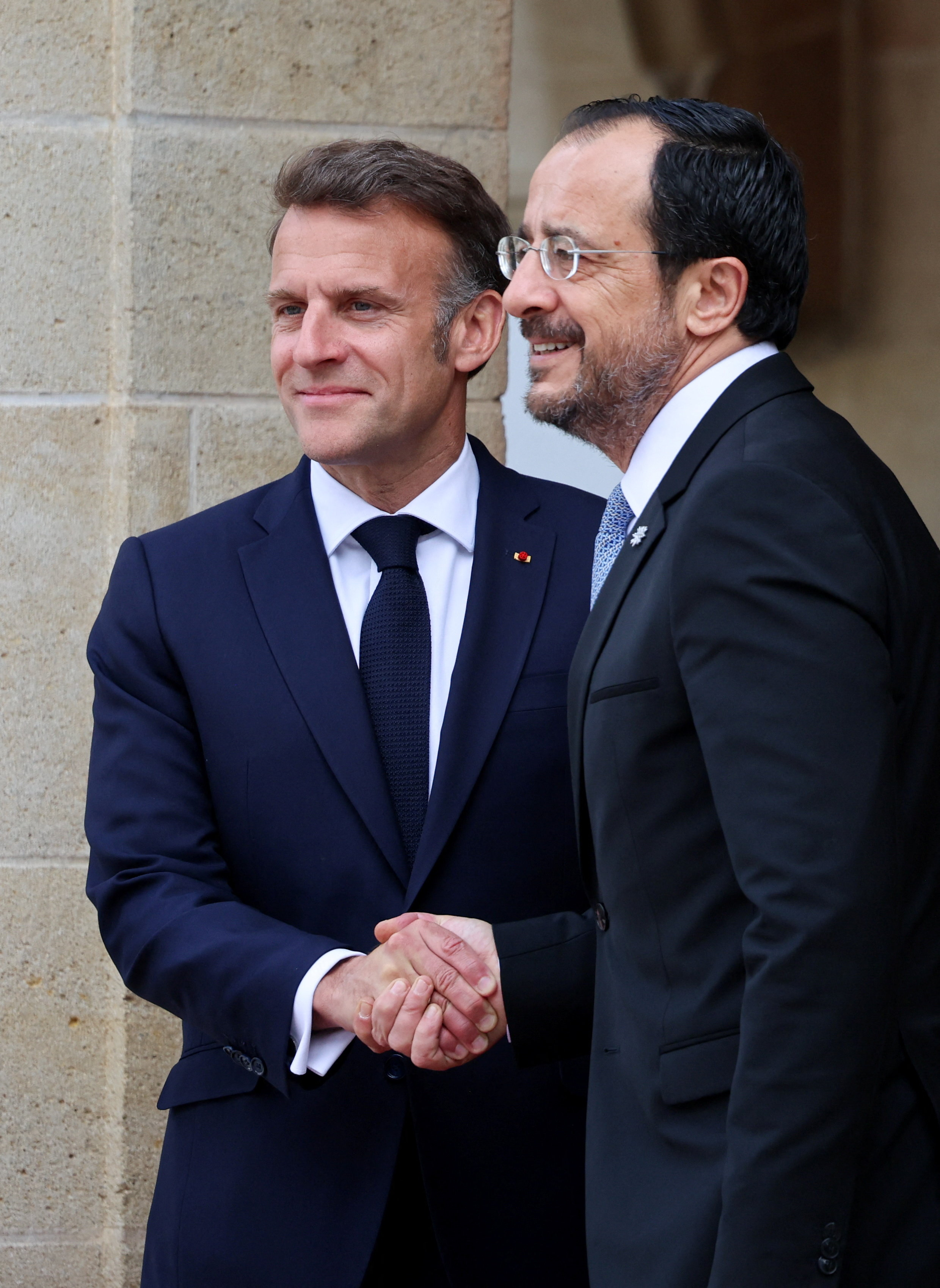 President Nikos Christodoulides shakes hands with French President Emmanuel Macron during a welcome ceremony at the Presidential Palace
But what does it all mean? And why now?
Veteran diplomat Euripides Evriviades described it as the culmination of a long process of deepening security relations between Cyprus and France.
Evriviades, ambassador ad honorem and Senior Fellow at the Cyprus Centre for European and International Affairs, said the notion of a “love affair” between the two nations is somewhat misleading.
“The relationship is not new. It has depth, continuity, and memory. What we are witnessing today is not its birth, but its evolution – its elevation to a more structured, strategic, and operational level.”
The analyst recalled that an inflection point came during the presidency of Tassos Papadopoulos.
In March 2007 Cyprus and France signed a defence cooperation agreement, described by both sides as a “routine pact” arising from the need to upgrade cooperation following Cyprus’ provision of ground and other services to French and multinational forces during the Lebanese crisis in 2006.
“These steps were not cosmetic,” asserted Evriviades. “They reflected a deliberate broadening of Cyprus’ diplomatic orientation beyond its traditional anglophone framework, including its participation in the Commonwealth of Nations.
“What has changed today is the level of ambition and the degree of institutionalisation.”
The former diplomat points to the Strategic Partnership Agreement signed in Paris in December 2025 by Christodoulides and French president Emmanuel Macron.
The behemoth of a text – some 4,000 words – provides the political framework. It formalises cooperation across defence, security, innovation, and European coordination.
It signals intent.
Now, said Evriviades, the SOFA establishes the legal and administrative framework for the presence and activity of French forces in Cyprus.
“These are not ad hoc isolated steps. There is a sequence: from political alignment, to strategic partnership, to operational presence.”
The ex-ambassador cited a number of “concrete benefits” to Cyprus.
First, it enhances its security posture and defensive capacity.
“Security for a small state does not come from isolation, but from relevance – from embedding itself in credible networks of cooperation, legality, and preparedness.”
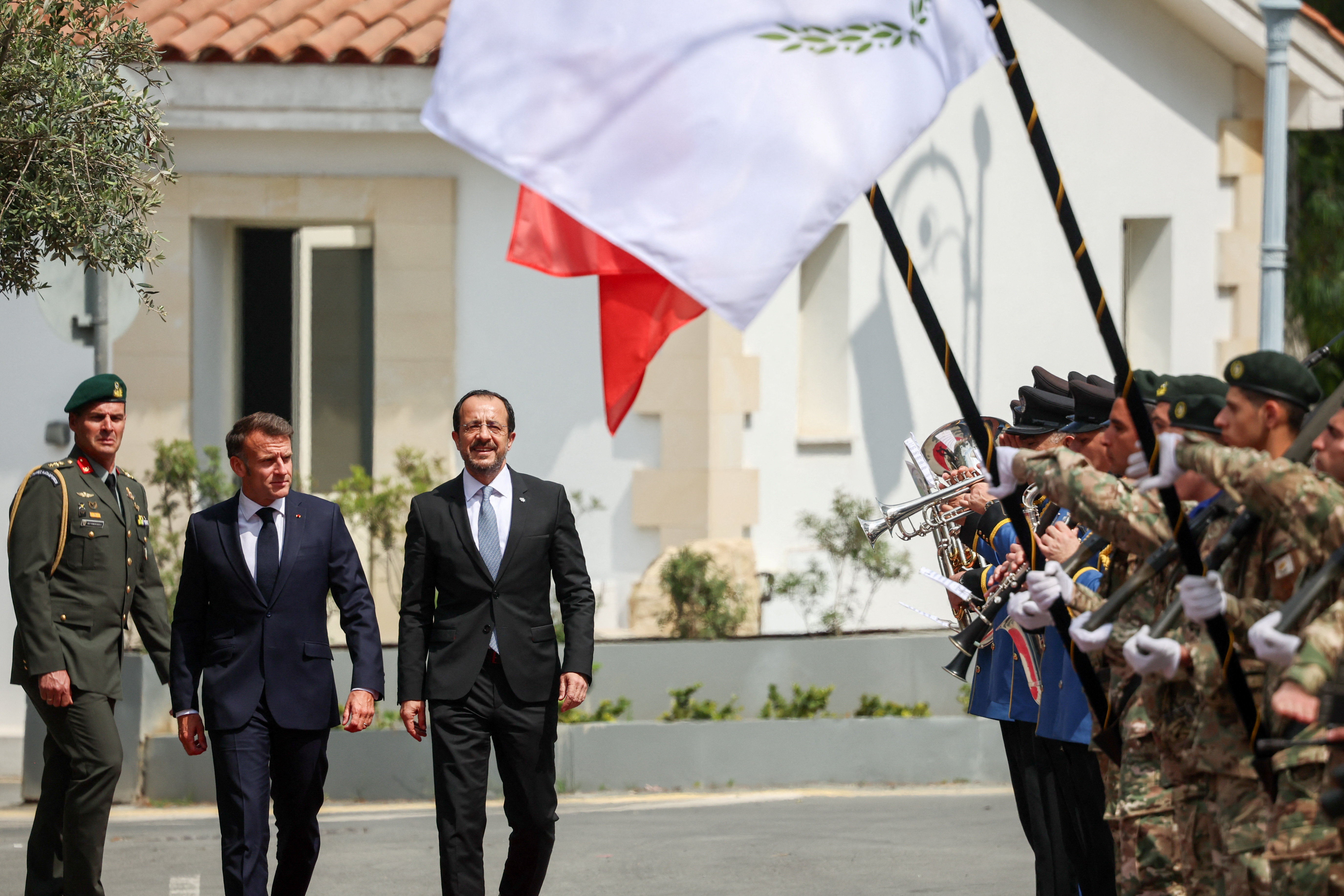
Second, it strengthens interoperability with one of Europe’s most capable military powers. France is a Nato member, a Mediterranean power, a nuclear power, a permanent member of the UN Security Council, and one of the very few European states with the capacity to deploy and sustain operations beyond its borders. Additionally, it is a central actor within the EU.
Third, Cyprus increases its strategic utility within the European emerging geopolitical security architecture.
“Geography alone is not enough,” Evriviades stressed. “It must be translated into relevance – into infrastructure, reliability, and contribution.”
For France, the logic is equally clear. Cyprus offers a stable EU-based platform in the eastern Mediterranean – proximate to the Levant, to Lebanon (a country of particular interest to France), to the Suez Canal, to energy and trade corridors, and to multiple theatres of instability. It also sits at the intersection of the security concerns of states across the region, including Israel.
“In a region where access matters, Cyprus offers access. In a region where reliability is scarce, Cyprus offers predictability.”
All this must also be viewed within the broader European framework – specifically Article 42.7 of the Treaty on European Union (TEU).
“This is not rhetorical decoration. Article 42.7 is the EU’s mutual defence clause. It commits member states to provide aid and assistance ‘by all the means in their power’ to a member state that is the victim of armed aggression. The clause is open to interpretation. As ever, the devil is in the details.”
That is precisely where Article 42.7 acquires renewed relevance. For Cyprus, not a Nato member facing an enduring security challenge, the clause carries particular weight. It’s the closest equivalent to a collective defence commitment within the EU framework.
“But clauses do not operate in a vacuum. They require clarity, rules of engagement, relationships, interoperability, presence, and trust to become credible.
“Those details now matter more than before. Transatlantic assumptions are no longer taken for granted. US President Donald Trump has injected uncertainty into the European security equation, including questions about the future role and reliability of Nato and the United States’ commitment to it. Nato remains central. But the EU is increasingly compelled to organise itself more seriously as a security actor.”
Article 42.7 does not, by itself, resolve the wider EU-Nato dilemma. But it addresses one essential part of it: how the EU responds when one of its own member states invokes its mutual-assistance clause.
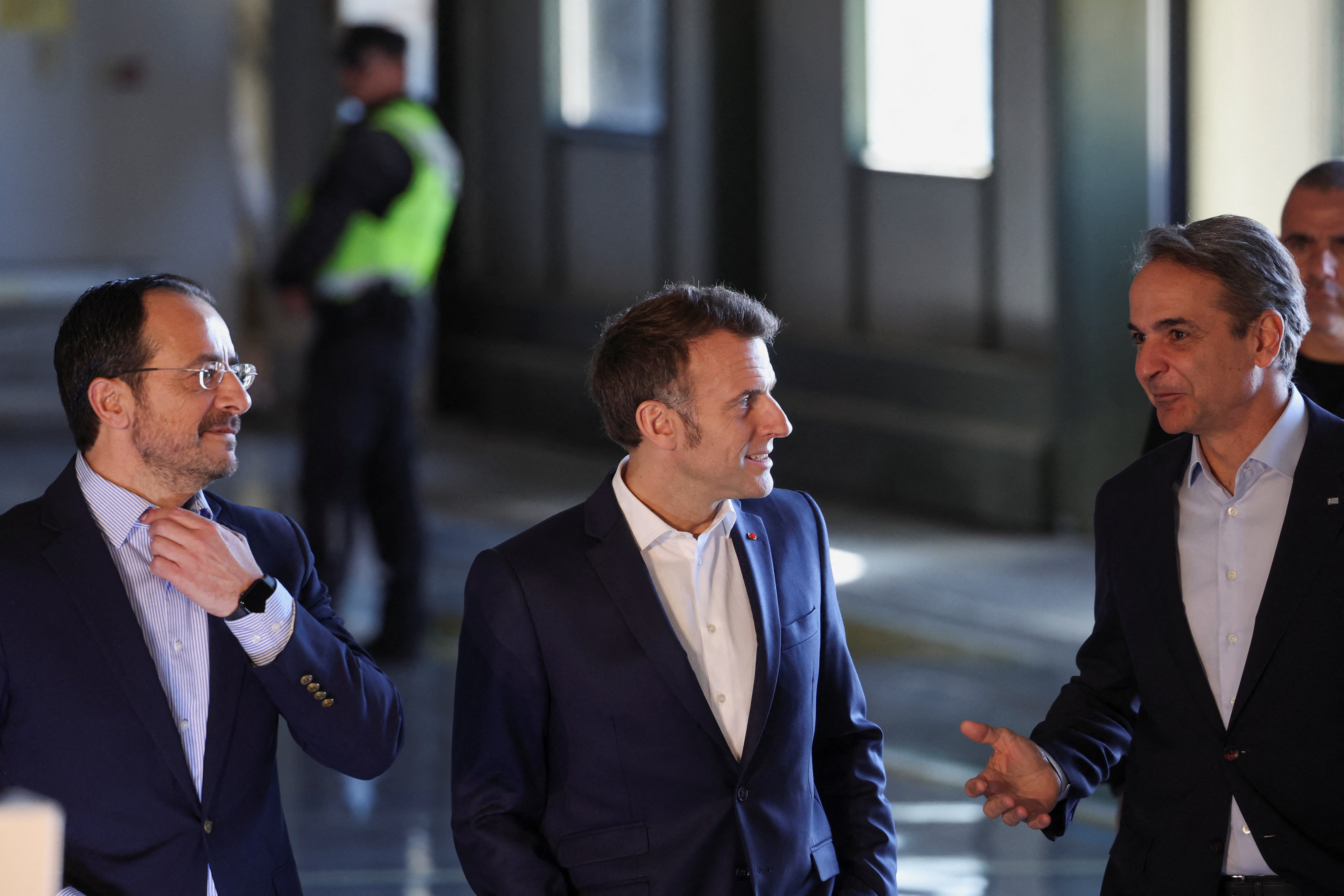
At the informal European Council meeting in Cyprus last month, and at the recommendation of Christodoulides, EU leaders tasked the European Commission with preparing a concrete operational blueprint for the implementation of Article 42.7 – defining who responds, how, and with what means if it is invoked.
“For years, the clause existed in legal form – clear in obligation, but vague in application. This is the first serious attempt to move it from text to mechanism.
“The Cyprus–France agreements do not replace this process. They anticipate it. They align Cyprus with a member state that has both the capability and the political will to act when such mechanisms are called upon.”
The response by some European countries, dispatching naval assets to Cyprus after the recent drone incident at RAF Akrotiri, provided a glimpse of how this can work in practice. Though not a formal invocation of Article 42.7, it nonetheless served as a practical demonstration of its underlying logic: that assistance, coordination, and solidarity can materialise when required. In that sense, Article 42.7 has already begun to move quietly – from principle to practice.
“Is this hype? No. Nor is it a formal defence guarantee in the Nato sense. It is something more subtle, but still serious: the gradual construction of a European security fabric in which Cyprus is no longer peripheral, but embedded.”
As to the timing, Evriviades explained: “Because the East Med has shifted. It is no longer peripheral. It is a space where European security, Middle Eastern instability, energy, migration, and great-power competition intersect. One single geopolitical strategic theatre. In truth, it always was. What has changed is the immediacy of awareness.”
And according to the ex-diplomat, Cyprus’ doctrine is defensive.
“These arrangements are not directed against any state. They strengthen preparedness, resilience, and the credibility of the overall security framework – within a framework of legality and cooperation.
“In diplomacy, small states do not have the luxury of strategic loneliness. The objective is not to provoke. The objective is to anchor – and to be useful.”
Perhaps, but both SOFA and related developments did rub Ankara the wrong way.
Last Thursday, Turkey pushed back against French plans to deploy troops to Cyprus, warning it risks destabilising the island and disturbing the existing security balance.
“Such moves risk upsetting the existing delicate balance and heightening tensions on the island,” a Turkish defense ministry official told journalists in Ankara at a press briefing.
“We reiterate that these initiatives could also pose future security risks for the Greek Cypriot Administration and that steps that could undermine regional stability should be avoided,” the official said.
As Turkish commentators write, the SOFA announcement did not occur in a vacuum. The previous week, France and Greece had signed an Enhanced Comprehensive Strategic Partnership – extending an overarching defence pact that will be automatically renewed when it expires in five years.
“In this partnership, there is a mutual support and assistance clause in case of armed aggression,” Macron said during a joint press conference with Greek Prime Minister Kyriakos Mitsotakis in Athens.
“Don’t even ask yourself the question; whatever happens, we will be there on your side,” he added.
Greece, Turkey’s Nato ally but longtime rival over territorial disputes, has also deepened cooperation with Israel in recent months, fuelling Ankara’s concerns about encirclement in the region.
