Pafos Live 19 May 2026

Members of the Cyprus Drug Enforcement Agency stopped a car driven by a 35-year-old man yesterday afternoon in Limassol.
During the search that followed in the vehicle, a number of packages containing a quantity of cocaine weighing approximately 38 grams, as well as a small amount of money, were found.
Subsequently, a search was carried out at the 35-year-old's home, pursuant to a court warrant, where a quantity of cocaine weighing approximately five grams, four glass pipes with traces of a substance believed to be methamphetamine, two pills with an unknown substance, as well as a glass container containing testosterone were located and seized.
The 35-year-old was arrested pursuant to a court warrant and taken into custody for the purposes of facilitating the investigations.
* * * * * *
Filenews
The presence and action of the Police last night was intense, throughout Cyprus, with organized patrols in key points of urban areas, with the aim of preventing serious criminal acts, ensuring public order and increasing the sense of security of the public.
The result of the preventive police operations was the arrest of five persons for various offenses, such as begging, non-appearance before the Court, traffic offenses, etc.
As part of these operations, during the night, 436 drivers and 147 passengers were stopped and checked. At the same time, 37 inspections of premises were carried out, with the aim of dealing with phenomena of delinquency, where seven complaints emerged.
During traffic checks carried out, 192 complaints were made, concerning various traffic violations, while 13 investigated cases of traffic violations also emerged.
Of the complaints made, 57 driver complaints for exceeding the speed limit stand out, while as part of the police examinations, 10 vehicles were detained. 75 alcohol tests were also carried out.
Coordinated policing operations, for the prevention and suppression of crime, continue daily, with an increased/enhanced police presence, targeted controls and immediate operational action, with the aim of increasing the sense of security of citizens/protecting citizens and ensuring public order.
* * * * * *
A consecutive four-year prison sentence was imposed today by the Permanent Criminal Court of Limassol on the 42-year-old accused in the case of the attack against the Lawyer of the Republic, which took place on Friday, April 3.
The accused faces a single charge, which concerns the offense of causing grievous bodily harm, which, according to Article 231 of the Penal Code (Cap. 154), provides that "whoever unlawfully causes grievous bodily harm to another is guilty of a felony and is subject to seven years' imprisonment or a fine or both".
At the previous hearing, his lawyer pleaded for a mitigation of his sentence, stating that her client expresses remorse for his act. "I regret my act and I apologize. I wasn't myself, I know there is no excuse for my act," is one of what he wrote in a handwritten note, which he handed over to his lawyer.
According to the facts of the case, the accused, after being sentenced to four years in a case of abduction of his ex-partner and after the departure of the three-member court, allegedly said from his seat in the dock: "Four years for two pats?". Subsequently, on his way out of the room and while he was accompanied by two members of the MMAD, he attacked the Lawyer of the Republic, causing her a fractured nose and swelling of the upper lip.
The sentence imposed on the 42-year-old will start to be counted after serving the sentence imposed on him for the first conviction. He will also be deducted a month from which he was in custody for this case.
* * * * * *
The Court of Appeal increased the prison sentence of a person, who in 2023 was found guilty by the Permanent Criminal Court of Limassol, for the offenses of sexual abuse of his minor daughter, abusing the position of trust, power and influence he had over the minor victim by four years.
The convicted person was initially sentenced to six years in prison for two counts, which, following an appeal by the Attorney General of the Republic for a manifestly inadequate sentence, was converted to a concurrent sentence of ten years in prison for each charge. The decision of the Court of Appeal was given on Monday, May 18, 2026 and was unanimous.
Characteristically, the Court of Appeal in its decision states that "regarding the seriousness of the offenses and the need to impose dissuasive penalties, the Attorney General of the Republic is right that the sentence imposed by [the Limassol Permanent Criminal Court] of 6 years on each charge with the sentences being concurrent, does not reflect what is stated in its [Criminal Court's] decision. […] It is therefore imperative that the sentence, without ignoring the circumstances of the accused, reflects exactly the need to protect underage victims from would-be offenders, especially given the alarming increase in the commission of such offenses."
The orders of the court of first instance, inter alia, for the referral of the accused to the Supervisory Authority remain in force.
On behalf of the Attorney General of the Republic, the case was handled by Ms. Louisa Sigar, Lawyer of the Republic.
* * * * * *
The 35-year-old British mother is still in a bad psychological state after her child was abducted by the 26-year-old Turkish father. The mother was informed that the child has been found and is in the hands of the so-called Social Welfare of the occupied territories after almost two days of searches to find the child who may have been transferred to an unknown location so that it would not be easy to locate him. It is recalled that the TAE Limassol handcuffed a 53-year-old Turkish Cypriot, an alleged accomplice of the Turkish father, who was detained for a period of eight days. The next day, i.e. last Thursday, the 26-year-old father was arrested and taken to the "court" of occupied Famagusta, which decided to detain him for a period of three days. [Note this period has been extended by the court]
It is noted that, despite the fact that his arrest is linked to the investigations into the abduction of a minor, the "court" focused mainly on the charges of violating a "military prohibited zone" and illegal entry and exit from the occupied territories.
Speaking to filenews, the lawyer of the 35-year-old mother, Ioannis Michalaki, stated that to date there has been no communication with either him or the mother from the authorities of the occupied territories. As he said, the 35-year-old is psychologically overwhelmed, noting that she also gave additional information to the Police, which concerns the possible involvement of other persons in the kidnapping and this information is expected to be investigated by the authorities. In particular, the mother gave information about a specific Turkish Cypriot woman, who works in the free areas and, according to some information, may be the person who transported them.
Questions are also raised by the fact that the father knew where the mother lived with her child, which may mean that he was watching her or even that he had had other people do so. It is possible, in fact, that he had arrived in the free areas from the night before the kidnapping.It should be noted that it is impossible for the English mother to go to the occupied areas to give a relevant testimony and according to Mr. Michalakis, it is expected whether a meeting will possibly be arranged to give additional information to the ceasefire line without endangering the mother's safety.Mr. Ioannis Michalakis pointed out that serious questions are raised as to the way in which the Turk entered the free areas, committed criminal offenses and returned to the occupied territories. As he mentioned, in a member state of the European Union, such incidents cannot be treated with political silence or institutional inertia. At the same time, he stressed that the Republic of Cyprus and the United Kingdom must continue with determination all diplomatic actions for the return of the child and the delivery of justice. As he noted, the case of the abduction of the minor highlights critical security issues for the Republic of Cyprus. He underlined that the incident, according to him, highlights weaknesses in the control of the line of confrontation, issues of public safety and crime prevention, gaps in the early detection and interception of wanted persons, as well as the need to strengthen the mechanisms for the protection of citizens and minors.
"The question that arises is very serious. It is not possible for a person who commits serious criminal offenses or a serious crime, such as murder, to be able to escape so easily. What do we do in these cases? There is a very serious security gap and measures must be taken to prevent similar cases of serious offenses," he said.
According to Mr. Michalakis, the child is currently under the protection of the occupying authorities. "We are in constant communication with both the UNHCR and the TAE of Limassol and procedures are constantly underway. The mother hopes to have her child back in her arms as soon as possible," he concluded.
Ioanna Mantziipa
* * * * * *
An asset freezing decree for one of the much-discussed naturalization cases that took place in the framework of the Cyprus Investment Program (KEP), was recently secured by the prosecuting authorities.
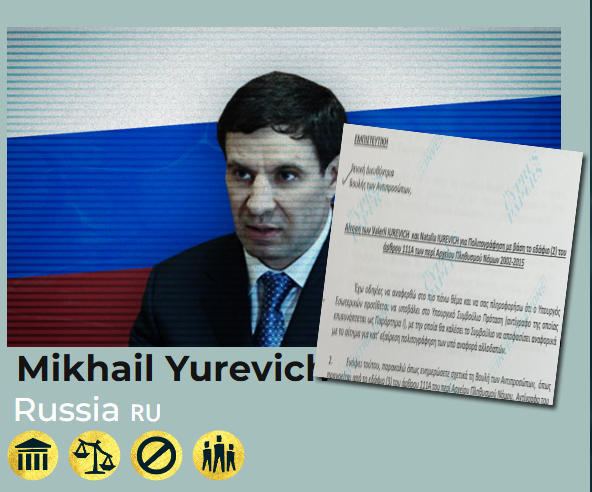
The Cyprus Police, through the Unit for Combating Cover-up Offences (MOKAS), requested the issuance of a charge order for two properties related to the businessman and former politician, Mikhail Jurevic, who is allegedly wanted on the basis of an international arrest warrant.
The request was approved within the previous 20 days by the Nicosia District Court, which issued a charging order. As far as the frozen real estate is concerned, it concerns a luxury apartment in Mesa Geitonia ("ONE" complex) worth €2,620,000 in the name of the 57-year-old and an apartment in Germasogeia for €555,000 that appears to belong to the father of the aforementioned, Valeri Jurevic ("Park Residence"). The total value of the frozen property amounts to €3,175,000.
The Court's decision has been made public, which is done only when it is not possible to locate the person concerned so that the decree can be served on him.
International implications
The case of Mikail Jurevic was one of those that caused a sensation internationally. Not only because he was a well-known political figure and businessman in Russia, but also because he engaged the authorities of his country for a bribery case. It is indicative that the news network Al Jazeera had given special prominence to the case of Mikhail Jurevic in August 2020 (The Cyprus Papers) when he had revealed data on the golden passports.
"Cypriot" from a distance
In addition, the 57-year-old, who became a naturalized Cypriot in 2016, according to the conclusion of the investigative committee on exceptional naturalizations under Myron Nicolatos, did not seem to have travelled to Cyprus after 2001. Simply put, without even coming to our island, he managed to secure the passport. In fact, in its conclusion (7/6/2021) the investigative committee that put under its microscope the most scandalous cases of the Cyprus Investment Program, recommended the revocation of his passport.
What the report said
In the summary reports of the final report of the investigative committee, it was pointed out that in the case of Jurevic and his family members who obtained a Cypriot passport, there may have been false statements.
We present a full report: "In the case of Mikhail Yurevich (naturalization of 2016), according to the arrivals/departures list the applicant does not seem to have come to Cyprus after 2001. Of the 5 M127 applications submitted by members of the Yurevich family, only one of the symbiosis Kristina Yurevich appears to have been signed by her. The other applicants appear to have not been in Cyprus on the date of submission of their applications and/or in the arrival/departure lists identified in the file there is no evidence confirming that they were in Cyprus, with the result that these statements may be false."
No Stamp
It is then added that "in addition to the above, it has been observed that in some cases, the M127 form, despite bearing the seal of a District Court, was not signed and certified before the registrar (Jionglong Zhang case), or was not included in the file (Jiatong Li case) (both are 2018 naturalizations)".
The then Council of Ministers had approved its Cypriotization on 28/09/2016.
"Condemned"
The committee's investigation, however, also came to other notable findings, such as that Jurević is wanted on an international arrest warrant: "In May 2018, he was included in a Ukrainian National Security sanctions list in relation to the Russian-Ukrainian issue. In January 2020 he was convicted of large-scale bribery during the period 2010-2014 and is now wanted worldwide. For the investor there are a number of negative reports which, however, seem to date back to the period of evaluation and approval of his application for naturalization. These reports concern serious crimes that have attracted extensive international interest."
"Acceptance of bribes"
Al Jazeera, previously, and specifically in the summer of 2020, noted about Mikhail Yurevich: "As a politician, Yurevich held a seat in the State Duma of Russia before becoming governor of the industrial region of Chelyabinsk Oblast from 2010 to 2014. In May 2017, he was placed on Russia's international wanted list, accused of accepting bribes from local ministers and businesses, as well as slandering regional officials. The Cyprus Papers reveal that Yurevich also funded his parents' application for Cypriot citizenship in November 2017. They themselves act as directors in his various companies. Yurevich has also been subject to Ukrainian sanctions since May 2018."
The international news network also published documents showing Jurevic's parents applying for their Cypriotization. The proposal was brought to the Council of Ministers on 22/11/2017. It should be noted that on 13/9/2016, according to the documents presented by Al Jazeera, the Cabinet had decided that the parents of a person who became a naturalized Cypriot are entitled to acquire citizenship. Mikhail Jurevic obtained a Cypriot passport on 28/9/2016, as we noted.
Recall in 2024
Mikhail Jurević's citizenship was revoked more than three years later. Specifically, in November 2024, a list of 77 investors for whom the government of Nikos Christodoulidis launched a citizenship revocation process was made public. According to a relevant list that had seen the light of day on 24/11/2024 ("Politis"), seven members of the 57-year-old's family received a Cypriot passport.
Cyprus Police: A case is being investigated
"F" contacted the Cyprus Police asking for additional information about the fact that an asset charge decree for Mikail Jurevic and Valery Jurevic was requested through MOKAS. We indicated that the Court's order has been made public. We were told that a case is being investigated and there is nothing to announce. However, information states that the case being examined by the investigators is related to what is recorded in the conclusion of the Nikolatou committee.
Besides, the Russian website chel.dk.ru in its publication in September 2025 and citing RIA Novosti, notes that Yurević has been reassigned to the wanted persons list.
The report is as follows: "The former governor of the Southern Urals has been declared wanted again. The agency does not disclose the article on the basis of which the prosecution is being carried out, but it was previously linked to a case of billions of rubles in bribes. Mikhail Jurević has been listed in the Interior Ministry's wanted database. The relevant information appeared in the corresponding section of the service's website.
"Yurević Mikhail Valerievich... Basis for the search: wanted under an article of the Criminal Code... He was declared wanted again, he was wanted before," the service said," according to RIA Novosti.
It is recalled that Mikhail Yurević is a former governor of the Chelyabinsk region. He led the district from 2010 to 2014. At the moment, a criminal case is underway against Jurevic for bribes amounting to more than 3 billion rubles (note about €35 million). According to the investigators' version, he received this money from intermediaries during his tenure as governor. After refusing to appear for interrogations and cooperate with the investigation, the former politician was declared internationally wanted. In the Southern Urals, Yurević also controlled the agro-industrial group "Makfa" — one of the largest Russian producers of pasta and flour. The company included the Chelyabinsk pasta plant, bakery and the Sosnovsky grain processing complex. In 2024, "Makfa" was nationalized following a lawsuit by the Prosecutor General's Office of the Russian Federation. The agency claimed that the company had a corruption-related origin, as its beneficiary, Mikhail Jurević, was engaged in business while serving in state offices and "for many years violated the prohibitions and restrictions provided by anti-corruption legislation".
A case that overturns the data to date in the family courts comes to show that the payment of alimony does not only concern the children, but also the parents, as the Court of Appeal gave the "green light" to the alimony of a 73-year-old father by his two adult sons, confirming that the obligation of financial support can now also weigh on the reverse direction. In the case under consideration, the Court of Appeal rejected in its entirety an appeal by two brothers against a temporary alimony order issued against them and in favor of their 73-year-old father, confirming that the conditions for the issuance of an interim treatment were met and that there was no legal or procedural error on the part of the Court of First Instance.
The case was heard on May 15, 2026 by the Court of Appeal (Civil Jurisdiction) and concerned an application by the father, who invoked Article 34 of the Parent-Child Relations Law 216/90, requesting alimony from his two adult sons, aged 52 and 43. The Limassol Family Court had issued a temporary order, obliging the two brothers to pay €75 per month each, until the final hearing of the case.
The appellants challenged the decision on a number of grounds, including that their father had misled the Court, that he did not come with "clean hands", that his needs were not proven, and that the Court of First Instance incorrectly assessed the testimony and financial data of the parties. They also claimed that the application was abusive, due to their father's allegedly long-term estrangement and behaviour.
The Court of Appeal rejected all the claims, pointing out first of all that at the stage of examining an interim decree it is not allowed to make a final assessment of the credibility of the testimony or to resolve the essential factual differences between the parties. As it was emphasized, the Court limits itself to whether there is a serious issue to be adjudicated, the likelihood of success of the application and the need to avoid irreparable injustice.
In relation to the 'clean hands' claim, the Court of Appeal stated that, although the principle of leniency requires the applicant to behave honestly, the relevant examination cannot be converted into a full trial on the merits in the context of an intermediate procedure. It was found that the appellants had not provided specific and proven evidence to substantiate an allegation of misrepresentation, but limited themselves to general complaints, which required an evaluation of conflicting testimony, which is not allowed at this stage.
The Court also noted that there had been no reversal of the burden of proof by the Court of First Instance, nor a misinterpretation of Article 34, which provides for an obligation for adult children to contribute to the maintenance of a parent who is unable to support themselves, provided that they themselves have the means to do so. At the same time, it was held that the Court of First Instance had sufficiently taken into account the financial obligations of the appellants, as well as the fact that they have minor children.
A significant part of the decision was also based on the father's health data, which included serious heart and respiratory problems, as well as data on his income, which is limited to a pension of about €424 per month, with previous occasional work having been terminated due to a deterioration in his condition.
With regard to allegations of transfers of property and family disputes, the Court of Appeal held that these are issues concerning the substance of the main application and cannot be resolved at an intermediate stage.
Finally, the Court of Appeal upheld the finding that the balance of opportunity was in favour of issuing the interim order, underlining that the risk of injustice would have been greater if provisional alimony had not been granted in the event that the father was finally vindicated in the main proceedings.
Based on the above, the appeal was dismissed in its entirety, with costs of €700 plus VAT at the expense of the appellants, jointly or severally.
* * * * * *
The acquittal decision of the Limassol Criminal Court for two of the three defendants in a case of drugs, weapons, money laundering and participation in a criminal organization during the period 2020-2021 was upheld by the Court of Appeal, by its decision dated May 14, 2026, rejecting the criminal appeal of the Attorney General and ruling that there was no legal error in the first instance decision.
The case involved three persons facing a total of ten charges, including possession of large quantities of methamphetamine and cocaine, possession of firearms and cartridges without a license, as well as money laundering of €71.500, which allegedly came from illegal activities.
The Criminal Court had fully acquitted one of the defendants, while a second had been acquitted of the charges of participation in a criminal organization and money laundering. The Attorney General challenged the decision, arguing that the court of first instance incorrectly applied the principles governing factual testimony and failed to assess false allegations as incriminating evidence.
The Court of Appeal dismissed the appeal, ruling that there was no legal error in the first-instance decision and that the factual testimony was not sufficient to establish guilt beyond reasonable doubt.
In his decision, he pointed out that the Attorney General's right to appeal against an acquittal is limited to legal issues and does not extend to a reassessment of the credibility of witnesses or the court's findings.
As the Court of Appeal stated, "the right of appeal on the part of the Attorney General is limited to legal issues, excluding the filing of an appeal against the evaluation of testimony or against any issue related to the evaluation".
In relation to the factual testimony, the Court of Appeal noted that general suspicions, social relations or the presence of persons in the same place are not sufficient on their own to establish criminal liability.
According to the decision, "the factual testimony can be a basis for the conviction of the accused only when he substantiates his guilt as a matter of logical consistency within the framework of human experience".
The Court held that evidence such as cohabitation, social relationships, presence of drugs in public areas and connection with a wanted person were not sufficient to prove knowledge and possession of drugs beyond a reasonable doubt.
At the same time, the issue of €71.500 found in the possession of the second defendant was also examined. The Prosecution argued that, since the court of first instance rejected the explanation that the money came from legitimate professional activities, this constituted a "lie" that should have been taken as incriminating testimony.
The Court of Appeal rejected this position as well, pointing out that the rejection of a version does not automatically equate to a proven lie.
Referring to relevant case law, the Court of Appeal noted, "the fact that the court rejected the version of the accused does not in itself constitute an element of factual testimony supporting the version of the prosecution".
He also added that, "in order for a lie to be drawn from the testimony of the appellant, it was not enough for the Criminal Court to reject his version. The lie in court had to be proven by independent testimony."
In conclusion, the Court of Appeal ruled that the grounds of appeal could not overturn the first-instance judgment and dismissed the appeal in its entirety.
CNA
