
With steady steps and strategic orientation, Cyprus is moving towards the transition to a more sustainable waste management model. By actively investing in prevention, reuse and the circular economy, the Department of Environment, through the European Project "LIFE IP CYzero WASTE", is launching the creation of two modern Repair and Reuse Centers (UHCs) in the districts of Nicosia and Limassol. These new infrastructures are expected to be the main pillars for the implementation of the waste management hierarchy in our country.
The location of the two centers was based on strict population, geographical and environmental criteria, with the aim of optimizing the system and reducing transport distances.
According to official data, the procedures for the specific plots where the two Centers will be installed are as follows:
>> Nicosia District (Idali): The process of assigning the plot to the Ministry of Agriculture, Rural Development and Environment (YGAAP) has already been completed. The Council of Ministers, at its meeting on March 5, 2026, approved the assignment of plot no. 1001, with an area of 3,400 sq.m., which is located in the Municipal District of Dali, of the Municipality of South Nicosia – Dali.
>> Limassol District (Agios Spyridonas): The center will be installed on a plot of land owned by the Municipality of Limassol with number 6 (F/Sch. 58/080202), which is located in the parish of Agios Spyridon, within a Category B industrial zone.
In the context of the European project, a techno-economic study has been prepared for the two Repair and Reuse Centers.
At this stage, the topographic survey of the plot is pending for the Nicosia KEE, while, at the same time, the documents of the design and construction competition for both centers are being prepared, with the aim of its immediate announcement.
The two centres have been designed to cover the largest part of the population of the Republic of Cyprus. The Nicosia UHCC will serve as a key service hub for the eastern and northeastern parts of free Cyprus, covering the districts of Nicosia, Larnaca and Famagusta. Accordingly, the Limassol UHCC will cover the southern and western parts of the island, covering the districts of Limassol and Paphos.
The location of the two centers was based on population, geographical and environmental criteria, with the aim of reducing the distances of transporting objects, limiting the environmental footprint and optimizing the operation of the reuse system at a national level. In the future, it is not excluded that the number of these centers will increase, so that there is autonomous coverage per province.
According to the techno-economic studies, the initial capacity of the two infrastructures is estimated at 3,500 tons of materials per year, with a clear prospect that this volume will reach 4,500 tons within three years from the start of their operation.
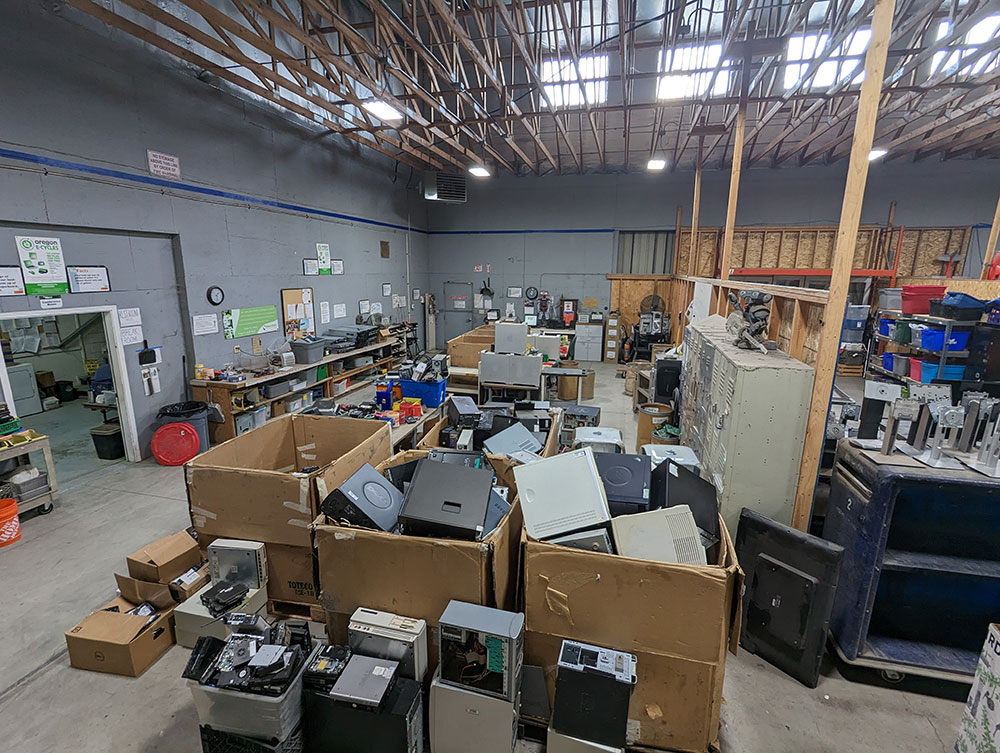
The KEEs will be organized infrastructures where used items from households will be collected, evaluated, repaired and resold. Items such as furniture, electrical and electronic appliances, kitchen equipment, bicycles, clothes, toys and books, which until now ended up in landfills, will get a second chance. After the necessary repairs, they will be resold at particularly affordable prices, reducing the need for new raw materials.
Reuse is a key pillar of European and national waste policy, as it precedes recycling in the waste management hierarchy and contributes substantially to the reduction of raw material consumption, the reduction of greenhouse gas emissions, the saving of energy and natural resources, the creation of "green" jobs and the strengthening of citizens' environmental awareness.
Network of 36 reuse stores in Green Points
In parallel with the large centers, a supportive Network of Reuse Stores is being developed. At the moment, two such stores are already operating on a pilot basis in the Green Points of Malounta and Linous. The response of the public there is particularly encouraging, as citizens hand over items that are no longer needed, but are in good condition or can be repaired and picked up other useful items free of charge.
The goal is for these stores to reach a total of 36 by 2028, covering all the Green Points in the country. Items delivered there that need minor repairs will be transported to the central CECs for repair, re-evaluated and then re-made for reuse at affordable prices. It is worth noting that at a later stage, with the full operation of the two centers, the payment of a symbolic fee will be established for the receipt of the items.
The creation of the two centers is included in both the National Municipal Waste Management Plan 2022-2028 and the 2026-2032 Waste Prevention Program under development.
For the implementation of the project, a Project Note (PCN) has already been prepared, with the estimated budget amounting to €6,760,000 (including VAT) for both KEEs. The project may be co-financed by the Operational Program of Cohesion Policy "Th.Al.E.I.A. 2021–2027", while its maturation is firmly supported by "LIFE IP CYzero WASTE".
It is noted that the tender for the construction of 21 reuse stores had been cancelled, however it is expected to be re-announced very soon.
Culture change by 2035
In the coming years, Cyprus is called upon to achieve a significant increase in the preparation for reuse and recycling of municipal waste, as well as a substantial reduction in the quantities sent to landfills. According to the European framework, by 2035 the landfill of municipal waste must be reduced to less than 10%, while, at the same time, the targets for recycling and reuse of materials are strengthened.
For this reason, the project places a huge emphasis on education. In the context of "LIFE IP CYzero WASTE", information campaigns, workshops and the creation of an Environmental Education and Awareness Center (Educational Hub), which will house educational laboratories within the two KEEs, are planned. The aim is for citizens to acquire new skills and become active members of the circular economy.
The transition to a zero-waste society is no longer a theoretical environmental need, but a collective and daily responsibility for the future of our country.
For more information and information on the progress of the project, those interested can visit the official website: www.cyzerowaste.com.
