
WHAT IS THE 'BROTHERHOOD OF THE ROSICRUCIANS' TO WHICH MAKARIOS DROUSIOTIS REFERS - MYSTICAL TRADITION THAT APPEARED IN EUROPE IN THE 17th CENTURY - Filenews 31/3
The reports of Makarios Drousiotis about the involvement of political figures, businessmen, lawyers and judges from Cyprus and Greece in the "Brotherhood of the Rosicrucians" have caused a stir. According to what he claims, it is a brotherhood that - as he states - operates nationwide, governs the country and includes people who pull the strings and prevent the proper functioning of the state.
The history of the Rosicrucians
The Rosicrucians is a mystical and philosophical tradition that emerged in Europe in the early 17th century. It is associated with occultism, esoteric knowledge (esotericism) and spiritual search.
Rosicrucianism is a movement that belongs to ancient mysticism. His teachings are translated into more than 16 languages, including French, English, German, Greek, Italian, Portuguese, Arabic, etc.
Rosicrucianism developed in a philosophical environment of inner search that began with Gnosticism and Hermeticism and the inexhaustible Western esoteric tradition, values, knowledge and ideals, with which it expects to pave the way for Initiatory realization.
It is not a religious or political organization. He is considered the guardian of the Mystical Tradition. As an institution, it introduced its basic principles to the forerunners of Freemasonry, regardless of whether the latter did not maintain its Mystical character as much as it should have and in all its forms. Today there are few "Traditional" Masonic Organizations that maintain the basic principles of the Mystical Tradition.
Essentially, we are talking about a pure and pure form of Illuminism, in the etymological sense of the term "Enlightenment".
Rosicrucians have been appearing since the time of the Apostles of Christ. Their mission was to unite the Ancient Egyptian-Jewish Initiation of the Rose, already preserved by the Essenes, with the Initiation of the Cross, which incorporated the Teaching of Jesus.
The Initiatory Tradition was thus rebaptized, transmitted to the ancient cultures of the Mediterranean coasts. The Initiations of the Orphics, Pythagoreans, Druids, Zoroastrians, and even India found their expression in the modern Rosicrucian movement. As early as the 10thcentury, Orders with the title of Rosicrucian had been presented. In 1577 the "Society of the Indiprovised" (Orden der Unzertrennlichen) was founded, which may have been a model for the Rosicrucian Brotherhood.
In Byzantium we have references to the Rosicrucian presence and initiatory activity, during the time of Constantine the Great and earlier. The Order of the "Brothers of the East" was an initiatory Order established in Constantinople in 1090 under the auspices of Emperor Alexios Komnenos.
From this Order came a secret and mystical Brotherhood, the Order of the "Unknown Philosophers". This Order was preceded by Henry Kunrat, Henry Sithon the cosmopolitan, Centivogius, Duke Saxonius Komnenos and James Baime. In this Brotherhood, Louis Claude de Saint Martin was initiated. Orders bearing the title of Rose+Croix appeared in the 14th century, as heirs of Pythagorean, Egyptian, Hindu, Eleusis, Brahmins, Magi of Persia, Gymnosophists of Ethiopia and Arabs.
According to Jean-Pierre Giudicelli de Cressac Bachelerie, French Templars who fled persecuted to England, when they returned via the island of Mull, founded on December 3, 1316 the Order of the "Elder Brothers of Rose+Croix" or "FAR+C".
The secret movement of the Rosicrucians slowly made its appearance with 3 manifestos: In about 1614 the manifesto "Fama Fraternitatis" was published, a hitherto unknown Brotherhood of the Rose and the Cross. A little later, in 1615, the "Confessio Fraternitatis R+C" or "Confession of the Brotherhood of the Rosicrucians" followed. In 1616 another book by an anonymous author appeared entitled "The Humic Marriages of Christian Rosenkreuz".
In 1660 we have the foundation of a society entitled "Invisible College of the Rosicrucians", which took official form and was the forerunner of today's Royal Society of London.
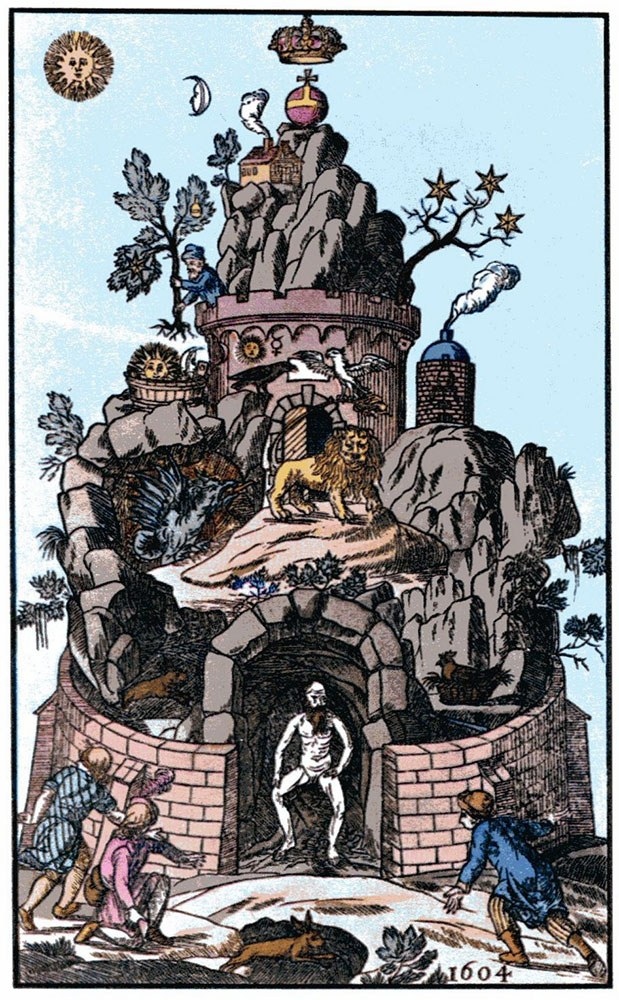
What they think
Essentially, according to the three manifestos, the secret brotherhood was founded by the mythical character Christian Rosenkreuz, a sage who supposedly travelled to the East and brought back secret knowledge.
The main symbol is the Rose Cross. The cross symbolizes matter and human experience, and the rose symbolizes spiritual evolution and knowledge.
Rosicrucians can become men and women regardless of class, race and religion.
The Rosicrucians are not a single "religion", but a set of ideas.
Central elements are the search for inner wisdom, the connection of science, philosophy and religion, personal spiritual development and the belief that there is "hidden knowledge" about the nature of the universe.
They are often associated with alchemy, hermeticism, and Neoplatonism.
Many historians consider that it was originally a literary myth or a spiritual motive for reforming society and science. However, even today there are modern organizations that declare continuity of tradition. These function as philosophical/spiritual schools and not as "secret sects" in the sense that is often presented.
Legend has it that the members of the brotherhood belong to the secret global elite and that they control the world. However, in reality it is considered to be mainly a philosophical-esoteric current with mainly cultural and historical influences.
Simply put, the Brotherhood of the Rosicrucians is a symbolic/mystical tradition with roots in the 17th century that combines science, philosophy and spirituality and continues today through various organizations.
The three Rosicrucian manifestos
The three main Rosicrucian manifestos form the core of the tradition and formulate a vision of an intellectual, scientific and social rebirth of Europe. They are not just "secret texts", but ideological manifestos of the time.
1. Fama Fraternitatis
It tells the life of Christian Rosenkreuz, the founder of the brotherhood. He describes his travels to the East (Arabia, Egypt), where he acquired "secret knowledge".
He announces the existence of a secret brotherhood of wise men in Europe, declaring that this brotherhood is secretly working for the betterment of humanity.
At the same time, it calls on the educated of the time to participate in a global reform of knowledge and science.
The central message of the text is that "humanity can be reborn through knowledge and wisdom".
2. Confessio Fraternitatis
It functions as a theological and philosophical proclamation of the brotherhood. He defends the Rosicrucians' mission against critics and emphasizes that their knowledge is based on God, nature, and the divine order of the universe.
It condemns ignorance, corruption and pseudoscience and at the same time, declares that a new era of enlightenment and truth is approaching.
The central message is that "true knowledge is divine and leads to moral and spiritual rebirth".
3. The Chymical Wedding of Christian Rosenkreuz
It is an allegorical narrative full of symbolism.
It describes a seven-day "secret wedding" where Rosenkreuz participates in trials.
It contains strong elements of alchemy, transformation and spiritual initiation, while "marriage" symbolizes the union of matter and spirit, therefore human and divine.
His central message is that "the inner transformation of man is a process of testing and initiation".
In total, the three manifestos form a single vision: the reform of society and knowledge, the union of science, religion and philosophy, the search for esoteric knowledge, the moral and spiritual rebirth of man, and the use of alchemy as a symbol of inner change.
Many historians consider the manifestos not necessarily to describe a real organization, but a spiritual and philosophical call for change in the Europe of the time.
Today, Rosicrucianism and the Rosicrucian worldview are inherent in the high degrees of Martinism, as well as Traditional Freemasonry.
