
"New ones are being added to the older forms of gender-based violence in Europe – and in Cyprus – with social networks gradually transforming into a digital Wild West of attacks, insults, sexism, sexual violence and lawlessness," underlined the president of the Coordinating Body for the Prevention and Combating of Violence against Women, Aristos Tsiartas, speaking at the conference organized on April 18, 2026 at the POED building in Nicosia by the Women's Movement of Ecologists entitled "From girl to woman – the unseen path of gender-based violence".
For her part, the scientific director of the Association for the Prevention and Treatment of Violence in the Family (SPAVO), Dr. Andri Andronikou, stressed that "many perpetrators of gender-based violence have a 'narrative' that justifies violence by blaming the victim and shifting the blame to him ("he provoked me", "he insulted me"), or to external factors, or they completely deny the facts, focusing on protecting their image."
Mr. Tsiartas and Dr. Andronikou participated in the fourth of the four panels of the event on the profile of the perpetrators. The first panel discussion on childhood/adolescence was attended by the Commissioner for the Protection of Children's Rights Elena Pericleous, the primary education teacher Andri Theodoulou and the scientific director at the "House of the Child" officer of the Hope for Children organization Rodoula Papalamprianou.
The second panel on student life, relationships, first cohabitations and domestic violence was attended by the director of the Mediterranean Institute for Gender Studies (MIGS) Susana Pavlou and the lieutenant of the Branch for Handling Victims of Domestic Violence and Juvenile Abuse of the Police Headquarters Stella Charalambidou.
The third panel on femicides and human trafficking was attended by the representative of the Office for Combating Human Trafficking of the Police, police officer Maria Michael, and the executive director of SPAVO, Dr. Andri Andronikou. The discussions were moderated on behalf of the organizers by Maria Kola, Nicoletta Louka, Alexia Sakadaki and Monica Pieridou.
Stronger legal framework for online violence
Aristos Tsiartas cited the new and most recent research by the EU Agency for Fundamental Rights and the European Institute for Gender Equality (2024) which demonstrates, as he said, how widespread the phenomenon of violence against women is in Europe.
According to the survey, 8.5% of European women have experienced cyberbullying, 10.2% have been monitored on social media by their partners, 7% of working women have been sexually harassed online and one in five girls in the European Union is sexually assaulted and abused online."
Referring to the actions of the Coordinating Body for the Prevention and Combating of Violence against Women, which is part of the Ministry of Justice, Mr. Tsiartas said, among other things, that "we are currently promoting major legislative breakthroughs to increase the protection of victims of domestic violence, for the legislative incorporation of many recommendations of the Grevio committee of the Council of Europe, but also for the incorporation by summer 2027, of the new EU directive on combating gender-based and domestic violence. This creates new offenses that carry severe sanctions, further strengthening our legal framework, especially at the level of online violence."
In her own intervention, Dr. Andri Andronikou said, among other things, that "no child, if asked what he would like to happen when he grows up, will answer that he wants to become a femicide, abuser or rapist. Nor that he dreams of imprisonment or participation in therapeutic programs for the violence he practices.
This is because children have not yet been affected by the distortions of society, i.e. upbringing, dogmas, prejudices and entrenched beliefs. We often see reports that the perpetrators are mentally ill, but the reality is different, since according to European and international surveys, people with mental disorders are involved in a small percentage of violent crimes that does not exceed 5.3%.
Many perpetrators invoke mental illness as a means of justifying their behaviour, often with the aim of reducing the consequences of their actions. A crucial question is whether the perpetrator can change. Under specific conditions and through long-term, targeted interventions, change is possible.
This requires acknowledging responsibility and understanding the impact of violence. A significant gap is the absence of specialized, structured treatment programs for perpetrators of gender-based and domestic violence, as well as for sex offenders when serving a prison sentence. At the same time, mandatory participation in such programs as part of the sentence is not systematically adopted, nor are surveillance programs and long-term recidivism prevention strategies based on international standards adequately implemented."
The representative of the Office for Combating Human Trafficking, police officer Maria Michael, a member of the team of investigators of the GEP, also spoke about the need to change social stereotypes in Cyprus. As she pointed out, "most victims of human trafficking are women with a low social, economic and educational level and in order to prevent the commission of such offenses, it is necessary to empower girls and promote empathy in boys from childhood".
In relation to sexual exploitation, she said that "the work of investigators is more difficult as all roles have been transferred online. Investigators - he added - are called upon to find traces left by suspects through websites, online advertisements and financial investigations.
A case has been investigated which is under trial where the identified victim was advertised on a specific erotic service advertising platform and in cooperation with the platform and through examinations the perpetrators were identified.
This platform was investigated by the GEP to identify indicators of exploitation such as the use of a common credit card to pay for advertisements of various persons."
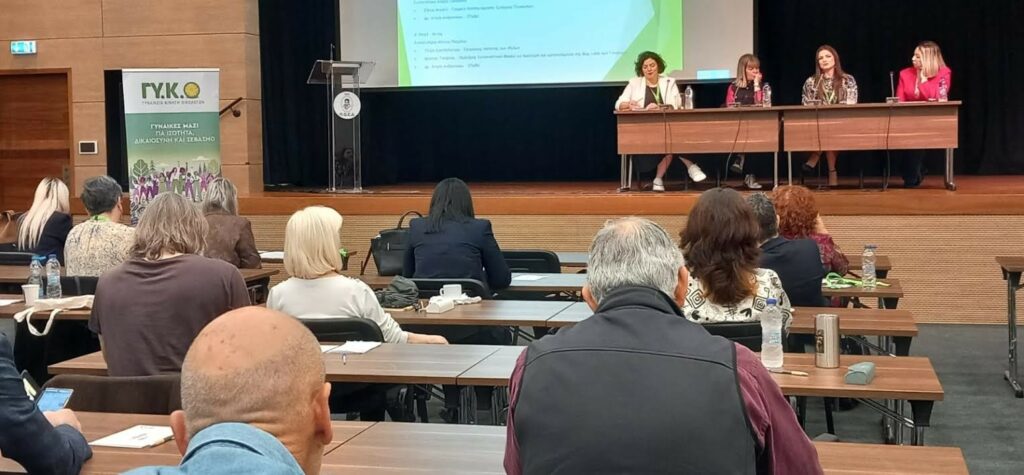 Snapshot from the event of GYKO on gender-based violence
Before stereotypes become silence and normality
As the Commissioner for the Protection of Children's Rights, Elena Pericleous, pointed out, "no prevention policy can be effective if it is not accompanied by the substantial empowerment of children and young people themselves.
Boys and girls – she added – must grow up with the ability and the right to resist what limits them and to claim an identity that is not defined by gender stereotypes. Prevention requires strategic planning – a family that raises children without double standards, a school that teaches consent, boundaries and respect, institutions that protect in a timely manner, professionals trained to recognize violence and a society determined to break stereotypes before they become silence, tolerance and ultimately normality. The responsibility of the state does not begin with the manifestation of violence, it begins much earlier in all social fields where the conditions in which violence can manifest are formed.
The state must design and implement a coherent, lasting and holistic strategy that links prevention with early recognition and effective response. This means policies that permeate education, health, social welfare and justice.
It requires professionals trained to identify, listen and protect. It requires safe and accessible reporting mechanisms and services that empower. Boys and girls need to learn that their value lies neither in imposition nor in submission, but in self-esteem, freedom and respect for others."
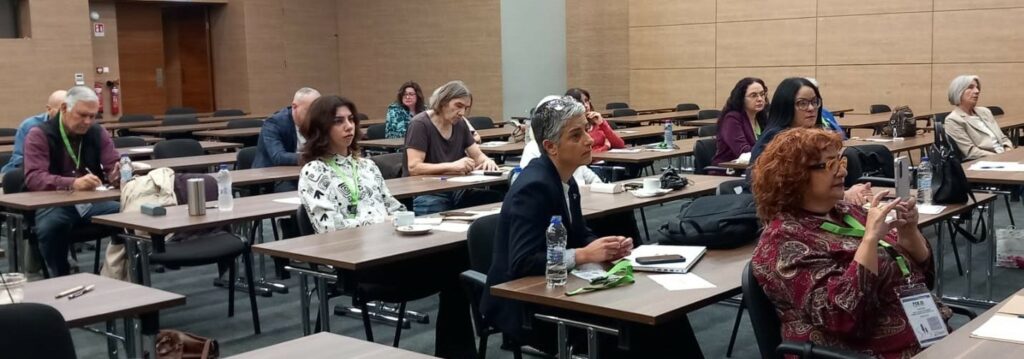 Some of the attendees of the conference
The shield, the freedom and the "wings" of the girls
"Gender-based violence is defeated when girls learn from kindergarten that their voice has power and their story deserves to be written on their own terms," said the teacher of a primary school in Limassol, Andri Theodoulou, in her own statement. "When we teach them sex education, we give them the shield.
When we break down stereotypes, we give them freedom. And when we know them as role models, we give them wings." Ms. Theodoulou spoke about prevention through three pillars: sex education, the deconstruction of stereotypes and the promotion of women who can act as healthy role models for both girls and boys.
She said that "the goal of sex education is to empower children by learning about the body, relationships, respect and safety. The relevant lessons focus on the correct nomenclature for private body parts. Children also learn the 'underwear rule' and are encouraged to create a safety network with adults they trust to ask for help in case they need it."
In relation to stereotypes, she said that "if we want to protect our children, girls and boys, let's start praising them for the effort they make, for their decisions, their acts of solidarity and not just for their external appearance or their strength." Regarding the promotion of female role models, she pointed out that "the reference to women in history textbooks at all levels is around 2.5%!".
She added: "The way history has been written, mainly by men for men, focused on war events, it is as if women did not exist in history. It is important for children to meet women who have pioneered and brought change in various fields, which can act as healthy role models especially for girls."
The Scientific Coordinator at the "House of the Child" Rodoula Papalamprianou also referred to the prevention of gender-based violence. She said, among other things: "It is no coincidence that the largest percentage of victims of sexual abuse concern girls, while most reports are recorded during the pre-adolescent and adolescent stage.
In adulthood, these entrenched patterns may lead to internalization of responsibility and further normalization of violence, while the coexistence of abusive behaviours with elements of caring or emotional dependence often delays the search for help, enhancing the vulnerability of victims.
In this light, the prevention of gender-based violence, as a multifactorial and evolving phenomenon, requires a holistic approach and early intervention with an emphasis on recognizing signs and deconstructing social perceptions that perpetuate violence. Systematic education around personal boundaries, consent, respect and self-protection becomes necessary from the early stages of development, while stopping the reproduction of abusive patterns is a collective responsibility. It is recalled that "Hope for Children" operates the 24-hour helpline 1466 which is free of charge and is aimed at all those who wish to receive guidance on child protection issues."
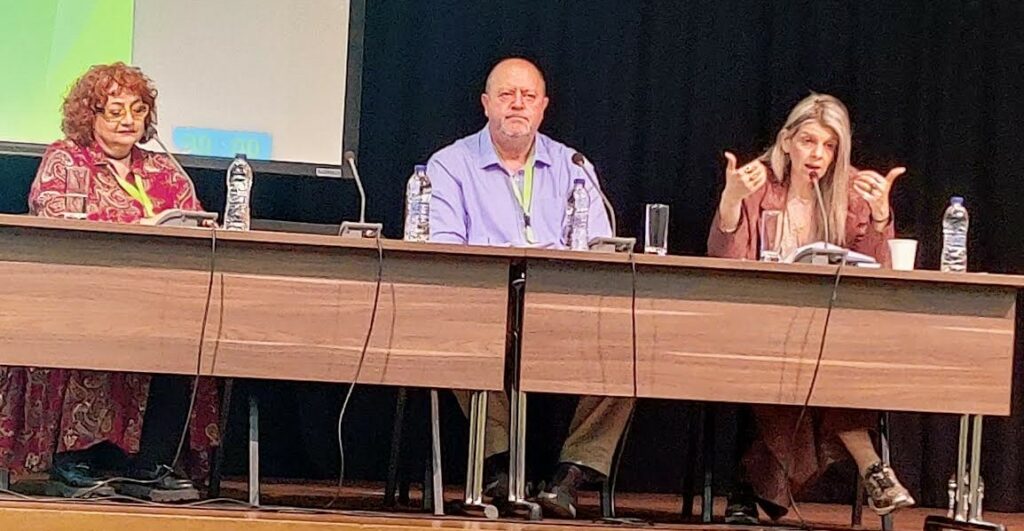
Training in healthy relationships offline and online...
"Violence in young people's relationships today is not only more common, but it is also more pervasive, faster and more normalized. And that's why the answer cannot be only protection, but must be education in healthy relationships, consent and gender equality – both offline and online," said MIGS Director Susana Pavlou.
She added that "the stereotypes we see affecting young people's relationships the most are that the man should be in control, that jealousy is a sign of love and that the girl should adapt, "understand" and tolerate.
These perceptions turn control, surveillance and pressure into something that is presented as normal or even romantic, while in practice they are warning signs of violence. We also see that these stereotypes are also expressed through the digital environment.
In relationships with young people we very often see psychological violence, control, surveillance via mobile and social media, pressure to perform sexual acts or send images, humiliation and verbal abuse. Physical violence exists, but it is often preceded or accompanied by these "less visible" forms of violence, which are often underestimated.
Today we are not only talking about "old" forms of violence, but also about completely new forms: non-consensual image sharing, cyberstalking, doxxing*, deepfakes, and even AI-generated sexual content. Technology has not only brought violence online, it has transformed and expanded it. Social media has radically changed the landscape.
The platforms and algorithms themselves systematically expose young people to content that reinforces gender stereotypes, such as sexualization and the perception of the "availability" of women and girls through sexualized or even pornographic content.
At the same time, narratives that normalize jealousy, control and inequality are reproduced, as well as forms of gendered misinformation that affect how young people perceive relationships. That is why it is crucial to talk not only about 'safe use of the internet', but about gender norms, boundaries, consent and the right to privacy."
* doxxing - to dox is to search for and publish private or identifying information about (a particular individual) on the internet, typically with malicious intent:
"Violence in young people's relationships today is not only more common, but it is also more pervasive, faster and more normalized. And that's why the answer cannot be only protection, but must be education in healthy relationships, consent and gender equality – both offline and online," said MIGS Director Susana Pavlou.
She added that "the stereotypes we see affecting young people's relationships the most are that the man should be in control, that jealousy is a sign of love and that the girl should adapt, "understand" and tolerate.
These perceptions turn control, surveillance and pressure into something that is presented as normal or even romantic, while in practice they are warning signs of violence. We also see that these stereotypes are also expressed through the digital environment.
In relationships with young people we very often see psychological violence, control, surveillance via mobile and social media, pressure to perform sexual acts or send images, humiliation and verbal abuse. Physical violence exists, but it is often preceded or accompanied by these "less visible" forms of violence, which are often underestimated.
Today we are not only talking about "old" forms of violence, but also about completely new forms: non-consensual image sharing, cyberstalking, doxxing*, deepfakes, and even AI-generated sexual content. Technology has not only brought violence online, it has transformed and expanded it. Social media has radically changed the landscape.
The platforms and algorithms themselves systematically expose young people to content that reinforces gender stereotypes, such as sexualization and the perception of the "availability" of women and girls through sexualized or even pornographic content.
At the same time, narratives that normalize jealousy, control and inequality are reproduced, as well as forms of gendered misinformation that affect how young people perceive relationships. That is why it is crucial to talk not only about 'safe use of the internet', but about gender norms, boundaries, consent and the right to privacy."
* doxxing - to dox is to search for and publish private or identifying information about (a particular individual) on the internet, typically with malicious intent:
