
FOOT AND MOUTH - EU CLEAR WARNING - KILLINGS TO AVOID EXIT FROM THE COMMON MARKET - Filenews 14/3 by Angelos Nikolaou
After a week of waiting, the government now prefers the full and strict implementation of European protocols as the only way to save livestock farming, but also the country's economy from foot-and-mouth disease. After successive meetings at the Presidential Palace, with the European Commissioner for Animal Welfare, but also with all stakeholders, The President of the Republic and the Government Spokesman clarified that the country is facing critical decisions, with the specter of economic exclusion now visible.
President Christodoulidis, in his statements from Ayia Napa, underlined that non-compliance with Brussels' instructions would automatically mean "exit from the common market". Such a development, as he warned, would deal a major blow: To the exports of halloumi and other agricultural products. In the field of tourism and services. The financial support that the Republic receives from the EU. "Times require difficult decisions with the sole interest in mind," the President stressed, giving the signal for the immediate completion of animal killings in infected units.
"What I want to say is that it is definitely a critical moment. We all understand the criticality of the moments, which at the same time requires difficult decisions with the sole criterion of this, it is important to see in the long term and not only, the management of the current situation", said Nikos Christodoulidis. He added that the government will stand by those affected by foot-and-mouth disease.
In his statements after the meeting at the Presidential Palace, the Government Spokesman stated that the goal remains the fastest possible reactivation of livestock breeders. He announced the intensification of the vaccination program in full coordination with the EU, while calling for strict adherence to biosecurity measures. "The State will provide full financial coverage and support to the employees," the Spokesman assured, while publicly thanking the private veterinarians for the "superhuman efforts" they make under adverse conditions. According to Konstantinos Letympiotis, the common goal of all remains "the support, preservation and further strengthening of the primary sector", underlining that the current situation requires responsibility and understanding.
The reference to the management of the disease in areas that are not under the effective control of the Republic caused a particular sensation. The President noted that the status in force in the occupied territories will be examined with the EU, as the lack of control there is a constant threat of dispersion. The government spokesman added that legal and procedural arrangements are being considered for the units adjacent to the non-controlled areas, in close contact with the European Commission, in order to shield the health zone of the free areas.
73% of cows and 32% of sheep and goats throughout Cyprus have already been vaccinated and the first dose is expected to be completed by the end of March. On March 17, the second dose begins, while 451,000 doses of vaccine have been provided.
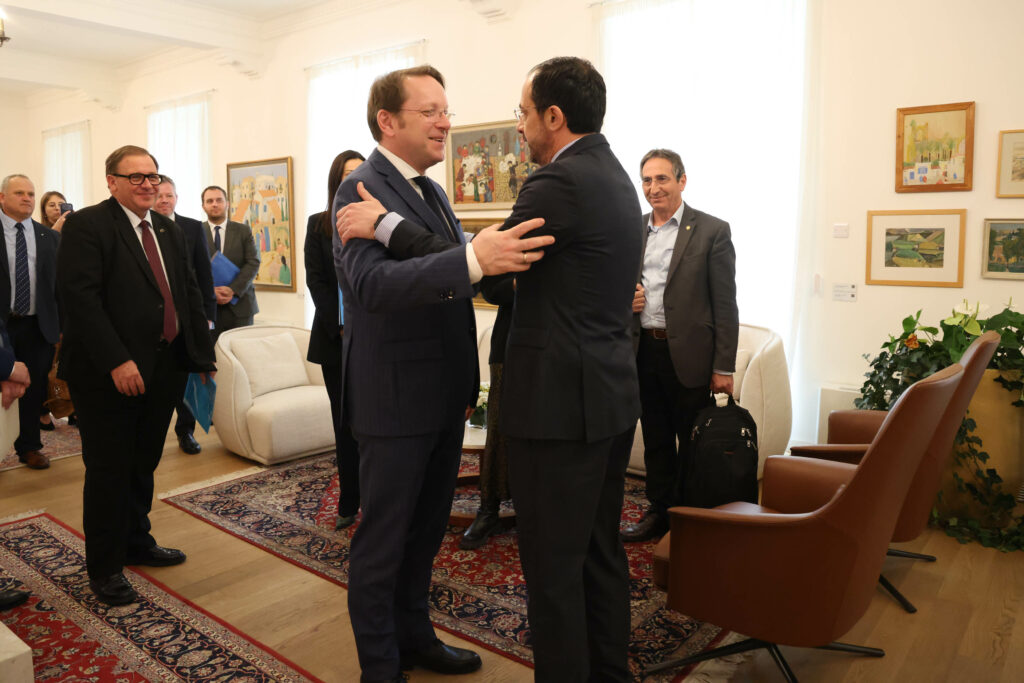
Oliver Varheli: Rules without discounts
Cypriot livestock farming is on a tightrope, with the European Commissioner for Animal Health and Welfare, Oliver Varheli, sending a clear and strict message from Nicosia: The faithful implementation of veterinary protocols is the only way for the survival of the industry.
After a round of contacts first at the JRC, then at the "House of Europe" and finally at the Presidential Palace, Mr. Varcheli clarified that the EU's decisions are not political but purely scientific. He warned, in fact, that any refusal to comply would put Cyprus out of the single market, with disastrous consequences on exports of products such as halloumi, but also restrictions on the movement of tourists. As he said, characteristically, if all the animals on the affected farms are not killed and the measures provided for in the protocol are not taken, then Cyprus is at risk of not having livestock farming for the next 5 years and will exit the single market until it is cleared of the virus. He added that if the measures provided for are taken, then perhaps by the summer it will overcome the crisis.
Responding to the request of political parties, agricultural organisations and livestock farmers not to kill all animals in affected units but only positive cases, the European Commissioner was categorical: "This is not the time for experiments. We must immediately and quickly close the infected areas." He described foot-and-mouth disease as the "toughest enemy" of livestock farming due to its enormous transmissibility, stressing that the virus can even be transferred to the clothes or shoes of those who approach the infected zones.
"Don't go there to protest or for interviews. You are carrying the virus without realizing it. Protesting is not a necessary task at the moment," he stressed, calling for restraint.
The EU actively supports the Republic of Cyprus, which has been implementing the proposed measures since 15 December. In fact, according to information, veterinarians from the EU are arriving in Cyprus to assist in the killings.
For pighouses within the 10 km zone, the Commissioner recommended the immediate slaughter of pigs over 80 kg on the basis of safety and sensitivity.
The Commissioner discussed with the government and stakeholders the option of "separation" into healthy units. This is a costly, but efficient method where the unit is divided into independent sections with natural dams, separate staff for each site and different feeding chains.
The EU stands ready to help implement this model, as long as it is ensured that biosecurity rules are strictly adhered to.
Mr. Varheli reassured the producers by promising that the EU will financially cover the slaughter, the destruction of products (milk, meat) and the wider economic losses. Once Cyprus is declared free of the virus, there will be a fund for the reconstitution of the animal population.
Regarding the occupied territories, he said that the Commission has sent vaccines there as well to reduce the viral load, however he noted that they follow a different strategy as they are not part of the EU. "We are trying to convince them of the effectiveness of our own rules," he concluded.
Rejects the criticisms
Despite the reactions and demands for resignations, the government appears determined to move forward. President Christodoulidis rejected the criticisms of DISY and AKEL, describing their approaches as "identical" and reiterated that the emphasis is on the essence of managing a crisis that cannot be half measures.
