
BILL FOR UNIVERSITY CLINICS AT AN IMPASSE - IT IS UNCERTAIN WHEN AND HOW IT WILL BE IMPLEMENTED IN PRACTICE - Filenews 6/3 by Marilena Panayi
The only fact is that the bill regulating the operation of university clinics in Cyprus is not going to be voted by the parliament in its current composition. It is unknown whether it will be voted on before the end of the year and even more unknown whether it will be able to be implemented in practice without adventures, mainly in state hospitals.
Those involved reiterated yesterday before the parliamentary Health Committee the disagreements between them, with the MPs wondering what they should do and the Minister of Health appealing to continue studying the bill, promising that by the next meeting the Ministry will try to study the objections and disagreements and will come back with proposals for possible changes.
On the part of private universities, doctors and private hospitals, individual concerns were expressed about specific provisions. However, the need to continue the discussion and pass the legislation that will pave the way for the operation of university clinics in the hospitals of Cyprus was emphasized.
The public doctors were strongly opposed to the passage of the bill, as expected, while the attitude of the parties, although not negative, at the end of the meeting was impossible to clarify as what had been said probably complicated the situation more.
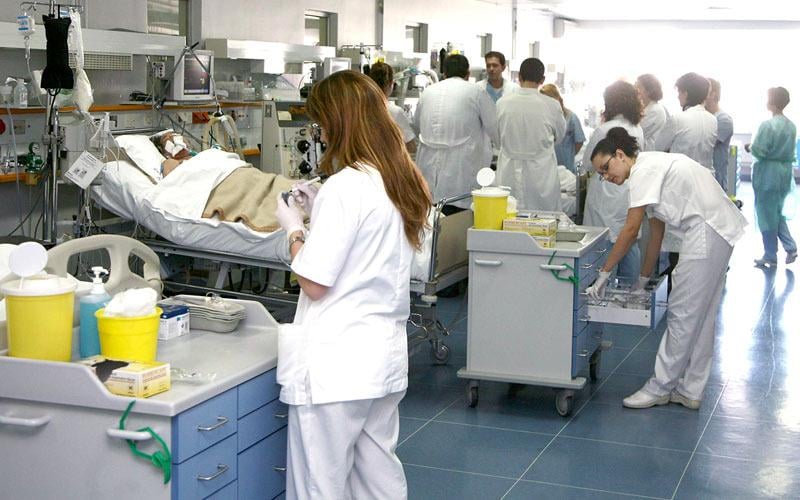
And the COLA recipe in the frame
Disagreements, during the meeting, on various issues, were recorded: Between public and university doctors, public doctors and the State Health Services Organization, OKYPY and private hospitals and even between Universities.
The session, which was a continuation of a previous discussion of the bill last November, began with the statement of the president of the Pancyprian Association of Private Hospitals, Marios Karaiskakis, who commented on the fact that "the bill may have a title that refers to university faculties and private hospitals, but in its provisions it operates prohibitively".
At the same time, he said, "conditions are set, for example, for the mandatory operation of an A&E and for a hospital to be able to train resident doctors". He asked for the deletion of this provision, saying that "those private hospitals that meet the criteria and have the necessary infrastructure must also be able to train resident doctors".
This position of his caused the immediate reaction of the executive director of OKYPY Cyprus Stavrides, who expressed his strong concern, even indicating "if we open it in private hospitals as well, the issue of the training of residents will spring up kiosks, just as kiosks are springing up in health from every corner and whatever statements you are".
The president of the Pancyprian Medical Association, Petros Agathangelou, said that if clear and strict criteria are set, any hospital that meets them should not be excluded. At the same time, he clarified that there is a clear distinction between the operation of university clinics and the training of students and the training of resident doctors, which are different procedures.
The strongest reactions were expressed by the trade unions of public doctors, with the presidents of PASYKI, Sotiris Koumas and the Doctors' Branch of PASYDY, Moses Lambrou, arguing that, "while as we can see, all the others participated in the preparation of the bill and welcome it, we were not invited to participate".
Among other things, they also raised the issue of the financial strength of OKYPY which will arise from the compensation of university doctors who will be in state hospitals.
They criticized OKYPY for the memorandum of cooperation signed with the University of Cyprus, claiming that it was never presented to them. In fact, the president of the Doctors' Branch of PASYDY commented in a mocking way that "one can find the recipe for COLA, but not the memorandum", leaving spikes for lack of transparency.
They also raised issues of labour relations and hierarchical structure, with Sotiris Koumas wondering "if in the clinic where I am the director there is a university doctor, whom I neither chose, nor had a say in his placement, an issue of legal responsibility arises. Why should I have legal responsibility for this doctor?"
Different approaches were also recorded between medical schools, mainly in terms of whether a hospital will be able to accommodate university doctors from a single university or from several.
The meeting was also attended by a representative of the students of the Medical School of the University of Cyprus, who underlined the need to proceed with the adoption of the relevant legislation, stressing its importance for the education of future doctors.
Voting with the new Parliament
>In three meetings, the Parliamentary Committee on Health is called upon to complete at least five bills
At the end of the meeting, the MPs asked all those present the clear question: "Tell us a reason why the Parliament should take on its shoulders the burden and responsibility for the passage of the bill for which you yourself do not agree", with the chairman of the Committee, Efthymios Diplaros, addressing the Minister of Health, who participated, to express his own opinion.
"The Government's position does not change because the Minister has changed, there is institutional continuity. There is a need for legislation to be passed. I believe, and I would ask you to continue the discussion of the bill, if it is possible for it to be voted by the current Parliament. Since 2013 we have been discussing the same things. It is not a solution to send the bill to the calends. Send us the memoranda of all those involved and I promise that by the next meeting, which I hope will be very soon, we will have answers to give you."
Efthymios Diplaros stated that "the present Committee will proceed as much as possible with the bill so that the next Committee is ready to take it to the Plenary to be voted into law".
The chairman of the Committee pointed out the fact that until the dissolution of Parliament in April there are three sessions, "If necessary we will also meet extraordinarily, it does not bother us. We will try to pass as many bills as possible before the parliamentary elections. We have the bill on palliative care, radiology centers, ambulances, clinical laboratories, nurses, the budget of OKYPY, you realize the workload is very high. We expect that this work of ours and all this work will be recognized because I and the members of the Committee are really racing to catch up."
