Filenews 11 February 2026 - by Marc Champion

Under the Biden presidency, Vladimir Putin's most effective tool for continuing the invasion of Ukraine proved to be his warnings of nuclear escalation, a tactic that prompted Kiev's allies to limit the supply of weapons for fear of eventually causing such an escalation. This threat began to wane due to its overuse, but in the Trump era, the Kremlin acquired an even more powerful weapon: the peace process.
More than a year after the start of negotiations that, according to President Donald Trump, would take 24 hours to resolve the Ukrainian issue, talks in Dubai last week yielded no results, other than a prisoner exchange – invaluable to the soldiers and families involved, but irrelevant to resolving the issue. Steve Whitkov, the real estate entrepreneur chosen to lead this initiative on the American side, made a brief reference to the trilateral meeting via X, in which he could not even call for "progress" on the critical issues: territorial concessions and security guarantees for Ukraine.
The reality is that, while Trump's peace initiative may seem blameless – like any call for a ceasefire – it has tipped the scales of the war in Moscow's favour, providing distraction and political cover while the US has effectively cut off its military support for Ukraine, leaving an annual gap of $46 billion in total military and financial aid to Kyiv, which Europe is struggling to cover. Last year, the US even briefly stopped sharing critical information, allowing Russia to recapture territory in the Kursk region occupied by Ukraine to break up Russian forces and have something to negotiate in future talks to end the conflict.
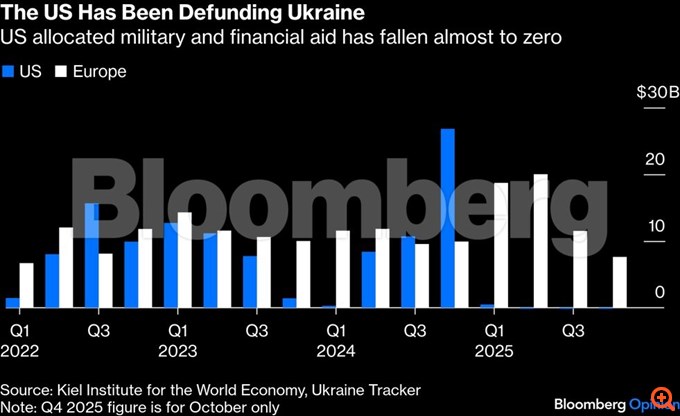
Putin also avoided the tougher economic sanctions that the US Congress wanted and which – without Trump in the White House – would surely have already been imposed at a time when the Russian economy was weakening. More weapons and money in Ukraine, combined with tighter trade restrictions for Moscow, would very likely have frozen the battlefield, creating the incentives for a deal. Instead, Trump's policies allowed for an escalation of violence, as Putin came to the only logical conclusion: To keep peace talks alive but ineffective while taking advantage of the advantages he has gained.
A typical example is the massive attack with 450 drones and 71 ballistic missiles and cruise missiles launched by Russia on February 3 against Ukraine's critical energy infrastructure, ending a brief pause in airstrikes carried out in parallel with ground attacks, which had been achieved with the mediation of the US. The attack took place amid freezing conditions in Ukraine, with temperatures reaching -20°C. Russia had hit all five major power substations around Kyiv before the shutdown, as well as the central thermal power plants on which about 55% of the city's residents depend.
Without heating and with little electricity in much of the capital, these conditions were already life-threatening for the elderly, the sick and very young children. But Russia did not stop there. The attacks, which resumed with such ferocity on the eve of the US-led peace talks, retargeted the stations that still had enough remaining capacity to keep the capital's water supply at a temperature of 5-10 degrees Celsius, the level needed to keep the water from freezing and pipes breaking.
If the Russian effort to eliminate all traces of central heating succeeds, 3 million people will be left without heating and water, as the network will have to be emptied to prevent the pipes from being damaged by frost.
On Saturday, a new massive attack was carried out with 40 missiles and 400 drones. "If we do not soon receive more ammunition for air defense and stronger diplomatic support, Ukraine's energy crisis will quickly turn into a humanitarian crisis," Maxim Timchenko, chief executive of Ukraine's largest private electricity company, DTEK Group, warned in a statement.
However, there is also a sense of desperation in Putin's desire to take advantage of winter temperatures to hurt the ordinary Ukrainian citizens he is supposedly saving from a "fascist" regime. According to a report (27/01) by the Center for Strategic and International Studies in Washington, Putin's land campaign is not going well. According to the report, over the past year, Russian forces have advanced at a rate of between 15 and 70 meters per day, along the Donbas front, centered around the so-called "fortress zone" of cities that Putin is demanding that Ukraine surrender in exchange for a ceasefire. Even the higher pace is slower than the Allied advance on the Somme, the World War I battle that became synonymous with static trench warfare.
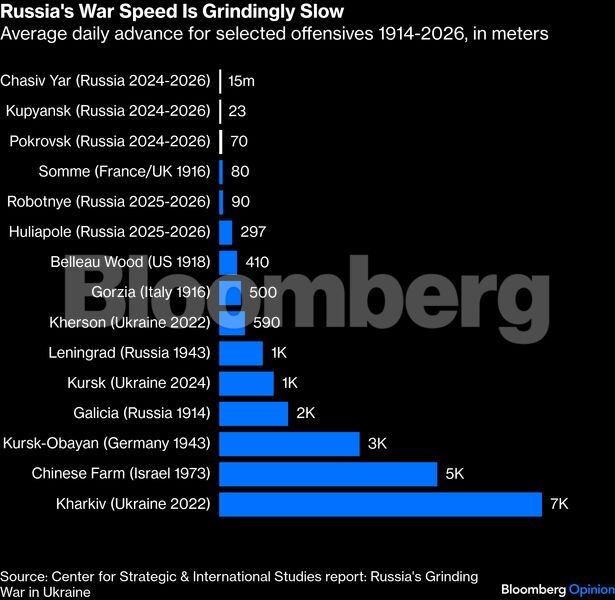
These marginal gains come at a huge cost, as Kyiv tries to exhaust an aggressor Russia by inflicting maximum casualties in a slow retreat. So when Ukraine's new defense minister, Mikhail Fedorov, set his goals last month, he said that "his second strategic goal is to kill 50,000 Russians a month," out of the 30,000-35,000 killed today. Ukraine is struggling to stop Putin's armies with 1,000 small "Pyrrhic victories", not by choice, but for lack of better options.
At the same time, Russia's extremely resilient economy is finally showing real signs of pressure, which means that time is running out for Putin as well. According to a study published in January by Moscow's authoritative Center for Macroeconomic Analysis and Short-Term Forecasts, the economy will enter a recession this year unless something changes, with the risk of a bank crisis and a possible flight of depositors by October.
At the same time, Europe is preparing to replace the oil price cap, to reduce Russian crude oil exports, with a potentially more effective ban on the services needed to transport it, at a time when lower crude oil prices globally are already reducing Russian budget revenues. This, in turn, forces the government to raise taxes and reduce spending on social welfare and health. It is becoming increasingly difficult for Putin to present the massive losses and the decline in living standards for a few territories as a triumph.
Trump's peace process can still succeed. Both peoples are exhausted, with polls in Russia and Ukraine showing a trend toward accepting some kind of compromise. President Volodymyr Zelensky revealed after the talks that the US has set a deadline for peace in June and that Russia has offered Trump a bilateral deal worth (completely unlikely) $12 trillion on economic cooperation, presumably to entice him to approve an unequal agreement.
If the White House wants to reach a deal, it must start putting pressure on the Kremlin to end this invasion and stop offering Putin advantages that encourage him to continue the war. On the plus side, Fedorov said last week that Elon Musk had agreed to limit Russia's use of Starlink terminals, which in recent months had become crucial to drone attacks.
All these measures to convince Putin that he has nothing to gain from the continuation of the war should have been taken long ago. The fact that they were not taken means that when the truce is finally agreed, as it is inevitable, it is not an achievement worthy of a Nobel Prize. Instead, it will have come after the U.S. first allowed the war to expand, taking the pressure off the Kremlin and forcing Ukraine to make far greater concessions than it should.
