KNews 15 February 2026
 |
| Opponents cite pesticide risks, unfair competition, Halloumi exclusion and fears of deeper EU dependence on imports. Photo credit: @cygreens Facebook |
Coalition delivers resolution to von der Leyen after protest outside the House of Europe in Nicosia.
A broad coalition of agricultural organizations, trade unions, environmental groups and consumer advocates staged a protest outside the House of Europe in Nicosia on Saturday, voicing strong opposition to the European Union’s planned trade agreement with the Mercosur bloc (Brazil, Argentina, Uruguay and Paraguay).
The demonstration served as the platform for delivering a formal resolution addressed to European Commission President Ursula von der Leyen. Organizers said the same resolution would also be submitted to President of the Republic Nikos Christodoulides and to all parliamentary parties.
While the gathering was the public trigger for the debate, the concerns raised extend far beyond the protest itself, focusing on what opponents describe as a far-reaching agreement that could affect food safety, public health, farming livelihoods, consumer costs, and environmental protection across Europe.
Concerns over food safety and banned chemicals
One of the most emotionally charged fears highlighted is the risk of imported food entering European markets under weaker standards than those enforced inside the EU. Opponents argue that agricultural products from Mercosur countries may be produced using pesticides and chemical substances that have long been prohibited in Europe.
They warn that this could expose European consumers to foods they consider less safe than domestic EU products, raising particular alarm about long-term health risks and the impact on vulnerable groups, including children.
Organizers described the issue not simply as a trade matter, but as a fundamental question of protecting citizens’ health.
Food security and Europe’s growing dependence
Critics of the deal also argue that the EU’s political messaging about building a more “autonomous” and resilient Europe is undermined by an agreement that would increase dependence on food imports from outside the bloc.
They contend that food security cannot be strengthened by outsourcing food production, particularly when supply chains are already vulnerable to global shocks.
In their view, the agreement risks leaving Europe less self-sufficient and more exposed in future crises.
Threat to small family farms and rural communities
Another central issue raised is the impact on small and medium-sized European farmers. Opponents argue that the agreement is structured in a way that benefits large industrial European economies, allowing them to export technology and manufactured goods, while agricultural producers in smaller countries bear the cost.
They warn that Cypriot farmers would face unfair competition from large-scale, low-cost agricultural imports, potentially driving local producers out of business.
Speakers argued that the collapse of farming would not only damage the agricultural sector, but would also weaken rural communities, reduce employment opportunities, and threaten a key pillar of Cyprus’s economy.
 Photo credit: @cygreens Facebook
Halloumi excluded despite PDO protections
A major grievance for Cyprus is the exclusion of halloumi, registered as a Protected Designation of Origin (PDO) product, from the agreement.
Although the deal reportedly includes safeguards for products with protected origin status, organizers said halloumi, Cyprus’s leading agricultural export and one of the country’s top three export products overall, is not covered.
Opponents see this as a serious economic risk and a blow to Cyprus’s ability to defend one of its most valuable food products internationally.
Claims consumers will not benefit from tariff reductions
The agreement has also been marketed as beneficial to consumers due to the reduction or removal of tariffs on agricultural and livestock products. However, critics described this claim as misleading, arguing that lower import duties will not necessarily translate into cheaper supermarket prices.
Instead, they claim the main financial gains would be captured by intermediaries, supermarket chains and trade monopolies, leaving ordinary households with little real benefit.
In their view, the deal risks harming farmers and weakening standards without delivering meaningful cost relief to consumers.
Environmental fears, including deforestation
Environmental groups at the event warned that the agreement could intensify ecological damage, particularly by encouraging expanded agricultural production in South America.
Speakers raised concerns about deforestation in the Amazon rainforest, questioning how environmental destruction could be prevented if demand rises across a combined market of hundreds of millions of consumers.
Critics also accused the EU of hypocrisy, arguing that while Europe has imposed strict environmental rules internally in the name of climate leadership, it may now be willing to tolerate lower environmental protections abroad for commercial advantage.
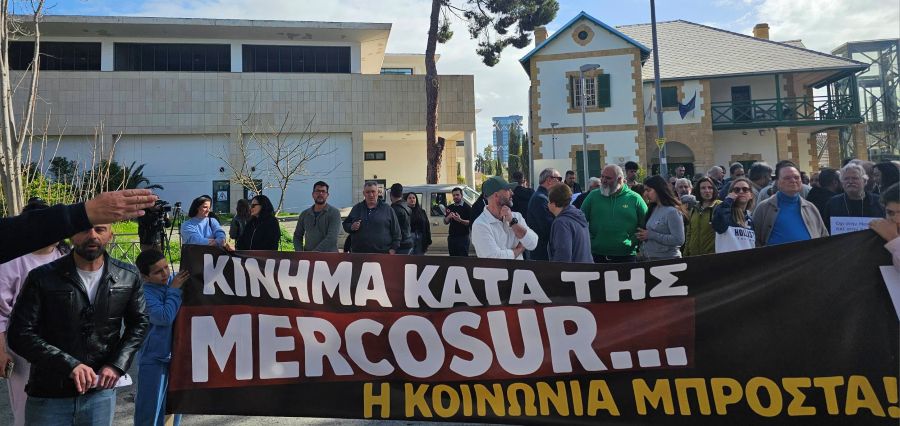 Photo credit: @peo.org.cy Facebook
A deal seen as serving industrial interests
Several speakers framed the agreement as one that primarily serves the needs of Europe’s largest industrial economies rather than its farming communities.
MEP Giorgos Georgiou described the agreement as effectively a trade-off of “Cars for cows,” claiming the major beneficiaries would be large German industrial sectors, particularly car manufacturers, while farmers and consumers absorb the risks.
Questions raised over democratic legitimacy
Beyond the content of the deal, critics also challenged the way the agreement is being advanced. According to opponents, the agreement was divided into two parts in a way that reduced the ability of countries to block it, allowing it to pass through a special majority procedure rather than national veto powers.
They argue this weakens democratic accountability by sidelining national parliaments, farmers, civil society and environmental organizations, and potentially even diminishing the role of the European Parliament.
PEO General Secretary Sotiroula Charalambous summarized this concern by stating that decisions are being made “about us, without us,” warning that multinational interests are being prioritized over public health and workers’ rights.
Calls for court review and warnings about “temporary” implementation
MEP Georgiou said the agreement is being referred to the European Court to determine whether it aligns with EU treaties and standards.
He also expressed concern over comments by European Council President António Costa suggesting the agreement could be applied temporarily, warning that provisional measures often become permanent in practice.
Yiannakis Gavriel, Chair of the Parliamentary Committee on Agriculture, urged von der Leyen not to proceed with implementation until the agreement is reviewed by the European Court.
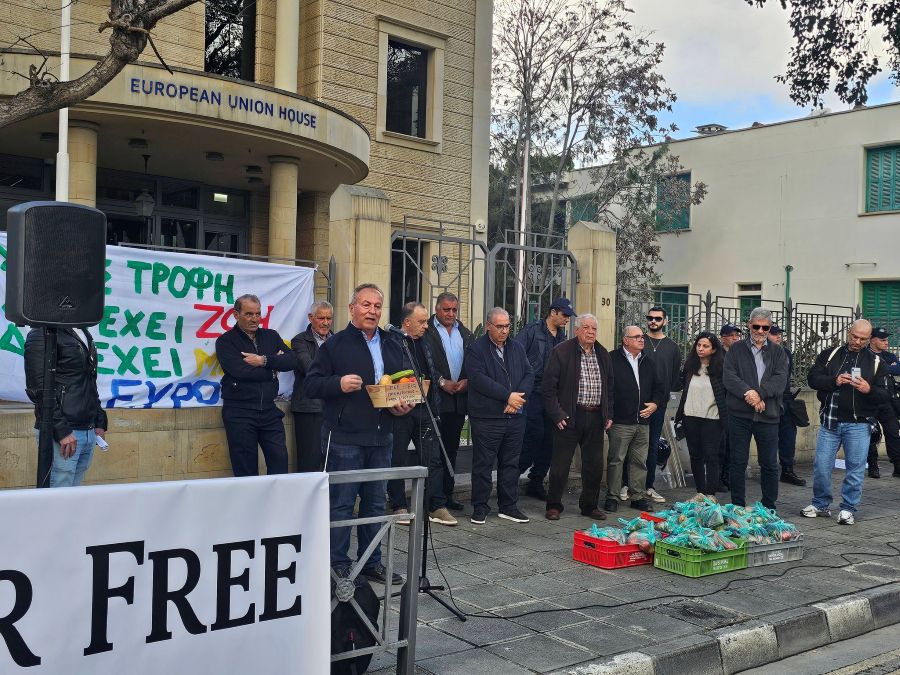 Photo credit: @peo.org.cy Facebook
Broad coalition of groups signed resolution
The resolution was co-signed by a wide range of organizations including PEK, EKA, Panagrotikos, New Agricultural Movement, NEDHIPA, TERRA CYPRIA, PEO, the Socialist Women’s Movement, the Consumers Association, Euroagrotikos, ACCEPT LGBTI CYPRUS, POGO, KOSP, ESEM, Proodeftiki, EDON, POA, the Ecologists Movement – Citizens’ Cooperation, NEDIK/ANAGENNISI, the LAONA Foundation, the Environmental Movement of Cyprus and the Progressive Students’ Movement.
The event was attended by, among others, AKEL General Secretary Stefanos Stefanou, AKEL MEP Giorgos Georgiou, AKEL MPs, and former Ecologists Movement leader Giorgos Perdikis.
During the protest, agricultural organizations handed out plastic bags containing cucumbers, tomatoes, potatoes and eggplants to those present, symbolically highlighting the potential impact of the agreement on local food production.
