Filenews 29 January 2026

By David Hambling
Three Russian soldiers, one covered in blood, come out of a building and surrender to an armed ground robot. This is not the first time something like this has happened, but it seems that it is the first time that a similar incident has been recorded on video. Armed robots are increasingly appearing on the Ukrainian front, and according to a recent report by the Jamestown Foundation, Ukraine is the world's leading power in their manufacture and use.
Robots are essential for both refuelling the front line and removing casualties from the battlefields. This year they will be used as a support force in the Artillery, taking part in battles with heavy machine guns and other weapons.
Robots are on the rise
Remote-controlled ground robots, known in the West as Uncrewed Ground Vehicles (UGV) and in Ukraine as Ground Robotic Complexes ("Nazemnyi Robotychnyi Kompleks" or NRC), have been around since the beginning of the war, but in small numbers. In the early stages of the war, most were imported models, but today the vast majority of them are made in Ukraine: 99%, according to the report of the Jamestown Foundation.
Production has increased rapidly. From hundreds of units in 2024, Ukraine aimed to produce 15,000 UGV in 2025 and over 20,000 for this year. There are at least 200 different models in use from 40 different manufacturers, all in Ukraine.
The rapid progress in this field is largely due to the close collaboration between robot manufacturers and frontline troops. Engineers aim to build robots that fully meet the requirements of the military unit they work with, while feedback from battles is used to make appropriate modifications and upgrades.
The production process is quick since robots are small in size and are easily assembled from commercially available components. Usually their size ranges from that of a supermarket cart to that of a golf cart. Models of robots that carry weapons have a turret where a 7.62 mm or .50 Cal machine gun is attached. Some cost as little as $5,000, but typically cost in the tens of thousands of dollars. The DevDroid in the photo costs $26-29,000, depending on the version.
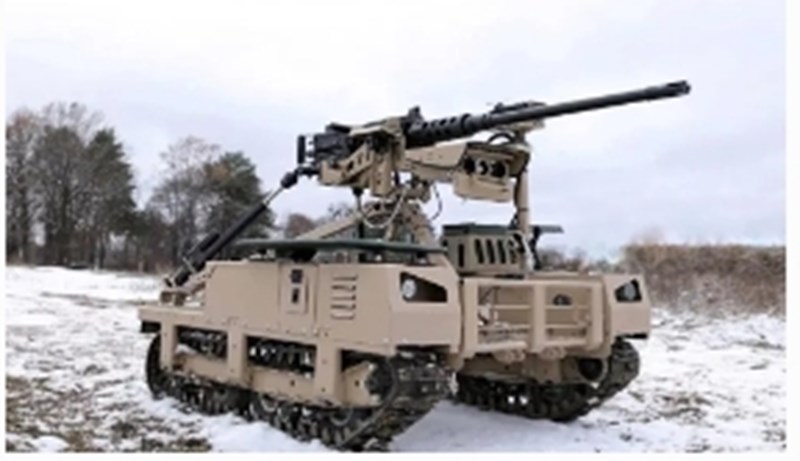 Copyright: Ministry of Defense of Ukraine
The progress of robots in the US is not the same, even though the country has much larger budgets, a deeper technological base and more "past". In 1985, the US Army tested a remote-controlled vehicle called Prowler, armed with machine guns, and in 1987 the Teleoperated Mobile Anti-Armor Platform launched anti-tank missiles. However, these developments have led nowhere.
The US armed robot SWORDS made significant progress and was even used in Iraq in 2008, but was never used in combat. The US military has several small robots, as well as remote-controlled weapon stations. Bringing these two factors together has so far proved to be a very difficult challenge.
The US Army's most recent robotic combat vehicle program, which had been progressing slowly since 2019, was cancelled last summer, apparently due to cost.
"We need robotic combat vehicles, but we don't want to choose just one supplier and pay almost 3 million dollars per unit," a US Army official told Breaking Defense. Decades of research and development have resulted in nothing.
The US military has submitted a request to restart the program, looking for an affordable, durable UGV that can "fight alongside infantry and destroy enemy armoured personnel carriers, trucks and troops".
That is, what Ukraine's UGVs are doing at the moment.
Military robots in action
From the Prowler era there are videos showing armed robots using machine guns. Ukraine and Russia have released images of armed robots in test action. Until recently, there were no videos of robots from the battlefields.
In 2024 we saw the first video showing a UGV leading an attack against Russian positions, and a few months later Ukraine carried out the first successful robot-only attack, using a combination of drones and UGVs.
In November, Ukraine published video of the "encounter" of one of its UGVs with a Russian MT-LB personnel transport vehicle. The Russians do not seem to have detected the robot that attacked them. In January we saw probably the first video showing him involved in a battle with Infantry forces, a UGV DevDroid.
A Ukrainian “Droid 12.7” UGV engages and destroys Russian infantry with its M2 Browning 12.7 mm machine gun.
This UGV is manufactured by the Ukrainian company DevDroid. https://t.co/7vnjOgiOWy pic.twitter.com/M11KEP4sR2— Roy🇨🇦 (@GrandpaRoy2) January 4, 2026
The robots also take on defensive tasks, holding the positions of Ukrainian soldiers. In December, Ukraine's 3rd Assault Brigade claimed that a DevDroid, again armed with a .50 Cal, had been repelling Russian forces for 45 days. The machine operated remotely under cover and recharged every 48 hours. We don't know how effective his fire was, but we do know that he held the position against overwhelming Russian attacks without any loss of human life on the Ukrainian side.
"Only the UGV was in this particular position," commander Mykola Zinkevych told Ukrainian media. "That was the basic idea."
The aim is to reduce casualties and, ultimately, reduce the need for infantry forces in the battles. Analysts, of course, argue that robots will never replace infantry soldiers. Modern UGVs may have limitations in their capabilities, but it seems that they can perform tasks that until now were undertaken by the Infantry, such as capturing prisoners.
"Come with me if you want to live"
Russians who surrendered in a UGV seem to be slightly confused. In another tradition, Russians are said to be "surprised" to be captured by robots.
It makes sense to use UGVs on the front line, especially for the process of handing over soldiers. Ukraine was the first to apply the technique of drone delivery, using quadcopters with microphones to lead Russian soldiers to safe areas, disarm them and capture them. A one-on-one meeting always carries the risk of a trap. Remote capturing prisoners ensures that the arresting side doesn't have to make life-or-death decisions in a split second.
UGVs will also affect the opponent's morale. When one side has losses, but the opponent is not injured, does not hurt and cannot die, then the battle may seem futile. Especially when there is the option of a safe and easy delivery.
Conflicts between UGV and ground forces are just beginning, and it is impossible to predict how this type of war will develop. It seems that most UGVs are destroyed by FPV drones, and many UGVs already carry jamming devices. The technological evolution of military robots is an essential factor in how the wars of the future will be fought.
