Filenews 8 January 2026

The artistic part of the official Opening Ceremony of the Cyprus Presidency of the Council of the European Union attempted more than a ceremonial display of culture: a condensation of the Cypriot experience, as it is formed between history, the present and the expectation of the future.
Without avoiding grand narratives, but also without being trapped in the graphic or postcard, the evening moved along an axis recognizable and familiar to the current cultural landscape of the island.
The ceremony, which was held on the Main Stage of the Cyprus Theatre Organisation, opened with the performance of the National Anthem of the Republic of Cyprus and the Anthem of the European Union by soprano Mariza Anastasiades, setting the tone of the double reference from the beginning: national identity and European integration.
The greetings were followed by an hour-long artistic program structured in three acts, with a clear dramaturgical line, starting from the experiences and traumas of the past, passing through modern Cyprus as an active EU member-state and ending with a look towards the future and reunification.
Each act was creatively based on the work of a Cypriot artist as a starting point and symbol. Young and experienced creators were transformed into carriers of memory and hope, connecting eras and generations, and created a fascinating narrative for the island and its inhabitants, who continue to walk with dignity, despite adversity. In this way, they defend the values of freedom, democracy and peace.
Utilizing the language of art, artistic director Costas Silvestros and his team combined history and tradition with contemporary artistic means to represent the spirit of Cyprus.
In the section that focused on the present, with the use of new means of video art, clear but lyrically elaborated references to the trauma of the invasion, with which Cyprus has been walking since 1974 as an open, lived experience, emerged.
The recitations of excerpts from the "Cypriot Rhapsody" by Tefkros Anthias and the "Turkish Invasion II" by Costas Montis functioned as clear historical references, without didacticism, reminding us that the Cypriot identity remains inextricably linked to the experience of loss and pending.
The music of Andy Skordis, which ran through the entire performance under his direction by a six-member echelon of the Cyprus Symphony Orchestra, moved in a contemporary sound style that drew sounds from the depths of time, acting as a discreet bridge between East and West and consistently serving the spirit of the ceremony, even if it surprised a less familiar audience. It was deeply elaborated and perfectly in harmony with the spirit of the ceremony.
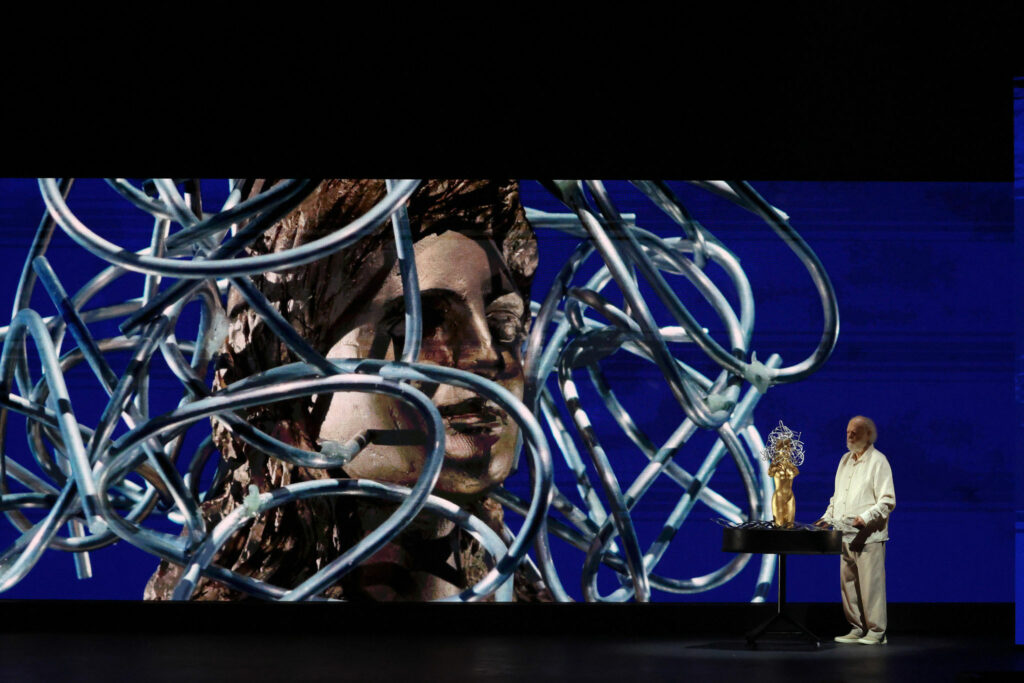
Of particular importance was the choice to put the visual arts at the center of the stage action. Nikos Kourousis on stage, taking care of and spinning a sculpture in real time, gave material substance to the concept of creation as a process, while the presence of Twenty Three, Nurtan Karagil and, in the finale, Hambis Tsagaris, acted as a bridge between the modern visual language and folk tradition. Particularly apt is the moment when Elli Michael's jar "brought to life" the stencil of Twenty Three, in a silent dialogue between image and sound.
One of the most powerful scenes of the evening was the appearance of the athlete Marios Georgiou and the educator and fighter Eleni Foka, who transferred the artistic narrative beyond the performing arts, to the body, endurance and memory. The presence of Eleni Foka served as a living symbol of the cause of the enclaved, through a woman who turned education and everyday resistance into an act of historical memory.
The recitation of the entire poem "Hey, adrope" by the folk poet Kyriakos Karneras by Despina Bebedeli was one of the climaxing moments, bringing folk poetry to the stage without embellishment, with emotion that did not need stage gimmicks.
In the musical part, the compositions of Andy Skordis were accompanied by the Amalgamation choir, the Monsieur Doumani band, creating a soundscape that moved between the scholarly and the contemporary, without losing its grounding.
The choreography and movement of Panagiotis Tofis, combined with the sets and costumes of Konstantina Andreou, avoided monumentality, opting for a simple, functional stage writing. The performative part was based on carefully selected dancers, who, through short stage episodes, gave the pulse and transition to each phase of the event.
The central figure of the performance was 12-year-old Ioli Antoniadou, who moved and sang on stage with naturalness and maturity, embodying in a direct way the "look to the future" of dramaturgy.
Overall, the artistic part of the Ceremony did not attempt to give a "definitive" image of Cyprus, but a complex, polyphonic depiction of its cultural present, with clear roots in history and an open horizon to the future. A choice that, in such an institutional context, functioned more as a statement of stance than as a mere demonstration.
During the ceremony, art in all its forms – music, dance, and poetry – emerged as a force for unity and a symbol of hope, reflecting how Cyprus looks to the EU as a force for unity in its reunification efforts.
The ceremony was attended by distinguished audiences from Cyprus and abroad, including foreign leaders, heads of European institutions and regional organizations, members of the European Parliament, senior government officials, as well as prominent personalities from the country's political, business and social life.
