Filenews 27 December 2025 - by Dr Petros Savvides

The recent procurement of new equipped helicopters for the Air Force Command (DA) arose from the need to replace the older helicopters available to the National Guard. That is, the four French Gazelle SA 342L1 equipped with four HOT-2/3 anti-tank missiles and the eleven Russian Mil Mi-35P helicopters that were capable of firing eight 9M120 Ataka or 9M114 anti-tank missiles. The Gazelle are temporarily kept in service, while the Mil Mi-35P were sold in Serbia in 2023.
The contract for the replacement of the 15 helicopters with modern twin-engine Airbus Helicopters H145M helicopters was signed at the Ministry of Defence on 24 June 2022 and included the initial procurement of six helicopters, for an amount of €140 million, and an option to acquire six more. The new helicopters joined the 450 Helicopter Squadron and carry a combination of weapons, such as eight Israeli Spike ER2 missiles and/or 2.75-inch FZ275 LGR guided rockets. They are also equipped with thermal sights and are fully capable of performing missions at night, which was not possible with older helicopters.
The technological superiority of helicopters provides a very high impact capabilities for the National Guard. In addition, the long range of the Spike ER2 missiles, which reaches 16 km, offers great operational flexibility and increased survivability in helicopters. In the past, the limited range of weapon systems carried by the Gazelle and Mil Mi-35P (4 and 5.8 km respectively), forced the firing of shots on or beyond the Forward Line of Defense (NG) of the National Guard, resulting in the exposure of helicopters to fire from MANPADS missile systems of the Turkish occupation forces.
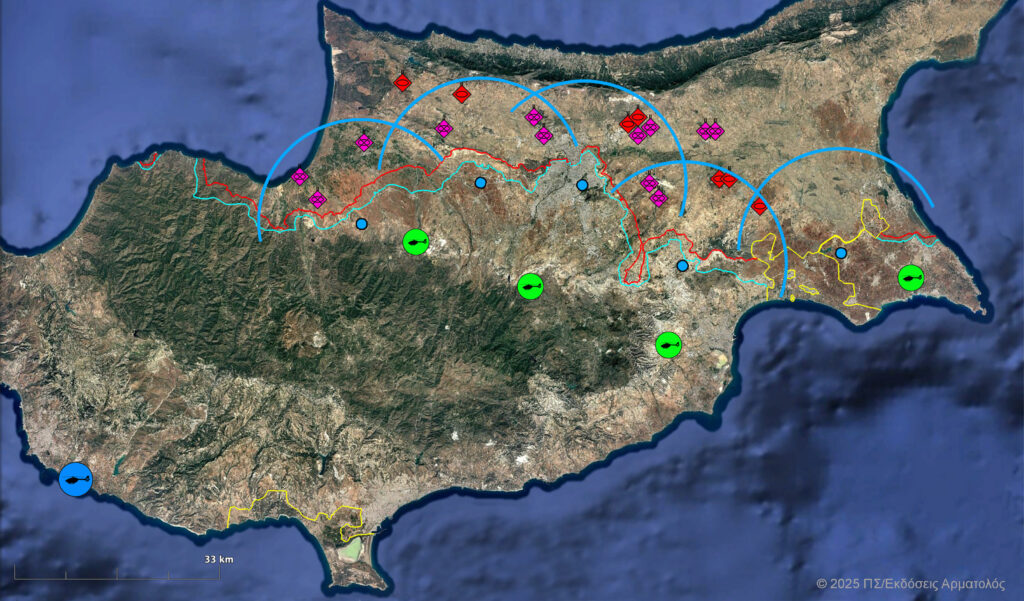
Today, the operational situation in this area has changed significantly since the long range of Spike ER2 anti-tank missiles provides the ability to fire at a depth of 10-12 km. within the occupied territories from safe distances of 4-6 km. from the Ceasefire Line (GP) of the occupying forces.
Business Advantages
It should be taken for granted that in the event of operations, the "Andreas Papandreou" Air Base will be attacked by the enemy in order to prohibit its use by friendly aerial means. It is estimated that the Squadron will advance in a timely manner to advanced deployment areas – and if the option is exercised – three squadrons of four helicopters or four squadrons of three helicopters to appropriate locations and will maintain readiness to attack the enemy manoeuvre echelons in the occupied territory, with the start of operations. That is, in the areas where the opposing Tactical Groups are formed, in the wider area of the camps where the armoured and motorized forces of the occupying troops are based, and in the Line of Attack of the attacking forces, which is the Turkish General Staff.
The deployment of twelve helicopters is equivalent to an operational capability of launching 96 Spike ER2 missiles, at a depth of 16 km, in each wave of attacks, while a force of six helicopters allows the launch of only 48 missiles in each wave. This difference is vital in the first hours of operations because it can cause great confusion and disorganization of the enemy at a critical phase of the struggle, before he has time to enter the buffer zone or penetrate the free territories of the Republic. It is expected that during the first wave of attacks, the Squadron's support echelons will be promoted to new areas to avoid being flagged by the enemy. During the second wave, another 96 enemy targets can be attacked (48 for six helicopters), while the continuation of the waves of attacks by the Squadron can cause great destruction to the enemy's manoeuvre echelons.
There is a strange reluctance to acquire the remaining six
However, despite the significant operational advantages of the equipped helicopters and the non-prohibitive price of €23 million. per unit – including initial stocks of ammunition, spare parts and training – it appears that to date the option to acquire six more helicopters has not been exercised. The reasons for this hesitancy are not known, considering that the eleven Russian helicopters were sold to Serbia for €105 million, as reported by Serbian Prime Minister Aleksandar Vucic. However, instead of the amount being allocated for the exercise of the option, it seems that part of it was used for the supply of artillery systems from Serbia.
The case becomes even stranger if other facts are taken into account. From a financial point of view, the repayment of the procurement of the six initial helicopters is completed in 2026. The 2026 budget provides for an amount of €176,800,000 for Defense Armour purposes, while a loan from the European Commission of €1,181,503,924 has been approved for defense purposes under the SAFE program.
Technical data should also be taken into account. Maintaining six helicopters is essentially equivalent, due to maintenance needs, to the availability of four helicopters and with the best omens five. The acquisition of twelve helicopters allows, at best, the availability of ten helicopters, significantly increasing the operational readiness of the National Guard for immediate response, in the event of a hot incident or crisis. Due to the increased demand for this type from many countries, not exercising the option is equivalent to increased costs, at least 20-30%, and a long time delay, if it is decided to acquire six more helicopters in the future.
Concluding remarks
The reluctance observed in the exercise of the right of option is incomprehensible but also harmful to the operational readiness of the National Guard. It seems that the issue is not financial, because the amount required to repay the procurement of six more helicopters is only €35 million per year over a period of four years. The studies carried out by the DA in the recent past provided for the procurement of 12 new helicopters to replace the 15 older types (Gazelle and Mil Mi-35P). The number of flying personnel and support personnel of the Air Force Command had been adjusted accordingly for the utilization of all aircraft, including the 15 helicopters that have been or will be withdrawn soon. What are the real reasons for this unacceptable and harmful hesitancy? Time seems to be running out and the Ministry of Defense-GEEF needs to make brave decisions.
*Academician, geopolitics, defense and security analyst
